
There is a farm not too far from where I live, on a quiet country lane called Monkey Hollow Road. I’ve visited several times, as the owners (Al and Jill) enjoy sharing their love of growing, creating, and learning with others. A family member is good friends with Al, so we often have the inside scoop about happenings at the farm. We’ll get messages like: “Al is bottle feeding the baby lamb! Want to go watch?” or, “Al is making apple cider this weekend. Want to go along?” And most recently: “Al is extracting honey this Sunday. Want to come help?” Um, yes, yes, and YES!!
Al and Jill are the coolest people. So easygoing and down to earth. They have a little bit of everything on their Monkey Hollow farm—sheep, chickens, vegetable garden, apple orchard, fishing pond, and of course—beehives!
Today was honey extracting day, and 10 of us showed up to help. Extracting honey is a multi-step process but is surprisingly simple. There are elements of the process that can be mechanized, but part of what is so neat about Al’s setup is that the tools and machinery are low-tech, timeworn, and simple. I like when things are simple.
Al has Langstroth hives, a popular and traditional system that uses a series of stacking boxes called “supers.” Inside the boxes are hanging frames with cells that the bees fill with honey. Once the cells are packed with honey and the bees have coated the surface with a protective layer of wax (beeswax!), the frames are ready to be removed from the hives for the honey to be harvested.
In the first step of the honey extraction process, you shave away the beeswax layer with a hot knife. Al makes this operation look exceedingly smooth and easy, the layer of beeswax falling away in a single unbroken sheet. For the uninitiated, however, there is a bit more beeswax butchery that occurs. It’s hard to hold the knife at just the right angle and tricky to skim it across the cells at just the right speed.

The next person takes two of these shorn frames and shuttles them—heavy and dripping with honey—to the centrifuge. These drop into baskets on opposite sides of the drum and as the next helper turns the crank to spin the centrifuge, the rotational force pulls the honey out of the comb. It collects in a shiny layer on the sides of the drum before slowly dripping down to the bottom. Turning the crank on the centrifuge was my four-year-old nephew Simon’s favorite part by far. Jill brought out a step for him to stand on so that he could reach the handle, and turning it was a two-handed, full-body exercise for him. I bet his little abs were sore the next day.
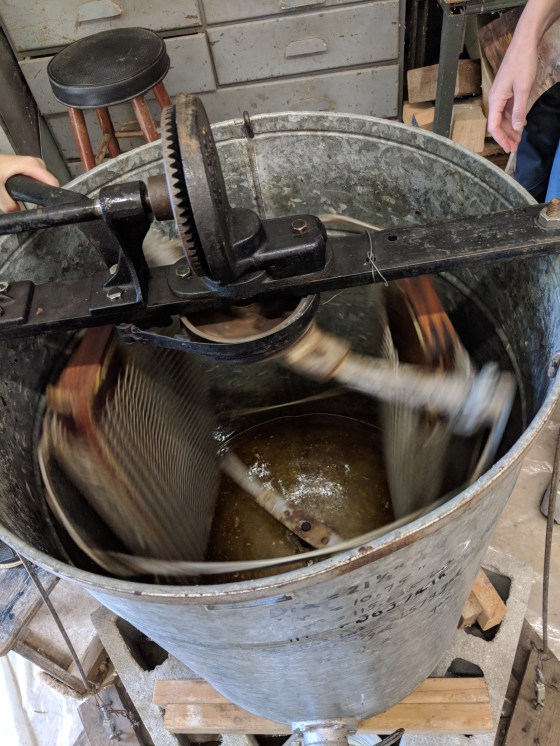
Before long, the honey at the bottom of the drum is deep enough that it starts to interfere with the spinning mechanism. The next step is to open the valve at the bottom and begin decanting the honey into buckets to be transferred to the filtration vat. The honey goes through two rounds of filtration before it’s bottled and ready to sell or trade. As a “thank you” for helping, Al gave each of us a jar of the day’s honey to take home. Those jars went through only the initial sieve—just enough to filter out any stray bee legs and chunks of wax.

I enjoyed the day of honey harvesting for a number of reasons, but if I were to list my favorite things about it, these three would rise to the top:
1. Axle Grease
Well, not actual axle grease. Not surprisingly, Al is quite a connoisseur of honey. When he travels to different states and different countries, he likes to share his Monkey Hollow honey with other beekeepers and collect as many varieties as he can. Just for fun, he arranged a honey lineup from his collection for us to sample.

It began with a super light linden honey, progressed to a medium-bodied manuka honey from New Zealand, and finished with the extra dark and molassesy honey he affectionately calls his “axle grease.” Starting from light to dark, we dipped toothpicks into the honeys and tasted each one, as Al excitedly solicited feedback about which were our favorites. The linden honey was popular, as was a blueberry variety. I was a little wary of the axle grease, but it was delicious!, bold and assertive, the honey equivalent of a French roast coffee. I expected to be blown away by the manuka honey, since it is ridiculously expensive in local stores due to its rarity as well as its medicinal properties, but taste-wise . . . it was just okay. The clear winner for me was the honey we were extracting and bottling THAT day, the apple honey from Al’s orchard. That honey simply exploded with a bright, pure, apple sweetness. Honey doesn’t come any better than that.
2. The Honey Breeze
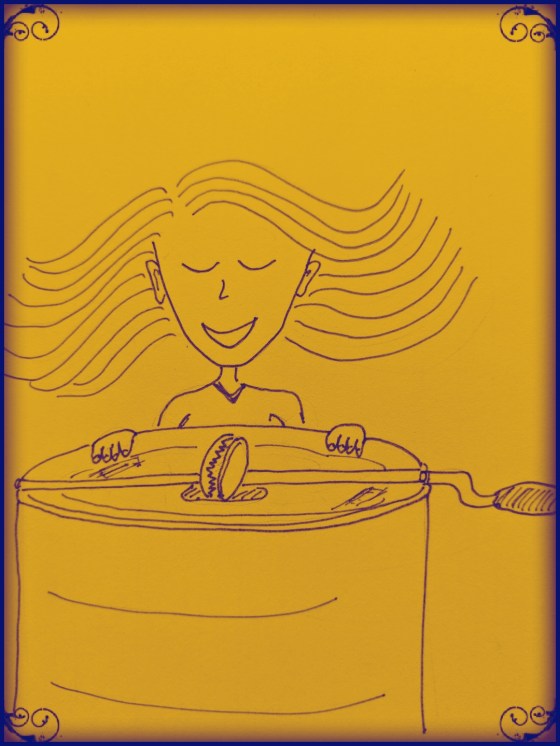
Ah, the Honey Breeze. One of the unexpected byproducts of the extraction process is what I call the Honey Breeze. When the honey frames are dropped into the hopper and you turn the crank on the centrifuge, a breeze rises up from the spinning baskets. A wave of sweet honeyed air caresses your face and blows back your hair. It is like being immersed in a cloud of honey, with all of the sweetness and none of the stickiness. I could bask in the honey breeze all day long.
3. Something Like Strega Nona
The very best thing about Honey Day, however, was the stories we heard from Al and Jill. Stories about Al’s initiation into beekeeping, stories about bee stings (and remedies!), stories about the social lives of bees, stories about people they know. . . . I have a feeling that Al and Jill are very popular around a campfire.
One of their stories that day reminded me of Tomie dePaola’s classic children’s book Strega Nona.
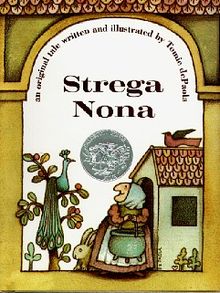
Here’s why: When you open the valve on the centrifuge to begin transferring honey to the filtration vat, the honey streaming out of the spigot is strangely hypnotic. It’s like a smooth golden rope, rhythmically unspooling and coiling into a glossy puddle. In fact, Jill told us about the time that their daughter became so mesmerized by the undulating honey that she simply didn’t notice when the container was full and it was time to close the spigot. Honey ran and ran, overflowing the container and creating a sticky flood on the floor of the workshop. In Strega Nona, it is not a flood of honey, but rather pasta from a magic pot that floods an Italian village when Strega Nona’s assistant muffs up the magic spell. He is made to right his wrong by eating the superfluous macaroni—a fitting punishment, right? (I’m pretty sure that Al and Jill didn’t force their daughter to eat her way out of the mess she created. Though if you ask me, I’m not sure that would really be much of a punishment!)
At the end of the day, after enjoying the fruits of the bees’ labor so thoroughly, many of us were curious about seeing where all this honey magic begins. Al promised that at the next Honey Day, we could don some protective gear and he’d take us out to visit the beehives. The fun and adventure never ends at Monkey Hollow!

 Don't Fleece the Bees
1 thought on “A Sweet Day at Monkey Hollow”