
Growing up, my family always ate pork and sauerkraut on New Year’s Day. These traditional foods are supposed to bring good fortune in the coming year. I never would have thought to attempt to harness the magic of sauerkraut at any other time of year, but would you believe that its power extends to new school years as well?
This discovery began with an interesting, and very unexpected, conversation with one of my students. At the beginning of the school year, I ask students to create a “picto-word” name card, in which they morph or change each letter of their name into a picture that tells something important about themselves. It’s a quick way to learn their names as well as a bit about about their personalities.

As I examined one student’s picto-word, I asked him to tell me about the pictures and what they represented about him. I was particularly intrigued when he pointed out how he’d turned one of the letters in his name into a jar of sauerkraut. Seriously?! How cool! I’m used to seeing baseballs, video games, and pizza from sixth grade boys. I’m not sure most sixth graders would even know what sauerkraut IS, let alone eat it, let alone find it important enough to warrant a spot on their picto-word! But apparently, for him sauerkraut-making is a large-scale, multi-generational, all-hands-on-deck family tradition. I asked him a variety of questions about their process, all of which he answered quite knowledgeably.
Was my enthusiasm that obvious? I suppose so, because his parents sent him to school a few days later with none other than a jar of their homemade sauerkraut as a gift. I’m not sure I’ve ever received a teacher-gift I was more excited about!
My husband and I made embarrassingly short work of that jar of sauerkraut, which was worlds away from the store-bought bags or cans—no big surprise there. Tangy and a little spicy (they included jalapeños in that particular batch) and nicely crisp—not the watery mush that sometimes comes from the store. Now, theirs was pressure canned, which would have killed the beneficial microbes from the fermentation process, but working at the large scale they do, it’s probably a necessity. If they didn’t pressure can it they’d have to refrigerate it, and how would you locate enough refrigerator space to house 500 pounds of cabbage-turned-kraut?
I was inspired. I decided it was time to add sauerkraut to my growing repertoire of homemade foodstuffs.
The first time I made sauerkraut, I made the process more difficult than it needed to be. Following a recipe, I got out the food scale and carefully weighed five pounds of cabbage (this was about two medium-sized heads) and very carefully measured the recommended amount of salt. And it’s good to be careful the first time you make something, right? But since I’ve learned more about sauerkraut, I’ve realized the process is actually much more forgiving.
Mainly, the process for sauerkraut—as with other fermented foods—requires a small amount of active time on your part, and then plenty of patience. The instructions here will walk you through how to make sauerkraut in a one-quart mason jar, which is a very manageable amount.
What You’ll Need:
- One medium-sized head of cabbage
- 1 1/2 tablespoons of Kosher salt
- A large bowl for massaging the cabbage
- A quart-sized mason jar
- A jar weight, or water-filled baggie to keep cabbage submerged under liquid in jar (don’t worry, I’ll explain below)
What You’ll Do:
- Slice the cabbage. At first I thought the easiest method would be to use the shredding attachment on my food processor, but that shredded the cabbage too finely. More akin to what you might want for coleslaw. It’s faster and simpler to just slice the cabbage into thin ribbons by hand on the cutting board. Don’t be alarmed at how, even using just one head, this will produce a veritable mountain of cabbage. The first time I did this, I couldn’t fathom how it ultimately was supposed to fit into a mason jar for the coming fermentation period.

- Place the cabbage in a large bowl and add the salt. Toss the cabbage to get it well coated, and then let it sit for about 15 minutes. This gives the salt time to start drawing some moisture out of the cabbage.
- Roll up your sleeves and warm up your arms: It’s time to massage the cabbage. If your spouse is as considerate as mine, he might offer to let you warm up by massaging his shoulders. . . . But you should probably save your strength for the cabbage. Using your hands, squeeze and knead the salted cabbage. In just a few minutes, the cabbage will really begin to release its liquids. It is amazing how much the cabbage compresses and condenses during this step. See? It will fit into the jar after all.
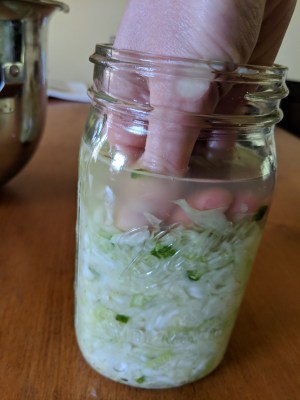
- Cram it. After about 10 minutes of massage, there should be a decent amount of liquid in the bowl. Cram the cabbage a handful at a time down into the mason jar, pressing each new layer firmly to squeeze out any air bubbles and settle the cabbage under the surface of the liquid. Make sure you don’t fill the jar all the way to the brim—you’ll need to leave a few inches of space at the top of the jar to add something to weigh down the cabbage. When you’re finished cramming, there should be enough liquid in the jar that the cabbage is completely submerged. If for some reason there is not, create a little extra brine by dissolving one teaspoon of salt in one cup of water, and add enough to the jar to cover the cabbage.

- Cover it. The next to last step is to weigh the cabbage down with some kind of cover that will hold it beneath the liquid as it ferments. I found handy glass jar weights to be just the ticket—gently settle a weight on top of the cabbage and lightly screw the lid of the mason jar in place. In lieu of a glass weight, you can also nest a smaller-diameter jar inside the mason jar, or even use a small brine-filled plastic baggie for this task. (You add salt to the water-filled baggie in case it tears or breaks during the fermentation period, because you don’t want your kraut to get all water-logged. Double up the baggies to minimize your risk of a leak altogether!)

- Burp it. I will admit, I love this step. Every day or so during the fermentation period, crack the lid of the jar until you hear a little hiss of released air, then tighten it again. Good stuff is happening in there!

And then you wait. The fermenting process for a jar this size typically takes about a week, but it largely comes down to a matter of taste. After a week, sample it and see if it’s reached a desirable level of tanginess and tenderness. It’s “done” when it tastes good to you! The longer it ferments, the sharper and more vinegary it will taste. So when you’re like, “Mmm, that’s good!” pop it in the fridge. The cooler temperatures halt the fermentation process, and it will keep in there for about six months.
I haven’t gone too crazy yet with additional ingredients and experiments, but I know there is a lot of potential here. In a nod to my student’s inspirational sauerkraut, I have made several batches with diced jalapeño added in—and it’s really good.
So give it a try! The holidays are drawing near, and I know firsthand how much a person loves to receive a jar of this as a gift! And of course New Year’s Day will be here before we know it. . . . What better way to ring in the new year than with some pork and homemade sauerkraut?

 Don't Fleece the Bees
1 thought on “A Student of Sauerkraut”