

Let’s start with a riddle:
It’s not quite a scavenger hunt, though it does involve hunting.
It’s kind of like geocaching, but you read clues rather than coordinates.
It requires secrecy and pseudonyms, yet it’s wholesome enough for your grandma to do.
…………………………………………………………………………………
Think you’ve puzzled it out? Why, it’s letterboxing of course!
The Backstory

I learned about letterboxing 10 years ago when my niece was in kindergarten. Her teacher introduced letterboxing to the students, and my sister, a volunteer in the classroom, learned about it by extension. She was hooked from day one, and soon after shared her newfound hobby with me.
So, what is letterboxing? Here’s how it works: Someone conceals a waterproof box in a public location. Inside the box you’ll find a logbook and a hand-carved stamp. The hider posts clues online (websites listed below) with step-by-step instructions on how to find the box, and then YOU set off to find it! When you do find it, you use an ink pad to add the found stamp to your personal logbook. Then you add your personal stamp to the found logbook to document that you were there. An exchange of stamps. Date and sign the page (using your trail name—yes, you get to make up a trail name)—and that’s it!
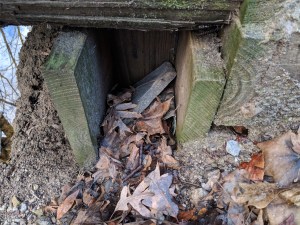
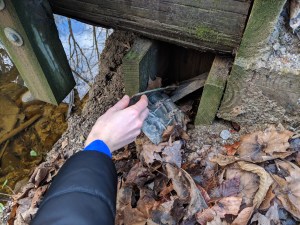
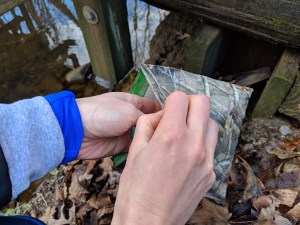

According to legend, letterboxing began in England in 1854. A hiking guide named James Perrott hid a bottle at the end of a difficult hike along Cranmere Pool in Dartmoor, England. He left a calling card in the bottle so that future finders could contact him, and encouraged these tenacious hikers to place their own cards in the bottle as well. Some years later, the bottle was replaced with a box, and hikers began leaving self-addressed postcards that the next finder would mail from their own hometown. (And in England, a mailbox often is called a letterbox.) The hobby continued to evolve and gain popularity in Dartmoor, but didn’t reach the U.S. until 1998, when Smithsonian magazine featured an article about letterboxing. (To learn more, you can read a detailed history of letterboxing HERE.) Today you can find letterboxes in every state around the country, and in fact it’s a fun way to explore and document places you’ve traveled.

Letterboxing Gear
I have a little satchel with all my letterboxing gear that I keep in my car, so I’m ready at any moment to take advantage of a letterboxing opportunity. The letterboxing websites list all of the boxes in a particular area, and I like to scan these periodically and file those potential locations away in my memory. When we’re traveling, my husband loves when I request a little detour to seek out a letterbox. (Okay, well he at least tolerates my letterboxing enthusiasm.)
These are the essential supplies in my kit:
Stamp
Logbook
Pen
Ink pad
Wet wipes (while not essential, you’ll be digging around in bushes and under rocks sometimes; it can get a little messy)


You can get all of these things—stamp, notebook, ink pad—at any craft store. When I learned about letterboxing, I didn’t know at first how much I would enjoy it. I was hesitant to invest too much time or money in a hobby that might just fizzle out. If you want to just try it and see what it’s like, before buying too much gear, it is acceptable to use your thumbprint as your “stamp” to make a mark in the logbook of any letterboxes you find. If you decide that you like it but don’t have the time to carve your own stamp, there are plenty of ready-made options to purchase at the store. So whatever the situation, there’s no reason not to get out there and give it a whirl. Eventually you will probably want to carve your own personal stamp—that’s what you see in the photos—and my Letterboxing 201 post walks you through how to do that.
So Many Reasons to Love Letterboxing
Once you try letterboxing, I’m sure you’ll have your own list of reasons why you love it. Here are a few of mine:
1. Discover hidden gems: There are numerous parks and sites that are just far enough off the beaten path that I would never have encountered them if not for letterboxing. It gets me out and about and leads me on spontaneous adventures close to home.
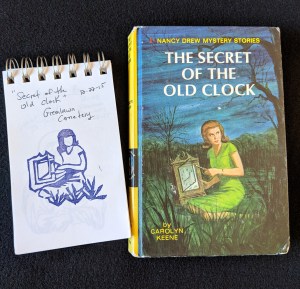
2. Learn new things: People create letterboxes because they have something to share with the world. Sometimes they want to draw visitors to a historic or meaningful location. Other times, people create a letterbox—or series of letterboxes—to honor a particular person, place, or thing. I love the opportunity to learn something about history, pop culture, or the personal experience of a fellow adventurer.
3. Travel souvenir: I always tuck my letterboxing gear into my bag when I go on a trip. Wherever I am—a city, a national park, a nondescript suburb—chances are there is a letterbox somewhere nearby. The collection of stamps in my logbook is an evolving souvenir and a unique way to remember the places I’ve been.
4. Fun for all ages: I have been letterboxing with my young nieces and nephews, and I’ve been letterboxing with my grandma! I mean, who wouldn’t enjoy a hunt for hidden treasure boxes? But here’s a piece of advice: If you can take a child with you on a letterboxing jaunt, you’ll look much less suspicious snooping around bushes and trees. And never forget the cardinal rule of letterboxing: Be stealthy and do not advertise that there is hidden treasure nearby.
5. The occasional misadventure: Letterboxing excursions do not always proceed exactly to plan, but that is part of the fun. Here’s an example: I love cats, so I was excited to discover that there was a letterbox hidden at a local cat rescue organization. Sometimes stamps are stashed at an indoor location with the owner’s consent, and you have to ask for it to earn it. I must admit, I felt a little weird sidling up to the counter like, “Heyyyy, so … I think you have something for me? …” And then it was especially awkward when the girl had no idea what I was talking about. We rounded up another employee, who had a dim recollection of a letterbox being hidden there, but clearly it hadn’t been found in a long time—boxes do go missing sometimes. A letterboxer must accept the occasional fail. BUT since I was already there, I visited for a while with the numerous, and very affectionate, rescued cats. Fell right into their trap, lured to the shelter by a phantom letterbox those critters no doubt planted themselves.
Hit the Trail!
There are two main websites for the letterboxing community. On either one you can find letterboxes to search for:
I tend to use Atlasquest, although it is good to check both websites. My favorite way to locate boxes is to search by zip code. If you set up your own account, you’ll receive notifications when new stamps in your area are added. You’ll also be able to log your finds online, to keep track of your discoveries and offer feedback and comments to fellow letterboxers.
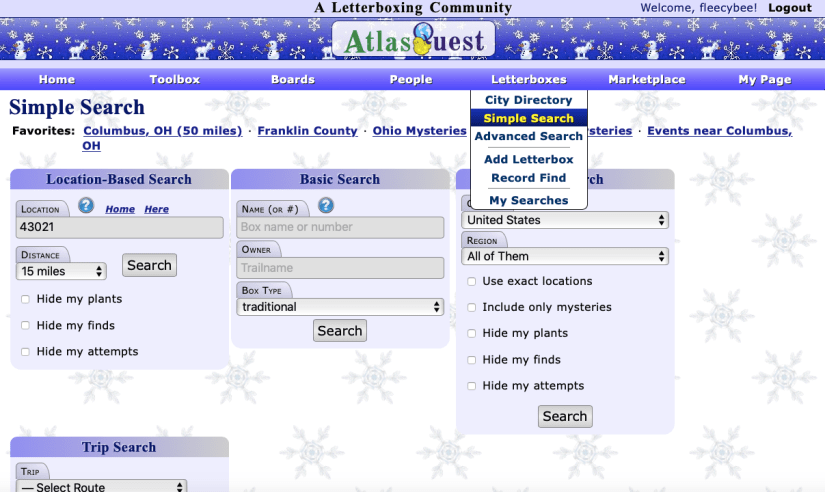
I have a hunch that once you try this, you’ll be hooked just like I was. I’ve even created two letterboxing series of my own, carving the stamps, writing the clues, and stashing the boxes out in the wild for others to find. If you’re ever in the Galena area (zip code 43021), you should try to find them!

 Don't Fleece the Bees
2 thoughts on “Letterboxing 101”