
For me, after several years of searching out existing boxes, I felt inspired to create a letterbox series of my own for others to find. I mentioned in my Letterboxing 101 post that people create letterboxes because they have something to share with the world; the catalyst for me was when my husband and I lost our three cats within a relatively short span of time. As anyone who’s ever had pets can imagine, that was pretty rough! My first series, hidden at my favorite park, honors our three little buddies. I loved the opportunity to share their stories and keep their memories alive.
My second series is bird-related. We put several bird feeders outside of our kitchen window, and they attract an amazing variety of birds. At certain times of year, we’re so thronged with hungry birds that it’s hard to keep the feeders stocked. I became a little obsessed with learning to recognize all of the visitors at our feast. Of course from there it progressed to identifying bird songs, and decoding bird behavior, … and creating a series of bird letterboxes.
What are your passions? Is there a special person or event you wish to commemorate? I can’t think of a better way than with a letterbox to tell the tale. If you’re ready to make the transition from finder to planter, these are the basic steps in creating a letterbox:
- Carve your stamp(s)—You can create a single stamp or a multi-stamp series. There is something about sets of three that I like; my series each contain three stamps. (My Letterboxing 201 post details how to design and carve your personal stamp.)
- Decide on a location—Usually, if you’re hiding your stamp in a public location, you just go and do it when you’re ready. Privately-owned settings can work too, if you talk to the owner and explain your goal. People are generally kind of tickled to be in on a secret like this. I learned after the fact that some parks require permits for hiding letterboxes (and geocaches, too), so you might want to check just to cover your bases. It would hardly do for your letterbox to be confiscated after you’d worked so hard to prepare and plant it!
- Prepare your letterbox—People use a variety of weatherproof containers to house the goods—I’ve seen plastic boxes, pill bottles, duct-tape-covered baggies. It’s a good idea to double-bag your stamp and logbook by putting them in a baggie and then putting that baggie into your container. Even though they’re supposed to reclose and rehide the letterbox carefully after finding it, people get a little sloppy sometimes.
- Hide it!—Go find the perfect spot and stash your letterbox. There are a couple of things I always think about when hiding a box—and that I appreciate when I’m the one finding a box. Is there a little spot nearby where people can inconspicuously get out their supplies and conduct the exchange of stamps? Maybe a nice rock, or a bench? Another factor to consider is potential overgrowth. A hiding spot that is easily accessible in the winter could be overgrown with poison ivy or some other pesky vegetation in the summer. When hiding my box, I take detailed notes so that when I write my clues, I can be as specific as possible with landmarks, number of steps to take, which direction to face, and so forth.
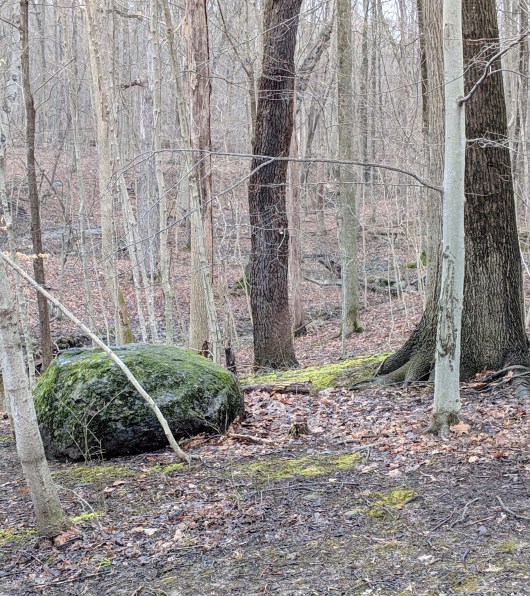
- Write and test your clues—I like to invite a friend or family member to use the clues I wrote to try to find my letterbox. Do the directions make sense? Does it work the way I thought it would? A few tweaks might be needed to smooth out the process. Once you’ve polished up your clues, post them!
- Post your clues—If you don’t already have an account on Atlasquest, you’ll need one now. The online form for creating a letterbox is very straightforward and easy to complete.
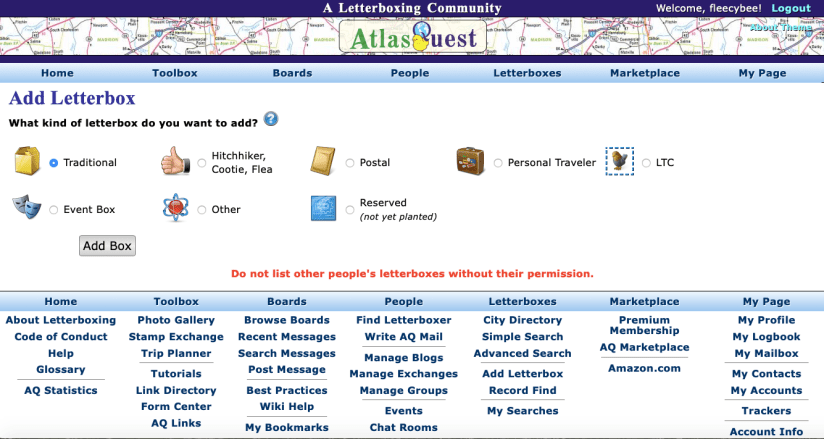
- Check your mailbox—Don’t forget to log in to Atlasquest periodically to check your mailbox. People will leave helpful comments about the health of your stamp to alert you to necessary maintenance. Sometimes they give compliments about how much they enjoyed your stamp. (Those are the best.) You’ll want to visit your actual letterbox regularly too, to make sure everything is holding up okay and to see who’s found it and stamped your logbook. After you’ve been letterboxing a while, you’ll start to recognize the trail names of fellow enthusiasts.
Letterboxing is a most enjoyable rabbit hole to fall into. From making your initial find, to carving a personal stamp, to creating a series for others to find, each step pulls you in and propels you along. Once you make the transition from seeker to hider, your subconscious will be ever on the alert for interesting new places that would make the “perfect” location for a letterbox. Embrace it! Enjoy it. See you on the trail!

 Don't Fleece the Bees