

At school, I always take an interest in what my students are reading. Whether or not it’s something I myself would like, I feel obliged to keep a finger on the pulse of what is popular among the tween crowd.
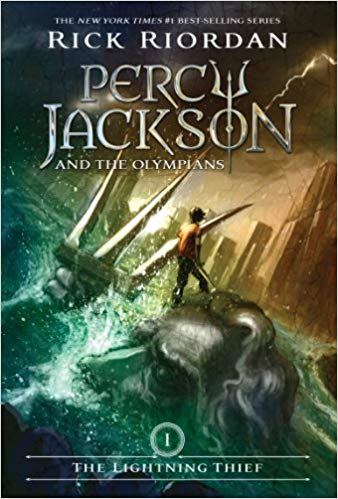
For several years now, the Percy Jackson series has been all the rage. Rick Riordan has almost single-handedly kindled an obsession with Greek mythology. (So much so that during our study of major world religions, more than one student has shared with me, quite in earnest, that his or her personal religion is a belief in the Greek gods.)
I read The Lightning Thief, the first book in the series. I thought it was . . . okay. Riordan’s no J.K. Rowling, in my opinion, the gold standard by which all writers of young adult fiction must be measured. The book seemed overly complicated, trying too hard to shoehorn too many of the characters from Greek mythology into analogous modern-day permutations. But I suppose if it gets kids excited about reading and learning, it’s all good.
So Greek mythology was seeming a little trendy to me when I started seeing Madeline Miller’s Circe on all the book lists. (In case you, like I was, are wondering how to pronounce the title, you have options. The author explained in an interview that in ancient Greek, the name would have been said “KIR-kee,” but that she herself says “SUR-see” in an effort to keep things more relatable for her readers.)
Even when one of my favorite authors promoted Circe on her bookstore’s blog, I still wasn’t sold. But then the librarian at school asked me if I’d read Circe yet.
“Ohhhhh.” She smiled knowingly, reverently. “You’ll love it.”
An endorsement from her is no small thing. As a media specialist, she reads a LOT. Incidentally, she also finishes every book she starts, which really staggers me because I ruthlessly abandon books if they don’t grab me with a compelling storyline or skillful writing within the first chapter or so. It’s funny though—a few times, I have started then abandoned a book, but later given it another chance based on Deanna’s recommendation. And loved it. I’ve mused to Deanna that she must be a lot more discerning than I am about books she starts, but she says no. She just feels more obligated to persist than I do, in the interest of being familiar with a wide range of authors and genres. At any rate, if Deanna loved Circe, I figured I should give it a look.
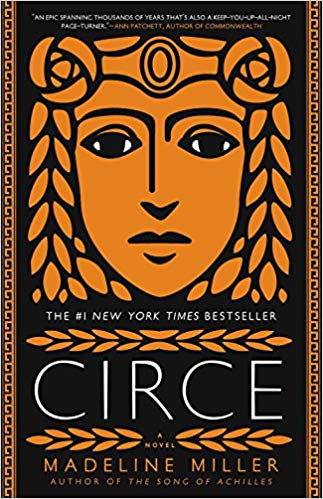
The first few chapters were a jumble of Greek name-drops and mythological backstory. Titans versus Olympians; naiads and dryads and oreads. Now Circe’s at a wedding banquet; oh, look at all the Olympians—Poseidon, and Apollo, and Hephaestus. Sigh. Percy Jackson for grownups, I muttered to myself disparagingly. But Deanna had loved it. . . . So I persisted.
And found myself utterly bewitched by Circe, the nymph, the sorceress, exiled to Aiaia for defying her father, contradicting his authority, and using witchcraft to poison a fellow immortal. (Who, let’s be honest, totally had it coming.)
But Circe’s punishment in many ways is more of a blessing. After eons of being overshadowed and derided by her more richly endowed family, the exile marks a new beginning. Circe’s truest self at last emerges. On the deserted yet peaceful island, amidst the lindens and cypresses, thyme and moly, Circe’s deep-rooted courage and resilience flourish. Through sheer hard work, she perfects her skills as a pharmakis. She takes no immortal shortcuts, and I loved her for her grit and determination in honing her witchcraft. Nature whispers its secrets to Circe, and she learns how to cast all manner of spells—though she has a particular affinity for transformation, as Odysseus’s men discover the hard way.

Exile is a terrible fate for an immortal, however, and self-contained though she is, Circe struggles with her share of loneliness. She bears the burdens of her fate as best she can. And never one to shy away from risk or fear, in the end the very qualities that gained full expression because of her exile—her bravery and sense of self-worth—are what bring it to an end.
Madeline Miller breathes new life into legendary heroes and villians of Greek mythology, from Prometheus and Daedalus to Medea and the Minotaur. And Circe herself, who was at most a footnote in my subconscious, a shadowy memory from a long-ago reading of The Odyssey, assumes her position as a shining example of what is possible when we embrace our true selves.

Once I had gotten on board with the Greek revival, I was all ears when Deanna recommended Lovely War by Julie Berry. It’s set primarily during World War I and weaves together the stories of four young people whose lives are shaped and changed by the war in various ways. But in addition, Berry overlays her telling of their experiences with a conversation among the Greek gods Aphrodite, Ares, Hephaestus, Apollo, and Hades. Actually, it is more like a series of reminiscences. But technically, it is a trial.
Berry mashes up the mythological with the modern-day: Hephaestus has caught his wife, Aphrodite, and her lover, Ares, in the act and ensnared them in a golden net. Faced with a humiliating and very public trial on Mount Olympus, Aphrodite proposes that they settle the matter privately, amongst themselves, in the cozy hotel room where they were caught. Aphrodite spins a spellbinding defense: She tells a love story, the story of our four young people, and calls upon the testimony of various witnesses—Apollo, Hades, even Ares—to round out the details of certain episodes. In this story, the gods are active participants in the human drama, nudging would-be lovers, inspiring soldiers, easing the shock of arrival in the afterlife. The gods’ strengths and weaknesses, desires and jealousies are exposed throughout the trial as well as in the ways they influence the lives of the mortals.

I came to love each of the gods, for their kindnesses and for their imperfections. And I loved the four young protagonists, so idealistic, brave, and loyal.
I also really enjoy novels that alternate narrators, expressing the action from multiple perspectives, as this one does. It is, quite simply, an imaginative, evocative, and beautiful work of historical (and mythological) fiction.
By the way: Do not let yourself be put off if you notice that the novel is marketed to teens/young adults. There seems to be a growing crossover genre spanning teens-adults, and Lovely War must fall in that range on the spectrum. I didn’t discover that until after I’d read it, but at no point did it strike me as a “teen read.” Not that there’s anything wrong with that. I’ve read lots of young adult literature! It’s just nice to know what you’re signing up for.
So . . .
Will there be a happy ending for the four young lovers, adrift in the carnage and chaos of world wars?
Does Circe embrace mortality or eternity?
There’s only one way to find out.

 Don't Fleece the Bees
1 thought on “Greek Revival”