
I wouldn’t call myself socially awkward, although I am a textbook introvert. While I do need and enjoy interactions with people, being around a lot of people for a lot of time requires a lot of energy from me. So it has always been easy for me to bemoan and disdain small talk. But let’s be honest, who doesn’t hate small talk? I’ve known exactly one person in my life who claimed to enjoy small talk. And he really probably did.
But for the rest of us? It’s a chore! We do it when we have to, and some of us navigate it pretty admirably, but at best we just endure it. I don’t totally suck at small talk, but I’ve often found myself feeling some anxiety before social occasions, dreading the upcoming small talk. What if I can’t think of something to talk about? What if there is an awkward silence? What if I seem boring or unfriendly?
I wondered if there might be a way to improve at small talk rather than live in perpetual dread.

Nerd alert: I googled “how to make small talk!” and “killer conversation starters!” And you know what? There is a lot of information out there. Apparently I’m not the only one who struggles with small talk. This was reassuring in and of itself, but what really bolstered my spirit was the knowledge that making small talk is a skill. There are strategies you can study and practice to improve at it.
Well then. I’m a teacher! Learning and studying are right up my alley.
I kept reading, and when I checked out Debra Fine’s book The Fine Art of Small Talk, it got me looking at this social nicety in a whole new light.
First of all, small talk really does serve a purpose. It breaks the ice, builds rapport, and allows you to progress to deeper conversation. Some people scoff that we should just do away with small talk and dive right into the good stuff. But that would be like trying to jump onto a treadmill already whirring along at 10 mph rather than gradually dialing up the speed as your muscles get warm. You don’t have to stay in small-talk mode forever, but it’s probably wise to ease into deeper conversation with it.

Debra Fine enumerates many strategies for improving at small talk, but she leads off with a couple of key objectives (admonitions?) for all of us reluctant small talkers to take to heart:
- Take the Risk: Rather than wait for others to approach you, be the one who strikes up a conversation. Maybe even with a stranger! Everybody fears potential rejection, but it’s up to you to be brave and take the risk.
- Assume the Burden: It’s not everyone else’s job to fill silences and keep conversation going. You have to assume the conversational burden of introducing topics, remembering names, and making others feel comfortable.
Oops and oops. I could have stopped reading on page 7 and been light-years ahead of where I started. I definitely was not pulling my conversational weight. It started to seem a little selfish or self-indulgent to claim, “Oh I’m just no good at small talk” and sort of “opt out” of it.
I started to look at small talk as a challenge rather than a chore.
It was time to learn some actionable strategies to put into practice. Read on to learn my three favorite takeaways from Debra’s book.

Do a little homework!
Some people seem like they are naturally gifted in the art of small talk. But have you ever considered that maybe they are just better prepared? When you know that you’ll be attending an event that will involve small talk, spend some time ahead of time thinking about things you might talk about. If the gathering is with people I know, I might reflect on things I already know about them that I am curious to learn more about. If the event involves meeting new people, I might have a few potential icebreakers in mind, maybe related to current events or the season of the year. I also try to think about what I have been up to lately, so that I can say more than “Not much!” if someone inquires. It was a revelation to me that you don’t have to just go into small talk “cold.” A little mental preparation doesn’t interfere with spontaneity either—since I feel more relaxed and confident from the outset, it is easier for me to focus on listening and being curious.
Be intentional with your questions
This one might seem obvious. If you ask simple yes-or-no questions, the conversation will be over almost before it begins. But asking better, more open-ended questions requires that you build a habit of using forethought and creativity in the way you phrase things. One example Debra uses in her book is instead of the standard, “Are you married?/Do you have kids?” you can ask someone to “Tell me about your family.” Another one I like is to ask, “What was the highlight of your weekend?” rather than “How was your weekend?” Subtle tweaks, but likely to yield richer responses that will get a conversation rolling.
Use and offer free information (this one is my favorite)
“Free information” is stuff you learn about someone by being a careful observer, which can help you start or continue a conversation. People give free information with what they are wearing (statement jewelry? team apparel?), interesting photos or knickknacks in their home or office, or extra details they include in answering an open-ended question–which you can then use to spin off or delve deeper. I consider myself a fairly observant person, so I like this tip a lot. But it also helped me realize something important about myself. My default mode is to be pretty quiet and private, but by making more of an effort to provide “free information,” I could provide more fodder for conversation. Here’s what I mean:
If somebody asked me, “Do you like to exercise?” and I responded, “Yes, I do!” I’ve done nothing to help the person out and provide additional sparks to keep our conversation going. I answered their question, but I didn’t really play the conversational game. What if instead I answered, “Yes, I do! I was involved in sports all the way through college. Today I like to do a variety of things, otherwise I get bored. I used to go to a gym, but lately I’ve been working out at home.” I gave a lot of free information there! The person can follow up with questions about my college sport, what activities I like to do today, the gym I used to attend, home workouts. . . .
Somewhat counterintuitively, offering free information helps me focus less on myself and think more about how I can help the other person by providing potential conversational threads. I don’t want them to feel like they are “pulling teeth” to get information out of me.
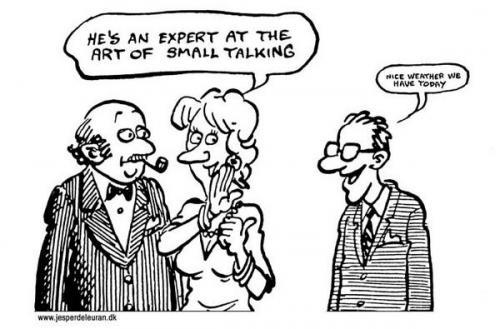
So while I don’t think I’ll be qualifying for the Small Talk Olympics anytime soon, I feel much better prepared to meet the challenge head on. I even feel a little excited. The only way to improve at anything is to practice, and luckily, opportunities for small talk are all around us.

 Don't Fleece the Bees