Read

Greek Revival

At school, I always take an interest in what my students are reading. Whether or not it’s something I myself would like, I feel obliged to keep a finger on the pulse of what is popular among the tween crowd.

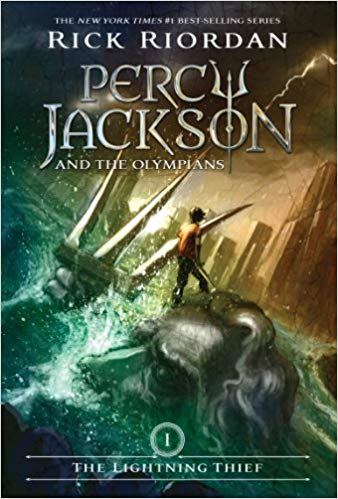
For several years now, the Percy Jackson series has been all the rage. Rick Riordan has almost single-handedly kindled an obsession with Greek mythology. (So much so that during our study of major world religions, more than one student has shared with me, quite in earnest, that his or her personal religion is a belief in the Greek gods.)

I read The Lightning Thief, the first book in the series. I thought it was . . . okay. Riordan’s no J.K. Rowling, in my opinion, the gold standard by which all writers of young adult fiction must be measured. The book seemed overly complicated, trying too hard to shoehorn too many of the characters from Greek mythology into analogous modern-day permutations. But I suppose if it gets kids excited about reading and learning, it’s all good.
51BfYSYSfxL._SX336_BO1,204,203,200_

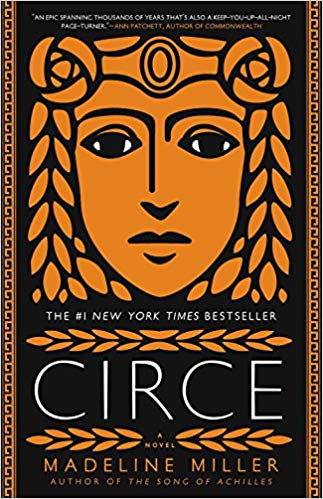
So Greek mythology was seeming a little trendy to me when I started seeing Madeline Miller’s Circe on all the book lists. (In case you, like I was, are wondering how to pronounce the title, you have options. The author explained in an interview that in ancient Greek, the name would have been said “KIR-kee,” but that she herself says “SUR-see” in an effort to keep things more relatable for her readers.) 

Even when one of my favorite authors promoted Circe on her bookstore’s blog, I still wasn’t sold. But then the librarian at school asked me if I’d read Circe yet.

“Ohhhhh.” She smiled knowingly, reverently. “You’ll love it.”

An endorsement from her is no small thing. As a media specialist, she reads a LOT. Incidentally, she also finishes every book she starts, which really staggers me because I ruthlessly abandon books if they don’t grab me with a compelling storyline or skillful writing within the first chapter or so. It’s funny though—a few times, I have started then abandoned a book, but later given it another chance based on Deanna’s recommendation. And loved it. I’ve mused to Deanna that she must be a lot more discerning than I am about books she starts, but she says no. She just feels more obligated to persist than I do, in the interest of being familiar with a wide range of authors and genres. At any rate, if Deanna loved Circe, I figured I should give it a look.
51eaZ1mO9ML._SX321_BO1,204,203,200_

The first few chapters were a jumble of Greek name-drops and mythological backstory. Titans versus Olympians; naiads and dryads and oreads. Now Circe’s at a wedding banquet; oh, look at all the Olympians—Poseidon, and Apollo, and Hephaestus. Sigh. Percy Jackson for grownups, I muttered to myself disparagingly. But Deanna had loved it. . . . So I persisted.

And found myself utterly bewitched by Circe, the nymph, the sorceress, exiled to Aiaia for defying her father, contradicting his authority, and using witchcraft to poison a fellow immortal. (Who, let’s be honest, totally had it coming.) 

But Circe’s punishment in many ways is more of a blessing. After eons of being overshadowed and derided by her more richly endowed family, the exile marks a new beginning. Circe’s truest self at last emerges. On the deserted yet peaceful island, amidst the lindens and cypresses, thyme and moly, Circe’s deep-rooted courage and resilience flourish. Through sheer hard work, she perfects her skills as a pharmakis. She takes no immortal shortcuts, and I loved her for her grit and determination in honing her witchcraft. Nature whispers its secrets to Circe, and she learns how to cast all manner of spells—though she has a particular affinity for transformation, as Odysseus’s men discover the hard way.

Edward_Burne-Jones_-_The_Wine_of_Circe_1900-1200x809
Illustration of Circe preparing a magical draught, from The Outline of Literature by John Drinkwater (Newnes, c 1900). Public domain.

Exile is a terrible fate for an immortal, however, and self-contained though she is, Circe struggles with her share of loneliness. She bears the burdens of her fate as best she can. And never one to shy away from risk or fear, in the end the very qualities that gained full expression because of her exile—her bravery and sense of self-worth—are what bring it to an end.

Madeline Miller breathes new life into legendary heroes and villians of Greek mythology, from Prometheus and Daedalus to Medea and the Minotaur. And Circe herself, who was at most a footnote in my subconscious, a shadowy memory from a long-ago reading of The Odyssey, assumes her position as a shining example of what is possible when we embrace our true selves.

41fKTpMUvnL._SX329_BO1,204,203,200_

Once I had gotten on board with the Greek revival, I was all ears when Deanna recommended Lovely War by Julie Berry. It’s set primarily during World War I and weaves together the stories of four young people whose lives are shaped and changed by the war in various ways. But in addition, Berry overlays her telling of their experiences with a conversation among the Greek gods Aphrodite, Ares, Hephaestus, Apollo, and Hades. Actually, it is more like a series of reminiscences. But technically, it is a trial. 

Berry mashes up the mythological with the modern-day: Hephaestus has caught his wife, Aphrodite, and her lover, Ares, in the act and ensnared them in a golden net. Faced with a humiliating and very public trial on Mount Olympus, Aphrodite proposes that they settle the matter privately, amongst themselves, in the cozy hotel room where they were caught. Aphrodite spins a spellbinding defense: She tells a love story, the story of our four young people, and calls upon the testimony of various witnesses—Apollo, Hades, even Ares—to round out the details of certain episodes. In this story, the gods are active participants in the human drama, nudging would-be lovers, inspiring soldiers, easing the shock of arrival in the afterlife. The gods’ strengths and weaknesses, desires and jealousies are exposed throughout the trial as well as in the ways they influence the lives of the mortals. 

hephaestus-4_orig
Painting of the ensnared lovers by Alexandre Charles Guillemot (French, 1786-1831), Indianapolis Museum of Art

I came to love each of the gods, for their kindnesses and for their imperfections. And I loved the four young protagonists, so idealistic, brave, and loyal.

I also really enjoy novels that alternate narrators, expressing the action from multiple perspectives, as this one does. It is, quite simply, an imaginative, evocative, and beautiful work of historical (and mythological) fiction. 

By the way: Do not let yourself be put off if you notice that the novel is marketed to teens/young adults. There seems to be a growing crossover genre spanning teens-adults, and Lovely War must fall in that range on the spectrum. I didn’t discover that until after I’d read it, but at no point did it strike me as a “teen read.” Not that there’s anything wrong with that. I’ve read lots of young adult literature! It’s just nice to know what you’re signing up for.

So . . .

Will there be a happy ending for the four young lovers, adrift in the carnage and chaos of world wars?

Does Circe embrace mortality or eternity?

There’s only one way to find out.


Explore

Wrong Turns on the West Highland Way

If you can’t make a mistake, you can’t make anything.

Marva Collins, American educator, 1936-2016

My husband and I love to hike, so a couple of summers ago we took on the West Highland Way, a 95-mile-long trail in western Scotland. It runs from Milngavie (“MULL-guy”), a town just outside of Glasgow, to Fort William, the capital of the West Highlands. It is Scotland’s most popular long distance route, and its many adventurers complete it over varying lengths of time. Some power through and finish in a few days; others ramble at a more leisurely pace and take as long as two weeks. We divided the hike over eight days. It was our first adventure of this sort, a long-distance hike, and it turned out to be more rugged and difficult than we anticipated. This was both good and bad—we really enjoy physical challenges, but the difficulty threw us for a couple of loops along the way.

Screen-Shot-2015-03-03-at-14.27.05
The West Highland Way (Source)

As much as I enjoy hiking and being out in nature, I equally enjoy a hot shower and comfortable bed at the end of the day. Some hikers shoulder all of their belongings and camp each night along the Way, but we worked with a company that makes the endeavor a bit more humane. They arranged lodging at inns or bed-and-breakfasts in quaint hamlets and villages along the trail and shuttled our luggage each day from place to place. We had a map and hiked at our own pace; we just had to make sure we ended each day in the correct village. 

366FE32A-9D37-490B-AAC4-D8CB31E78E92
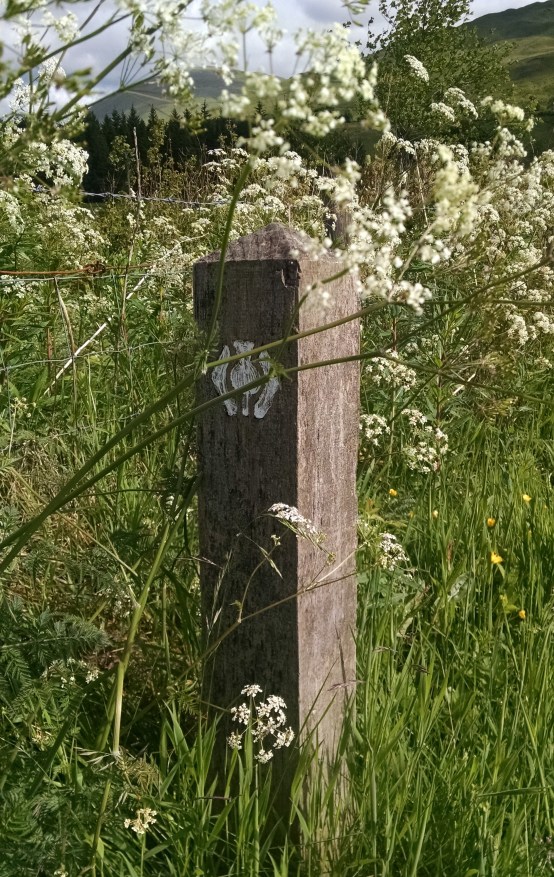
The trail was easy to follow, blazed with the Scottish thistle

It was ideal. . . . By day, we hiked along lakes and rivers, through old-growth forests and windswept moors. At night, we arrived at charming B&Bs, luggage awaiting us in our room, our hosts kindly inquiring how we would like our eggs in the morning.

There is no better way to experience the beauty and grandeur of a place than on foot. It forces you to go slowly. You can certainly cover more ground by car or train, but so much detail goes unnoticed. Walking, you are fully immersed in the sights, smells, and sounds of your surroundings. 

We loved exploring Scotland on foot and plan to undertake similar adventures in other countries. On the next hike, however, I will employ some accumulated wisdom I came by the hard way. The thing is, I love to research and plan trips. I thoroughly studied the ins and outs of a long-distance hike and knew what pitfalls to avoid. That being said, I fell hard into each and every pit. 

Day 1 of our hike was 12 miles; that was about the median length over each of our eight days. Some were longer, some were shorter. However, Day 1 was by far the most difficult day of the hike for me, for a number of reasons:

I didn’t eat and drink enough.

I didn’t dress warmly enough.

I didn’t pee often enough.

And my pack was too heavy.

Four cardinal sins of long-distance hiking, and I committed all four of them on the very first day.

The day started out easily enough. We chatted amiably with a few fellow hikers as we waited for the travel company’s van to arrive and make the first luggage pick up. We asked a sprightly old Scotsman to snap a photo for us, and were surprised to learn that he was planning to hike the West Highland Way as well.

“Aye, my sister wanted a wee adventure for her 70th birthday!” He gestured at a cluster of silver-haired folks standing across the courtyard. “It’s a loovely trail. Jest watch out for the midgies!” he gleefully advised before ambling over to join his group as they set off on their hike.

My husband and I exchanged a dubious look. In his bright blue plaid slacks, the old Scotsman was the least likely long-distance hiker imaginable. He wasn’t even carrying any supplies! And if his sister was 70, how old must he be?! Jesus. 

Off we went. The terrain was pretty tame at the outset. In fact it felt a bit as though we were hiking through a metro park until we got farther into the countryside. It was a perfect day for hiking—sunny and comfortable. We were making good time, stopping only for a PB&J picnic lunch and a few photo ops. 

The trouble started about two miles from our destination. I started to hit the wall. To be honest, I had never hiked 12 miles in one go before. I love to walk and hike, but a typical hike is more like three to five miles. I didn’t have a good frame of reference for what 12 miles would feel like. 

When I started to hit the wall, I should have stopped for a break to have something to eat and drink. But I was so tired; it felt like too much trouble to dig down into my pack for a Clif bar. We were almost there, right?

Also, I kinda had to pee. But what a hassle. We were almost there. Two miles? I could hold it. 

Until it became a bit harder to hold. But by then, there were no good places to slip off the trail and take care of business. I had squandered all of my opportunities. Guess I’d have to hold it.

And then it started to rain. We were in Scotland, after all. But no worries, I was well prepared with my waterproof jacket and pants. Only . . . I was so tired . . . and I had to pee . . . and I just wanted to get there. Stopping to dig out my rain pants and put them on felt like too much trouble, seeing as we were almost there. Besides, it wasn’t raining hard at all. I’d just tough it out. 

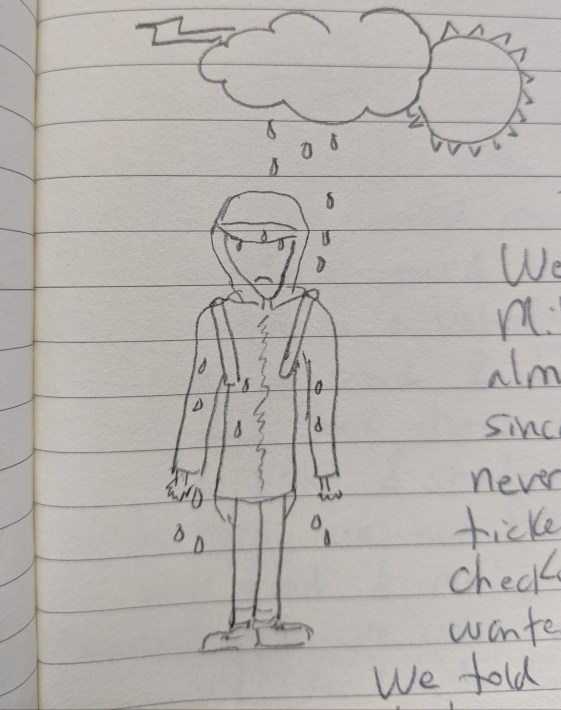
You can guess what happened next. The light rain escalated into a steady rain. The steady rain burst into a torrent, a transition signaled by a single giant thunderclap. Were we hiking, or were we on the deck of a doomed crab boat? We were so soaked, so fast, that rain gear no longer mattered.

IMG_20191103_105944

By the time we reached our village, I was numb. We straggled into town like a pair of nautical birds returning from a misadventure at sea. I was wet, cold, hungry, and did I mention that I had to pee?? My husband asked through the driving rain, “Where do you want to stop in to warm up?” I think my lips moved, but nothing came out. Ahead there was a small cafe; mutely, we agreed upon it as our destination and trudged grimly forward. As we got closer, I saw someone standing outside the cafe beneath an awning. Wait a minute. Bright blue plaid slacks. . . . It was the hale old Scotsman! How could he have beaten us here? Yet there he stood, as dry as a bone, puffing thoughtfully on his briar pipe. Which he raised to us in a jaunty salute as we shuffled into the cafe.

So Day 1 was not my best day. In fact, at our B&B that evening, I began to question the entire undertaking. Why are we doing this? Is this supposed to be fun? What are we trying to prove? The whole thing seemed like a giant boondoggle. We decided to sleep on it and see how we felt in the morning.

Wouldn’t you know, everything looks better after a good night’s sleep and a proper Scottish fry-up.

IMG_20191226_122847
Anatomy of a Scottish fry-up

With a renewed dedication to making the most of the experience, we made some adjustments and set off on the day’s hike. I learned little things every day that made the hiking easier and more comfortable.

I learned to eat and drink at regular intervals . . . and to keep an Emergency Clif Bar in the front pocket of my jacket for easy access.

I learned to respond quickly in regulating my temperature. It takes me a long time to warm up, but when I do, I go from comfortable to sweltering in an instant. Even when it seemed like a “hassle,” I stopped to adjust my layers of clothing, to keep as comfortable as possible. These adjustments included my rain gear as well. The rain (and it rained nearly every day of our hike) was a non-issue as long as I had my rain gear on. (Plus, rain kept the midges away. Oh, the midges. These tiny biting insects are relentless. Even slathered in Avon’s oily, cloying “Skin So Soft,” touted as the only effective deterrent for the little buggers, I still incurred my share of bites.)

I learned to pee before it became a dire need. If I kinda had to go, then I would go as soon as we saw an opportune place to stop. There are no merit badges on the trail for “holding” it the longest.

I learned to carry the bare minimum in my backpack. The funny thing was, on Day 1 I thought I was traveling light! I mean, our real luggage was shuttled from one B&B to the next. I only had to carry my supplies for that day’s hike. But I realized that I had included too many “just in case” items that I could live without, and did I really need to carry the entire loaf of bread and jar of peanut butter so that we could make our sandwiches at point of use? After Day 1, I shaved every possible ounce from my day pack, and it made a world of difference. A backpack that feels okay during Mile 1 can feel totally different by Mile 12.

Despite my many mistakes, there was one thing I did get right: my Darn Tough wool socks. When I started researching footwear, it seemed counterintuitive that wool socks would be the best choice. I equated wool with heavy itchy sweaters. But wool has some superpowers that make it the ideal hiking companion: It is moisture-wicking and dries quickly, and it is naturally antimicrobial so it combats stink. Between my well-fitting hiking shoes and Darn Tough socks, I accumulated exactly ZERO blisters along our 95-mile hike. Darn Tough offers a lifetime warranty on their socks (you can mail back a spent or damaged pair any time and they’ll send you a voucher for a replacement!), and I have since upgraded my entire sock collection to feature nothing but Darn Tough socks in varying ankle heights.

Here they are. Minus the pair that is currently on my feet, of course.

(Okay. If I haven’t convinced you to try them yet, here is a link to get $5 off your first pair of Darn Tough socks. It also puts $5 in my rewards account, but to be honest, I haven’t ordered new socks in years since I just send back my old ones for replacements! I really just want you to try them. You’ll love them!)

Exploring Scotland via the West Highland Way was a perfect introduction to the beauty and hospitality of the country. Additional Scottish trails like the Great Glen Way are high on our list of future travels. If you enjoy nature, adventure, and physical activity, a long-distance hike could be just the ticket. Each day held challenges, but after righting the wrong turns from Day 1, there was nothing we couldn’t handle!

Read

A Shout Out for Quiet

If there is one book that has changed my life—and I do not say this hyperbolically—it is Susan Cain’s Quiet

I am a quiet person.
I am soft spoken and calm.
I listen more than I talk.
I think before I speak.
I need a lot of alone time.

In other words, I am a textbook introvert. 

It’s funny, when I look at personality inventories or lists of questions to determine whether a person is an extrovert or an introvert, there is never any gray area with me. Not that it’s something I’ve ever doubted about myself—I’ve always known that I am an introvert. But it is striking to see it confirmed so unequivocally.

Yet for much of my life, I wished that I weren’t this way. 

I couldn’t tell you how many times some extrovert has made the hearty joke, “Whoa, you shouldn’t talk so much!” Or how many times a teacher noted that I needed to participate more in class. Or that I noticed that my tally of close friends always equaled one or two, while other people had entire flocks. 

What was wrong with me? Why wasn’t I more outgoing? Why would I rather stay home and read a book than go to a party? Why would I rather eat a quiet lunch at my desk than join a boisterous crowd in the cafeteria?

As an introvert, I grew up feeling less-than. Abnormal. For years, I felt like there was something wrong with me. Through high school, through college, even into adulthood, I always wished I could be different.

But don’t go feeling sorry for me! Because when I read Susan Cain’s book Quiet: The Power of Introverts in a World That Can’t Stop Talking, it changed everything.

img_20190707_165344_1

The first, and most powerful, effect was that I realized: I’m not alone. She knew EXACTLY how I felt. She, and the people whose stories she shared, knew firsthand the bias against quiet people. The shame we felt as children being admonished to talk more and  “come out of our shells.” The guilt we feel as adults declining party invitations in favor of solitude. I felt validated and understood for perhaps the first time ever. 

Here’s what I learned.

One-third to one-half of the population are introverts. Half! We’re not some freakish anomaly—there’s a lot of us!

Introverts are often misunderstood and misrepresented. People hear the word “introvert” and picture an awkward, tongue-tied bookworm, pale and atrophied from spending too many hours alone in a laboratory. 

But introverts can be social. Introverts can be public speakers. In fact, many introverts are probably people you wouldn’t expect.

People often assume that the main distinction is that introverts are shy and extroverts are outgoing. And many introverts are shy and experience significant social anxiety, but that isn’t the most important difference. In large part, it comes down to a difference in how their neurological systems respond to stimuli. 

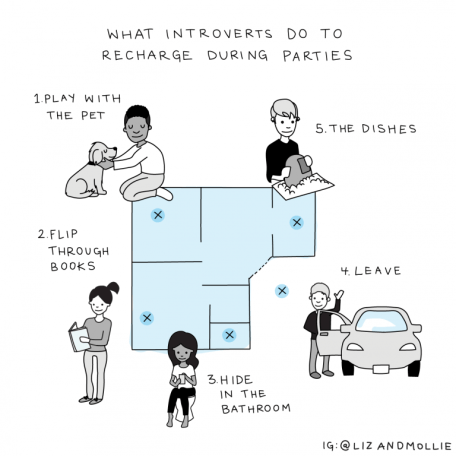
Introverts have sensitive neurological systems, a trait they often display from infancy. Their systems are, as Susan Cain explains, “high reactive,” easily overstimulated by too much noise, too many people, too much visual distraction. To recover, they must then “recharge their batteries” or restore their energy by spending time alone. Extroverts, on the other hand, have “low reactive” systems and need lots of stimulation in order to feel engaged and energized. So while introverts find themselves drained after a social event, even one at which they have enjoyed themselves, extroverts find the same experience invigorating. One of my secret coping mechanisms (in fact used by many fellow introverts) is to escape to a bathroom for a few minutes of quiet and solitude when I’m feeling overstimulated at a party or event. 

QA1-1-768x768
© Liz Fosslien and Mollie West

It might seem counterintuitive that an introvert like myself would choose to be a middle school teacher. Talk about chaos and overstimulation! Spending all day either talking or being talked at definitely depletes me. I usually drive home from school with the radio off, just enjoying the silence in my car, and my understanding husband knows that I need about an hour of quiet time before I’m fit for additional socialization at home. Yet my work is also incredibly rewarding, and many of my coworkers (well, probably one-third to one-half) are introverts as well. Introvert does not equal awkward/antisocial/loner. But we’re probably going to pass on the Friday after-school Happy Hour in favor a quiet, restorative evening at home.

In fact, “restorative niches” are one component of a theory Cain learned about from Professor Brian Little, a former Harvard University psychology lecturer. This engaging, theatrical, and—surprise!—introverted professor developed the Free Trait Theory to explain personality characteristics. According to Professor Little, we are all born with certain fixed personality traits, like introversion, but can and do choose to access other “free traits,” like extroversion, when we want to. A free trait is not our biological default, but we can employ it when a situation demands, or when we are adequately motivated by our beliefs and passions. The Free Trait Theory explains how an introvert like Susan Cain can deliver speeches to crowds of people in boardrooms and auditoriums all over the world. She is passionate about her work, and the drive to share her passion with others trumps her instinct to stay hunkered down in her cozy office at home. (The Free Trait Theory also explains why you can’t always spot an introvert.) So introverts can enjoy success and fulfillment in traditionally extroverted settings (and vice versa), however . . . they’re going to need some restorative niches. Professor Little describes a restorative niche as the place we go to return to our true selves. An introvert can free-trait an extroverted persona for only so long. She needs a place, either an actual physical space or a quiet place in her mind, where she can escape to be alone and recharge her battery. Without restorative niches, a person is headed for burnout.

In our society, it can be difficult to be introverted. As we evolved from a rural, agrarian society into a more urban, industrial one during the twentieth century, our culture shifted toward a celebration of what Cain calls the Extrovert Ideal. The person who was bold, outspoken, and dramatic, quick to think and speak, was the one who stood out in a crowded city and could “sell” his or her talents in competitive marketplaces. Still today, in our schools, businesses, and popular culture, extroverts tend to command the most attention. Extroversion is still the “ideal” by which we are measured and to which we are encouraged, explicitly or not, to aspire. 

But with Susan Cain’s quiet voice shining a light on the hidden power of introverts, things are starting to change. In Quiet, she offers research, personal stories, and advice for helping introverts find their path. She teaches us how to celebrate and cultivate our strengths and how to navigate a world that “can’t stop talking.” After all those years of wishing I were different, I now embrace my introversion.

We are gaining a deeper understanding of ourselves and the people around us. This is important for parents and children, teachers and students, spouses, and friends. We are learning to appreciate our differences and recognize that the world needs the yin and yang of extroverts and introverts. 


References and Resources

Quiet: The Power of Introverts in a World That Can’t Stop Talking by Susan Cain

Susan Cain TED Talk: The Power of Introverts

Quiet Revolution: Susan Cain’s Newsletter

Quiet: The Power of Introverts with Susan Cain (Podcast)