Read

Do You Hygge?

Lately, I’ve been finding myself intrigued by Scandinavia.

It started when I read a couple of books about hygge—pronounced something like “HYOO-guh” as far as I can tella Danish concept that is best described as a feeling of coziness. The hygge mindset is about cultivating a space of warmth and wellbeing in one’s life, and also about minimizing mental, emotional, and physical clutter to create room for appreciating the simple pleasures in life.

Hygge is curling up on a squashy sofa with a good book and mug of tea.

It’s board games, glasses of wine, and laughter with a few close friends.

Chunky wool sweaters, knitted scarves, and coffee. Lots of coffee. Pretty much my dream life. Hygge, it seems, is the secret to making those long, cold winters just a bit more bearable.

And then there’s friluftsliv, which in Swedish loosely translates to “open-air life.” An appreciation for the outdoors also features prominently in Scandinavian culture. The latest book I read, There’s No Such Thing as Bad Weather by Linda Akeson McGurk, derives its title from the popular Scandinavian adage “There’s no such thing as bad weather, only bad clothing.” Apparently people say this a lot to their kids, who resent it when they’re young but then find themselves saying it to their kids when they become parents themselves. If people in that region only ventured outdoors when it is warm, sunny, and inviting, they’d probably log about two hours a year. In Sweden (where the author is from) as well as the other Scandinavian countries, children are forced encouraged to spend time outside every day, rain or shine, which fosters from an early age a connection with and compassion for nature that continues into adulthood. Raising her two young daughters in the midwestern United States, the author is struck and dismayed by how different her childhood was compared to the American norms. She tries to instill in them a Swedish-style hardiness and outdoorsiness, but the American-style drive-through conveniences and screen-time addiction make it feel like she’s swimming upstream. It’s hard to be a person trying to do things differentlyin her case, modeling an active, outdoorsy lifestyle.

In Sweden, children at school spend time outside every day. It is an expectation. They bring the appropriate gear and clothing, and there is no negotiating about it. Their school supply lists are less about glue sticks and colored pencils than rain boots and two pairs of woollen mittens. And it’s good for them. It’s good for all of us. It is easy to think that we humans are such a distinct and special presence in the world, but in reality we’re made of all the same stuff as everything else. Is it any wonder that we feel ourselves at peace when we’re immersed in nature?

So what have I taken away from this?

I have become pretty immune to my students’ complaints that it’s “too cold” to go outside for a little recess during their lunch break. They need to run around! It’s good for them! If it’s above freezing (no doubt the Swedes would snicker at this wimpy American standard), we go out and play. Wouldn’t you know, more often than not the complainers quickly forget how “cold” it is as they laugh and play with their friends. Their rosy, smiling faces say it all.

I invited hygge into the home by finally learning the cozy craft of making candlesI’d been wanting to do this for years! The bonus is that I then get to enjoy the calming scents and light of my homemade candles.

And I’ve been making it a goal to spend some time outside every day. On my way home from work, there are several places where I can stop and walk to enjoy some sunshine or, at the very least, some fresh air. Hygge and friluftsliv tell me that I can’t use the weather as an excuse to skip an outdoor excursion. On one of my walks, it started to lightly rain just as I was setting out. In the past I likely would have turned tail and headed back to my car. But instead, I pulled up my (waterproof!) hood and kept right on going.

Apparently, the right clothing really does make all the difference.


Reading List

There’s No Such Thing as Bad Weather by Linda Akeson McGurk
51OcbO6M9yL._SX325_BO1,204,203,200_

The Little Book of Hygge by Meik Wiking
51YQpxZWUGL._SX348_BO1,204,203,200_

The Life-Changing Magic of Tidying Up by Marie Kondo
(She’s Japanese, not Scandinavian, but this book will change your life too. You’ve probably heard about it by now, but if you haven’t read it yet, do! Her philosophy dovetails perfectly with the hygge mindset.)
9781494508944_p0_v1_s550x406

Eat

Go With Your Gut–Make Yogurt!

Gut. Kind of an ugly word, isn’t it? That’s a shame, because it’s one of the most important and beautiful components to our overall health and well-being. The more I learn about the gut, the more I appreciate it. Trillions of microscopic bacteria in there, with so much potential to optimize our physical, mental, and emotional health. The tricky part is that their effectiveness depends on the quality of what we feed them. But really, that’s also the good news—it means we have a lot of power to improve the health of our microbiome by feeding it well.

But First: Fermentation

Fermented foods include things like yogurt, sauerkraut, kombucha, kefir, tempeh, even beer and wine. Fermentation is a technique that civilizations worldwide have used since ancient times to extend the life of perishable foods. Like by turning milk into yogurt. So how does this magical transformation occur? Basically, hungry bacteria. Fermentation happens when bacteria feast on the carbohydrates in a food item. The byproducts of this feast include various acids, which create an inhospitable environment for the growth of BAD bacteria in the food—and thus increase its shelf life.

There is a lot to know about fermentation, but let’s keep it simple and focus on yogurt. Milk becomes yogurt in the process called lacto-fermentation. This means that bacteria eat the lactose (a sugar) present in the milk and produce lactic acid (among other things) in the process. This acid gives yogurt that tanginess we all love. You’ll see below that one of the steps in yogurt-making involves adding a “starter” to the milk. At this stage, you are adding a bit of mature or finished yogurt—full of bacteria—to your warmed milk to kick off the microbial feast.

Feed Me Yogurt!

Fermented foods are chock-full of probiotic microbes that are helpful visitors in your gut. Every book or article I’ve read about gut health sings the praises of fermentation, which sparked all sorts of new kitchen adventures for me. Including…homemade yogurt. It’s easy, and exciting, to make your own yogurt. Start to finish it takes about 24 hours to make a batch, but only a fraction of that time requires activity on your part. Primarily you just have to give the bacteria time to work their magic!

But why invest the time or energy to make yogurt when you can so easily purchase it?

  • It tastes so much better than store-bought. I’ve probably eaten just about every brand and variety of yogurt over the years—regular, Greek, whipped; plain, flavored, fruit on the top, fruit on the bottom—and they are definitely not created equal. But even the best yogurts from the store take a distant second to my homemade. It’s tangy but not too sharp and doesn’t have any sort of unpleasant chemical-y taste that I only started noticing in store-bought yogurt once I began making my own! It tastes utterly pure and fresh.
  • It carries a significant cost savings. To buy organic Greek yogurt from the store, I pay at least $6.00 for a 32 oz. container. When I make my own yogurt, even when purchasing quality organic milk, I get twice as much yogurt for the same price.

If at First You Don’t Succeed…

Years ago I read that it was possible to make yogurt in a crockpot and thought, Gosh, that sounds easy! However, my first attempt at this was a fail. At the moment of the big reveal when I reverently slid the lid from the crockpot, ready to dip into my creamy creation, I was completely deflated to see nothing but milk soup. No thickening, no yogurt. I figured, Well. It was too good to be true that you could actually make your own yogurt in a humble crockpot.

But several years later, I felt inspired to give it another try. I did a bit more research, and realized that my mistake the first time around was using improper starter yogurt. There are several brands or varieties that will work, but you must ensure that it has the live and active cultures Lactobacillus bulgaricus and Streptococcus thermophilus. Lo and behold, when I attempted yogurt-making with the right starter, it worked beautifully! I haven’t had a failed batch since. (Before making my own yogurt, my favorite brand was Fage Total, and this is what I used to create my first successful batch at home. You can also purchase starter cultures online; a company with a good reputation is Cultures for Health.)

I’ve read many people’s methods for making yogurt, and each person’s system is slightly different. After you make it a few times, you’ll discover exactly what works for you.

Read on for my method!

What You’ll Need:

  • 1 gallon of milk (I like to use organic 2% milk; whole milk is supposed to result in a thicker yogurt, but I have not noticed much difference in my experiments.)
  • 1/2 cup of starter yogurt (check the ingredients list for those bacteria!)
  • A crockpot
  • An instant-read thermometer
  • A wooden spoon
  • A large towel

What You’ll Do:

1. Pour the milk into the crockpot (mine fits just shy of one entire gallon). Turn it on HIGH.

Maker:S,Date:2017-11-7,Ver:6,Lens:Kan03,Act:Lar02,E-Y

2. Bring the milk to 180°. The first few times you do this, you’ll want to start checking the milk after a couple of hours. In my crockpot, this step consistently takes four hours, but your crockpot is its own person and may heat faster or slower than this. (Probably faster. You can see from the photos that my crockpot is kind of a relic, but I’m quite fond of it.) 

3. After the milk reaches 180°, turn off the crockpot and tent the lid. Allow the milk to cool to 110°-115°. For me, this takes about three hours. 

Maker:S,Date:2017-11-7,Ver:6,Lens:Kan03,Act:Lar02,E-Y

4. The next step is to add the starter. But before you do anything else, remove the skin that has formed on the top of the milk. I forgot to do this once, and trust me, you don’t want to be the person fishing pieces of that out of your mouth later on.

In a small bowl, mix your 1/2 cup of starter yogurt with about one cup of warm milk you’ve scooped from the crockpot. I like to stir this very gently, with a wooden spurtle, pampering the live bacteria that are about to start working so hard for me.

5. Once the yogurt starter and milk are combined, pour the mixture into the crockpot and, gently still, stir to combine. I stir in a back-and-forth, side-to-side pattern, kind of like a plus sign. Don’t go whisking it in a vigorous circle. The bacteria are fragile.

6. Put the lid back on the crockpot and wrap the whole thing in a large towel. (It’s less bulky if you remove the crock from its metal housing before wrapping it up, but I’ve done it both ways and the resulting yogurt has been the same.) 

Maker:S,Date:2017-11-7,Ver:6,Lens:Kan03,Act:Lar02,E-Y Maker:S,Date:2017-11-7,Ver:6,Lens:Kan03,Act:Lar02,E-Y

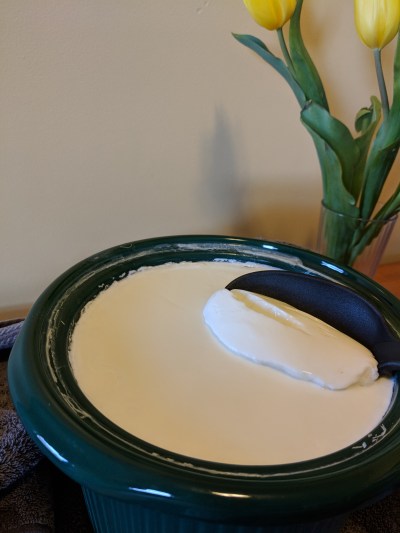
7. And now we wait. Leave it to sit and ferment for a good 12 hours. This is not a hard-and-fast number. I’ve gone a bit above or below this time, and the yogurt has turned out fine every time. It will get tangier the longer it ferments though—but I like this taste!
Maker:S,Date:2017-11-7,Ver:6,Lens:Kan03,Act:Lar02,E-Y

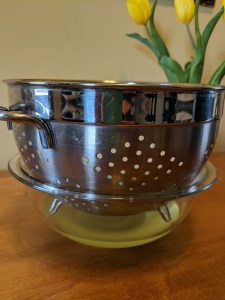
8. The final step is to strain the yogurt to your desired consistency. Some people just skim the whey from the top of the crockpot and then decant the finished yogurt into glass containers for refrigeration. I like it a little thicker, so I strain it for a couple of hours. I use gallon-size coffee filters for this step but other people just line a colander with cheesecloth. Either way, position the colander over a bowl and add the yogurt to it. After a couple of hours, it will be nicely thickened and ready to scoop out and store in the fridge.

Maker:S,Date:2017-11-7,Ver:6,Lens:Kan03,Act:Lar02,E-Y Maker:S,Date:2017-11-7,Ver:6,Lens:Kan03,Act:Lar02,E-Y Maker:S,Date:2017-11-7,Ver:6,Lens:Kan03,Act:Lar02,E-Y Maker:S,Date:2017-11-7,Ver:6,Lens:Kan03,Act:Lar02,E-Y

In a Nutshell:

  1. Fill crockpot with milk. Turn on HIGH and heat milk to 180°.
  2. Once milk reaches 180°, turn crockpot off and allow milk to cool to 110°-115°.
  3. Once milk reaches 110°-115°, gently combine 1/2 cup starter yogurt with 1 cup warm milk from crockpot.
  4. Gently stir this mixture back into the crockpot, then wrap the whole thing in a large towel.
  5. Leave to ferment for 12 hours.
  6. Strain the finished yogurt until it reaches your desired consistency.
  7. Refrigerate and enjoy!

A Few Special Tips

Timeline: As I said at the beginning, this process takes about 24 hours start to finish, but very little of that is active time on your part. I make a batch of yogurt every weekend, and I have developed this as my perfect yogurt-making timeline:

  • 12 noon on Saturday: Turn crockpot to high and begin heating milk
  • 4 pm: Turn crockpot off and begin cooling milk
  • 7 pm: Add starter; wrap crockpot in towel for overnight ferment
  • 7 am on Sunday: Strain the yogurt
  • 9 am: Store strained yogurt in glass containers in fridge

Quantity: My husband and I really like yogurt, and this recipe reflects the amount that we can go through in about a week. If you don’t think you’ll use that much, just pour less into the crockpot from the start. Maybe a half-gallon container of milk.

Coffee Filters
The first few times I made yogurt, I used a fine-mesh cheesecloth as recommended by most people, but to be honest, it was a freakin’ disaster every time. You can wash and reuse the cheesecloth, but it’s a messy process. I was not at all convinced that I was actually getting the fabric clean. I also found that too much of my yogurt was slipping through the colander with the whey, even when I doubled up the cheesecloth. It was frustrating and felt wasteful.

But then I read about using large 1.5-gallon-size coffee filters to strain the yogurt, and these saved the day. I might not have persisted in home yogurt-making without these. I had to order 500 at once, so thank goodness they worked out. Line a colander with a coffee filter and position it over a bowl. After a couple of hours, the yogurt will be nicely thickened, with nothing but whey in the bowl underneath it! Scoop your yogurt into the glass containers of your choice, and it is ready to store in the fridge.

Recommended Resources

For a fascinating read, check out The Good Gut: Taking Control of Your Weight, Your Mood, and Your Long-Term Health by Justin Sonnenburg and Erica Sonnenburg, PhDs. I learned so much from this book and thoroughly enjoyed the authors’ engaging and relatable voices.

Cultures for Health is a reputable company that sells all types of kits and starter cultures for home fermentation. This was the company I used when I needed a SCOBY and starter liquid for making kombucha.

Sandor Katz is a leader and authority in the field of fermentation. His books include Wild Fermentation and The Art of Fermentation, and HERE you can find an interview with Katz on NPR’s Fresh Air.

For a much more in-depth and scientific explanation of all things fermented, I found THIS article from Science-Based Medicine very informative and well researched.

Create

A Sweet Day at Monkey Hollow

There is a farm not too far from where I live, on a quiet country lane called Monkey Hollow Road. I’ve visited several times, as the owners (Al and Jill) enjoy sharing their love of growing, creating, and learning with others. A family member is good friends with Al, so we often have the inside scoop about happenings at the farm. We’ll get messages like: “Al is bottle feeding the baby lamb! Want to go watch?” or, “Al is making apple cider this weekend. Want to go along?” And most recently: “Al is extracting honey this Sunday. Want to come help?” Um, yes, yes, and YES!!

Al and Jill are the coolest people. So easygoing and down to earth. They have a little bit of everything on their Monkey Hollow farm—sheep, chickens, vegetable garden, apple orchard, fishing pond, and of course—beehives!

Today was honey extracting day, and 10 of us showed up to help. Extracting honey is a multi-step process but is surprisingly simple. There are elements of the process that can be mechanized, but part of what is so neat about Al’s setup is that the tools and machinery are low-tech, timeworn, and simple. I like when things are simple.

Al has Langstroth hives, a popular and traditional system that uses a series of stacking boxes called “supers.” Inside the boxes are hanging frames with cells that the bees fill with honey. Once the cells are packed with honey and the bees have coated the surface with a protective layer of wax (beeswax!), the frames are ready to be removed from the hives for the honey to be harvested.

In the first step of the honey extraction process, you shave away the beeswax layer with a hot knife. Al makes this operation look exceedingly smooth and easy, the layer of beeswax falling away in a single unbroken sheet. For the uninitiated, however, there is a bit more beeswax butchery that occurs. It’s hard to hold the knife at just the right angle and tricky to skim it across the cells at just the right speed. 

IMG_20180708_102106
In the background, you can see one of the supers with the honey-filled frames all lined up.

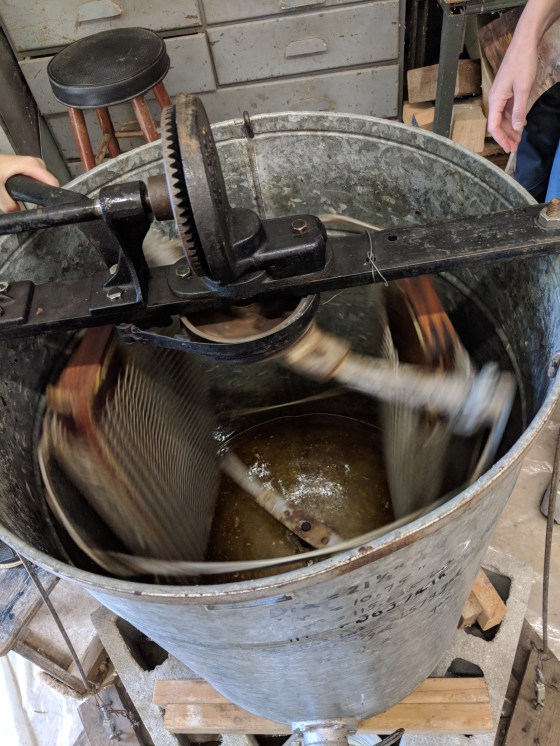
The next person takes two of these shorn frames and shuttles them—heavy and dripping with honey—to the centrifuge. These drop into baskets on opposite sides of the drum and as the next helper turns the crank to spin the centrifuge, the rotational force pulls the honey out of the comb. It collects in a shiny layer on the sides of the drum before slowly dripping down to the bottom. Turning the crank on the centrifuge was my four-year-old nephew Simon’s favorite part by far. Jill brought out a step for him to stand on so that he could reach the handle, and turning it was a two-handed, full-body exercise for him. I bet his little abs were sore the next day. 

IMG_20180708_105210_1

Before long, the honey at the bottom of the drum is deep enough that it starts to interfere with the spinning mechanism. The next step is to open the valve at the bottom and begin decanting the honey into buckets to be transferred to the filtration vat. The honey goes through two rounds of filtration before it’s bottled and ready to sell or trade. As a “thank you” for helping, Al gave each of us a jar of the day’s honey to take home. Those jars went through only the initial sieve—just enough to filter out any stray bee legs and chunks of wax.

IMG_20180708_120507

I enjoyed the day of honey harvesting for a number of reasons, but if I were to list my favorite things about it, these three would rise to the top:

1. Axle Grease

Well, not actual axle grease. Not surprisingly, Al is quite a connoisseur of honey. When he travels to different states and different countries, he likes to share his Monkey Hollow honey with other beekeepers and collect as many varieties as he can. Just for fun, he arranged a honey lineup from his collection for us to sample.

IMG_20180708_105506

It began with a super light linden honey, progressed to a medium-bodied manuka honey from New Zealand, and finished with the extra dark and molassesy honey he affectionately calls his “axle grease.” Starting from light to dark, we dipped toothpicks into the honeys and tasted each one, as Al excitedly solicited feedback about which were our favorites. The linden honey was popular, as was a blueberry variety. I was a little wary of the axle grease, but it was delicious!, bold and assertive, the honey equivalent of a French roast coffee. I expected to be blown away by the manuka honey, since it is ridiculously expensive in local stores due to its rarity as well as its medicinal properties, but taste-wise . . . it was just okay. The clear winner for me was the honey we were extracting and bottling THAT day, the apple honey from Al’s orchard. That honey simply exploded with a bright, pure, apple sweetness. Honey doesn’t come any better than that.

2. The Honey Breeze

IMG_20180714_163254_1

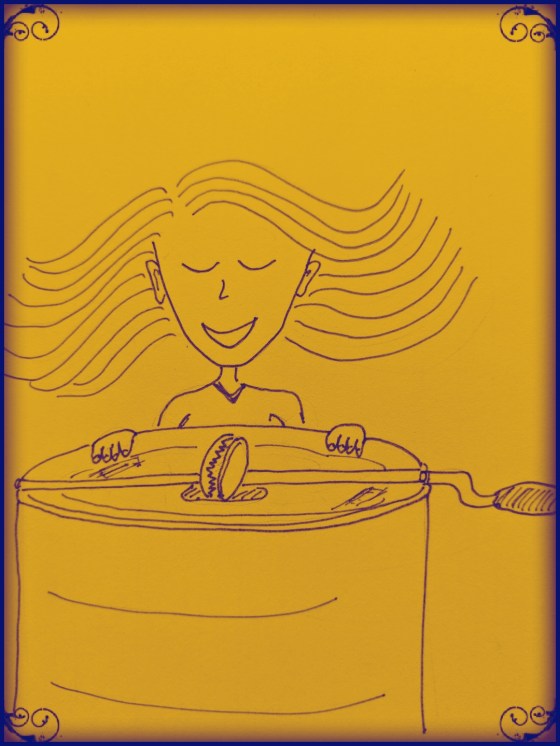
Ah, the Honey Breeze. One of the unexpected byproducts of the extraction process is what I call the Honey Breeze. When the honey frames are dropped into the hopper and you turn the crank on the centrifuge, a breeze rises up from the spinning baskets. A wave of sweet honeyed air caresses your face and blows back your hair. It is like being immersed in a cloud of honey, with all of the sweetness and none of the stickiness. I could bask in the honey breeze all day long.

3. Something Like Strega Nona

The very best thing about Honey Day, however, was the stories we heard from Al and Jill. Stories about Al’s initiation into beekeeping, stories about bee stings (and remedies!), stories about the social lives of bees, stories about people they know. . . . I have a feeling that Al and Jill are very popular around a campfire.

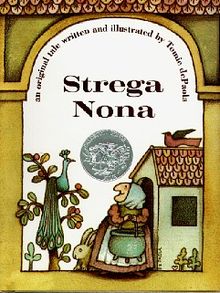
One of their stories that day reminded me of Tomie dePaola’s classic children’s book Strega Nona

Strega_Nona_(Tomie_dePaola_book)_cover_art

Here’s why: When you open the valve on the centrifuge to begin transferring honey to the filtration vat, the honey streaming out of the spigot is strangely hypnotic. It’s like a smooth golden rope, rhythmically unspooling and coiling into a glossy puddle. In fact, Jill told us about the time that their daughter became so mesmerized by the undulating honey that she simply didn’t notice when the container was full and it was time to close the spigot. Honey ran and ran, overflowing the container and creating a sticky flood on the floor of the workshop. In Strega Nona, it is not a flood of honey, but rather pasta from a magic pot that floods an Italian village when Strega Nona’s assistant muffs up the magic spell. He is made to right his wrong by eating the superfluous macaroni—a fitting punishment, right? (I’m pretty sure that Al and Jill didn’t force their daughter to eat her way out of the mess she created. Though if you ask me, I’m not sure that would really be much of a punishment!)

At the end of the day, after enjoying the fruits of the bees’ labor so thoroughly, many of us were curious about seeing where all this honey magic begins. Al promised that at the next Honey Day, we could don some protective gear and he’d take us out to visit the beehives. The fun and adventure never ends at Monkey Hollow!