Explore

When in Rome, Drink the Water

img_20160604_203619947_hdr-2.jpg

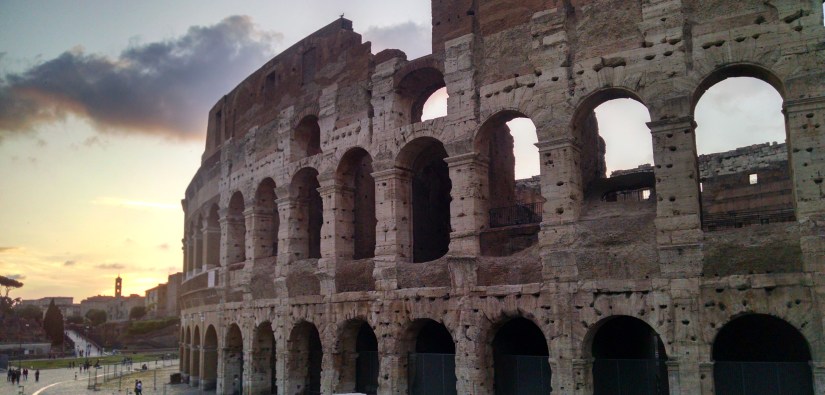
In June of 2016, my husband and I traveled to Italy. It was the biggest adventure of our lives to date. We planned a grand tour of some of Italy’s greatest hits, spending time in Rome, Florence, Venice, and the Cinque Terre. We were excited, of course, to experience masterpieces like the Colosseum, the David, the gondolas and canals. But what we were maybe looking forward to above all else was the food.

This we knew: The Italians take their cuisine seriously.

This we learned: The Italians take their cuisine VERY seriously, and the water they drink is no exception.

Water is water, right? Bottled mineral water or fizzy water (what the Italians refer to as “still” or “sparkling,” respectively) … what’s the big deal? The main thing most tourists to a foreign country are concerned about is if the water will be safe to drink. Throughout Europe in general, the tap water is fine. But with Italy, in handling the water situation, I feel that we were a little misguided by our trusty Rick Steves guidebook. While he does explain in passing that the Italians can be “water snobs,” he goes to some trouble as well to make sure we American tourists know exactly how to order the perfectly fine tap water at a restaurant. He provides the exact terminology (“Acqua del rubinetto, per favore”) and describes how, if all else fails, one can mime the charming little hand motion of turning a tap and drinking its output.

Rick’s advice is always spot-on. We felt well prepared to order our tap water and avoid the tourist trap of paying for water—and save our euros for the important stuff. Like gelato.

The only problem with that plan is that the Italians are water snobs. Yes, their tap water is perfectly fine, but they prefer special, bottled water. Our first clue should have been the fact that the waiters actually ask what kind of water you want with your meal. (“Still, or sparkling?”) Italians must discern some taste enhancement that makes it worth the extra euros when ordering out at dinner. To them, it defies logic that someone would order tap water when they could have the superior still or sparkling water instead. We didn’t think twice about ordering our “tap water,” but more often than not, it earned us furrowed brows, disdain, even outright refusal. On a couple of occasions the service and possibly the quality of our meal suffered after we were so gauche as to request tap water. On one outing, we were told flat out that they didn’t have any tap water. At least once, we were served plain old water in a glass carafe … and charged for having special water. It must be charming to mime turning on a tap only if you’re Rick Steves.

We were a little frustrated. What was the big deal? To us, water in a restaurant is a given, and rather an afterthought. It’s always free, it’s always from a tap, and it’s always perfectly fine. But dining is a much more serious activity in Italy, to the extent that not even a detail like the water is overlooked. Every meal is a mini-occasion. Waiters never ask if you are ready for the bill, because it is expected that you will linger for perhaps the entire evening. A traditional Italian dinner, a formal dinner, can have as many as ten courses! Granted, we did not go in for a ten course dinner, but even a much shorter Italian dinner is more involved and leisurely than we are used to here in the States.

IMG_20160607_104757335_HDR
Yet another difference between the Italian and American approaches to food and dining

These cultural differences gave us much food for thought as we explored and ate our way through some of Italy’s iconic cities.

These cities are known for their ancient ruins, Vespa scooters, and native women strolling in stiletto heels. But they are also known for their public fountains that serve up cold, fresh (and free) water. We frequently partook of these, filling up our reusable bottles whenever we had the opportunity.

We really hit the jackpot, though, with a fountain we discovered in Florence, tucked along the back of the piazza outside the Palazzo Vecchio. There were two spigots, one which provided still water, and the other spigot?—sparkling water. Fizzy water from a public fountain! Who ever heard of such a thing?! It was easily the best water we tasted on our trip.

That experience at the fountain was the turning point for us. A baptismal cleansing of our palates and preconceptions. Clearly, if these people have a public fountain serving “acqua gassata,” they take their water seriously. We had no choice but to embrace the Italian appreciation for excellent water. For the remainder of our dining experiences in Italy, in addition to the house wine, we wholeheartedly requested and drank every drop of the delicious sparkling water.

Explore

Utah’s Yin and Yang

Many people are familiar with the concept of yin and yang, the ancient Chinese philosophy that all things exist in balance, that there are opposing but complementary forces at work in the universe, inseparable and harmonious. Male and female, light and dark, hard and soft. One does not exist without the other, and each is most striking when considered in relation to its counterpart.

My husband and I recently embarked on a long-anticipated hiking adventure in Utah. We had never been to Utah, but the allure of its national parks had been calling us for years. Given more time, we would have loved to take on the “Mighty 5” and explore all of Utah’s national parks in one sweep, but on this trip we had to prioritize. We visited Zion and Bryce Canyon. In retrospect, we couldn’t have planned a more interesting and complementary pair of parks to explore! We knew that we would see lots of rocks and canyons on this trip. What we did NOT know was how different each park’s rocks and canyons would be! Bryce Canyon is the yin to Zion’s yang.


First stop: Zion

Zion was a fantastic introduction to the splendor of Utah. It is a majestic, awe-inspiring place.

It is the most visited of Utah’s national parks, and from May through October, cars are in fact prohibited from driving into the main canyon of the park, from where hikers access the various trailheads. It would be too crowded, there isn’t enough parking, and frankly it would ruin the quiet and majesty of the area. Shuttle buses transport visitors from end to end and everywhere in between.

As you wind your way deeper into Zion, you’re surrounded by walls of massive sandstone. While in the company of such impassive and immovable giants, you can’t help but feel how tiny, brief, and fragile a single human life is. It was unfathomable that these canyons were created by the forces of wind and water. . . . So soft! So gentle! Well, in fact the flash floods that tear through the canyon walls, hurling boulders, flinging trees, gauging and fracturing and reshaping the landscape over the millenia are NOT so soft and gentle. We heard a lot about the flash floods during our time in Zion, and I couldn’t help but wish we’d had the opportunity to witness one of these events—from a safe height and distance, of course!

Maker:S,Date:2017-11-7,Ver:6,Lens:Kan03,Act:Lar02,E-Y

In Zion, all of the hikes begin at the bottom of the canyon. There are, of course, trails that STAY at the bottom of the canyon, flanking the Virgin River or tucked into a slot canyon, but our hikes involved some rigorous uphill climbing. There’s barely time to warm up your muscles before you begin ascending, and the trails we explored featured steep switchbacks—too many to count—and massive drop-offs. People die from falls on the trails and it was not hard to see why. Given my husband’s tendency to roll his ankles, we were particularly careful along these cliffs.

Angel’s Landing is one of the most famous and dramatic hikes at Zion. It’s a tough one from the get-go, but as you approach the final summit of Angel’s Landing, the trail becomes so narrow and treacherous that you must cling to chains embedded in the rocks to keep from falling. As an added challenge, while you are climbing UP this steep, narrow corridor, the returning hikers are coming back DOWN. At times it felt like a vertical game of Twister as we contorted our bodies to move past and around each other while maintaining our grips on the chains. But if you find spaces to pause here and there to safely look up and out, the views across the canyons from such a height are breathtaking.

Our favorite hike at Zion, however, was Observation Point. We decided to explore it after eavesdropping on a conversation on the shuttle bus. A fellow traveler asked the young intern/ranger on board about his favorite hike, and without pause he responded, “Observation Point.” We knew it would be a hard one—eight miles round trip, elevation gains even greater than the hike to Angel’s Landing—but the rigor tends to make trails less crowded, which is always a bonus in our estimation. In fact, there were many stretches of the trail when it felt like we were the only hikers on earth.

Maker:S,Date:2017-11-7,Ver:6,Lens:Kan03,Act:Lar02,E-Y

We hiked through artfully sculpted canyons, along narrow ridges, and across wildflowery meadows on our way to the top. Every drop of sweat was worth it when we reached the summit and took a few moments of well-deserved rest to soak in the vastness of the landscape.


Second stop: Bryce Canyon

From Zion it is a pleasant and scenic hour and a half drive to Bryce Canyon. As we soon discovered, Bryce Canyon is the opposite of Zion in almost every regard. If Zion is a muscley, solid, no-nonsense lineman, Bryce Canyon is a graceful, delicate, twirling ballet dancer.

img_20180602_155910.jpg

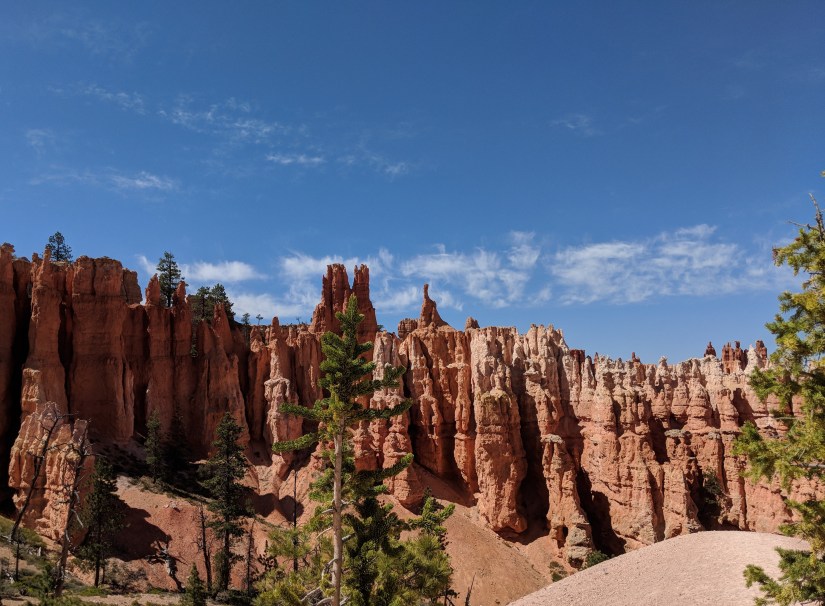
Bryce Canyon is much smaller. There are fewer visitors. It’s at a higher elevation, and therefore cooler. Its signature rock formations are delicately carved and improbably balanced statues of red rock. But the biggest difference is that in Bryce Canyon, home base lies at the TOP of the canyon rather than at the bottom. Entering Zion, there is no question that you are in a land of canyons. They rise up all around you! But as we drove into Bryce, we saw fields of cattle, and piney woods, but no canyon. Puzzling. We parked and gathered our hiking gear, and it wasn’t until we approached the edge of the rim that the canyon was revealed in all of its improbable and whimsical glory. It drops DOWN, below the horizon line, invisible from surface level, into an expansive amphitheater of hoodoos—intricately carved pillars of red rock rising up from the floor of the canyon, no two alike.

Maker:S,Date:2017-11-7,Ver:6,Lens:Kan03,Act:Lar02,E-Y
We called this hoodoo the Fertility Goddess.

All of the hikes at Bryce, therefore, begin with a steep descent and end with a rigorous climb. A hiker is wise to save a little energy for the return trip. After experiencing both extremes of hiking, I prefer tackling the hardest part—the ascent—on the front end rather than as the finisher. My husband can attest that I get a little . . . cranky when I’m really out of gas.

We had a day and a half to explore Bryce. On our full day we took on the strenuous eight-mile Fairyland Loop that dips up and down and all around the amphitheater of the park. But on our first day, when we had just a few hours of daylight for hiking, we did the Peek-a-Boo Loop, and what an introduction it was!

We were a little concerned about crowds as we began the descent into the canyon for our hike, as the “main drag” leading down into the canyon from Sunset Point was thronged with tourists posing and snapping pictures of the breathtaking hoodoos. But the crowd dissipated almost entirely as we began the actual hike, which was steep and strenuous (see elevation profile below!) and featured the added challenge of being a horse-poop-minefield, as the trail is also used as a bridle trail. The temperatures at Bryce were not as hot as at Zion, but I could definitely feel the impact of the strong sun and thinner air at its higher elevation.

profile_Peekaboo
Peek-a-Boo Loop; credit: www.nps.gov

The trails we explored were quiet and secluded, and between gawking at the infinite vistas and marveling at the intricacies of the hoodoos, we were never at a loss for something to enjoy.

So when you go to Utah, if you have time to take on the Mighty 5 . . . lucky you! If not, Zion and Bryce Canyon make an excellent and complementary introduction to Utah’s canyon country.