Explore

Being World-Class

world-class \ˈwərl(d)-ˈklas \ (adj)
being of the highest caliber in the world
Merriam Webster

We’ve all heard the accolade “world-class” attached to various people. Athletes, surgeons, musicians, chefs, anyone performing at the highest levels of their craft.
I never gave a moment’s thought to anything in MY life being world-class until recently.

I was listening to an episode on the Tim Ferriss podcast. His guest was Ann Miura-Ko, a technology-startup investor as well as lecturer on entrepreneurship at Stanford.

She grew up in a very traditional Japanese family (i.e. driven by education, effort, and excellence) in which her father’s common refrain throughout Ann’s childhood and adolescence, to check whether her work had met the family standard of quality, was to ask, “Is that world-class?” A tough metric by which to be measured, but that was the expectation. World-class effort. 

Ann shared a story about her work-study job at Yale. She was basically an office grunt for the Dean of Engineering. When she called her parents before her first day on the job, her dad reminded her to do world-class work. She was like, Um, pretty sure photocopying and filing is not world-class stuff. But then, standing in front of the copy machine, she couldn’t help thinking: What would world-class photocopying look like? Perfectly aligned pages, crisp and neat, color-matched exactly to the originals. What about world-class filing? Coffee runs? She decided to bring an effort and mindfulness to her work, tasks that many might have said didn’t really matter. Her “world-class” office work was noticed by her bosses, but even if it hadn’t been, it mattered to her to feel proud of the work she’d done.

I was very inspired by that philosophy. I do so many things on autopilot, or put minimum effort into tasks that seem insignificant. And maybe not everything I do has to be world-class, but it got me thinking, what if MORE of the things I do were? If I’m bothering to do something, why not try to do the thing as best I can? Show a bit more care? Go just a little above and beyond? Find a way to take something “small” and turn it into something special.

I think we kid ourselves when we take comfort in the knowledge that nobody else will witness our shoddy work or half-assed efforts. I think, whether we consciously acknowledge it or not, all that half-effort accumulates and erodes our sense of self-respect. Whether anyone else will ever know, WE know whether we’ve tried hard or not. It feels good to do your best at something. It feels kind of crappy to know that you slacked off. 

It’s probably not realistic for every aspect of your life to be world-class. Sometimes it’s fine if things are good enough. You can drive yourself into the ground if perfection is the only acceptable outcome for all of your endeavors, and I do not have the energy for that. But I enjoy turning that world-class lens on different aspects of my life:

  • What does a world-class teacher look like?
  • What would it mean to be a world-class wife?
  • Did I do a world-class job cleaning the bathroom??

Just asking the questions and reflecting on the answers is a worthwhile practice. I’m not a fan of the word “mindful” because it is so overused, but it is the perfect word in this case to describe taking that pause to consider the why and how of what we’re doing.

“World-class” has become sort of a thing for me and my husband. We use it in a kidding-not-kidding way, to acknowledge each other’s efforts and shine a light on people whose hard work we admire. 

Like this guy:
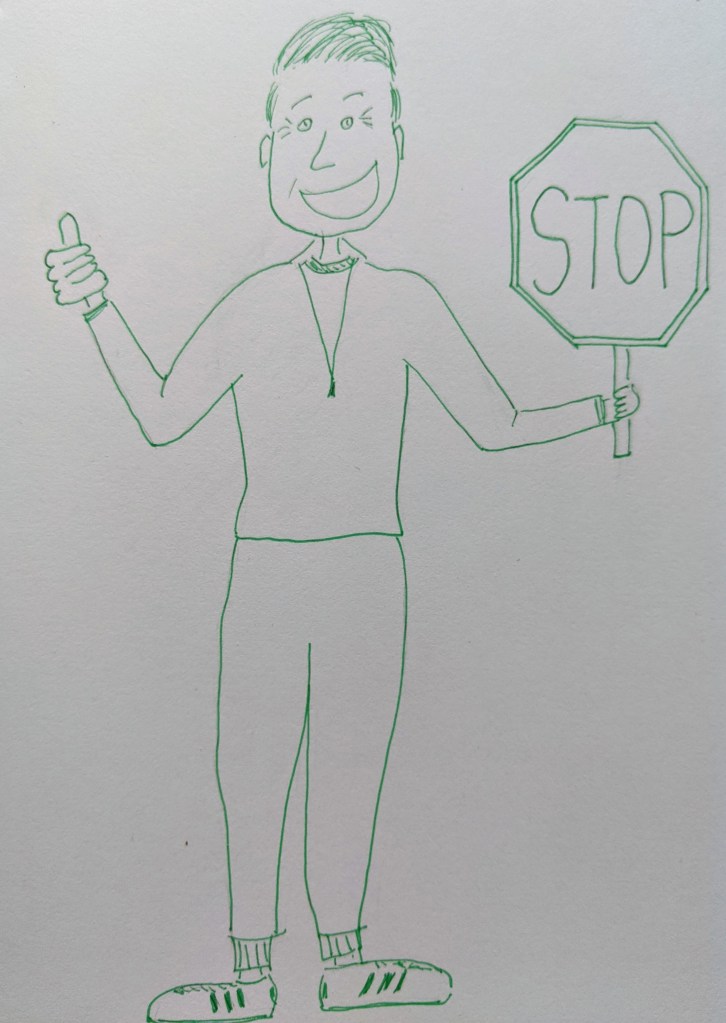
There is a crossing guard at the elementary school I drive past every day on my way home. He’s in his 50s or 60s, possibly an early retiree who enjoys having a little something to do in the afternoon each day. He’s been doing the job for several years, and every time I see him, I marvel at his energy and enthusiasm. He cheerfully greets the children by name. As he stops traffic to usher the children across the road, he lets the kids jump up and “high five” his stop sign as they pass. He then jogs back to the side of the road so that traffic can resume, but always gives the passing cars a smile and thank-you thumbs up. It makes ME happy to see him each day, and I don’t even know him! 

After listening to the podcast, it hit me: That’s a world-class crossing guard!

What stories can you share? Who is doing world-class things in your life? 
Explore

The Fun of Rucking

If you are not familiar with the term, “ruck” is a thing, and it’s also an action. You ruck with your ruck. Translation: You carry weight in your backpack. This simple activity, hiking while carrying a weighted pack, is not a new concept, though these days it is gaining traction with people from all walks of life.

I was familiar with rucking from my husband. He would sometimes load up his backpack with a weight plate (or two) before hitting the hiking trail. Years ago when he first started rucking, I was like, “Seriously? That sounds horrible. Why ruin a perfectly nice walk in the woods?”

And that was the sum of my thoughts about rucking.

Until recently, when I read The Comfort Crisis by Michael Easter. Rucking is hardly the central focus of his book, which interweaves the story of his month-long caribou-hunting expedition in the Arctic with research and commentary on how the comforts of our modern lifestyle can be detrimental to our health, happiness, and longevity. But he does spend some time discussing rucking (super relevant to the part of the story when he must carry 100 pounds of caribou meat five miles back to camp), and it was eye-opening.

Rucking’s genesis is in the military, where soldiers have always had to carry heavy loads pretty much everywhere they go. As far back as Roman times, soldiers engaged in weighted marches. Today, soldiers’ “rucksacks” generally weigh from 50 to 100 pounds. Not surprisingly, carrying all that extra weight exerts a substantial cardiovascular and strength load on your body and builds mental fortitude as well.

Like many things that started in the military and eventually trickled down into civilian use—like duct tape and the internet—rucking entered the mainstream in the 2000s. I was starting to understand its growing popularity. The benefits of rucking are huge:

  • It contributes to functional strength—we carry things all the time in regular life. And by improving core strength, balance, and body awareness, rucking makes us less injury-prone.
  • It provides time in nature. Always a good thing! 
  • It can be a social activity. Because it is easily scalable, people of varying abilities can still ruck together. 
  • It is so simple. You need very minimal gear to get started, and you can ruck literally anywhere. 
  • It exerts less impact on your joints than running, yet burns significantly more calories than walking. So it splits the difference between the benefits and risks of the two activities. Keep in mind that the heavier your rucksack, the more stress on your joints. It’s important to build up slowly, use good form, and wear appropriate footwear.

So it got me thinking. I like to walk. I like to strength train. I like to do cardio. Rucking checks all three of those boxes. A win-win-win! To his credit, when I shared my newfound excitement about rucking with my husband, he didn’t roll his eyes. Instead he offered to let me borrow his backpack and showed me how to load the weight properly. (I know—he’s the best.)

I did a little more reading about “Rucking for Beginners” to figure out how much weight I should carry. Starting out, they recommend about 10-15% of your body weight. I weigh about 140, so 20 pounds seemed like a good place for me to start. 

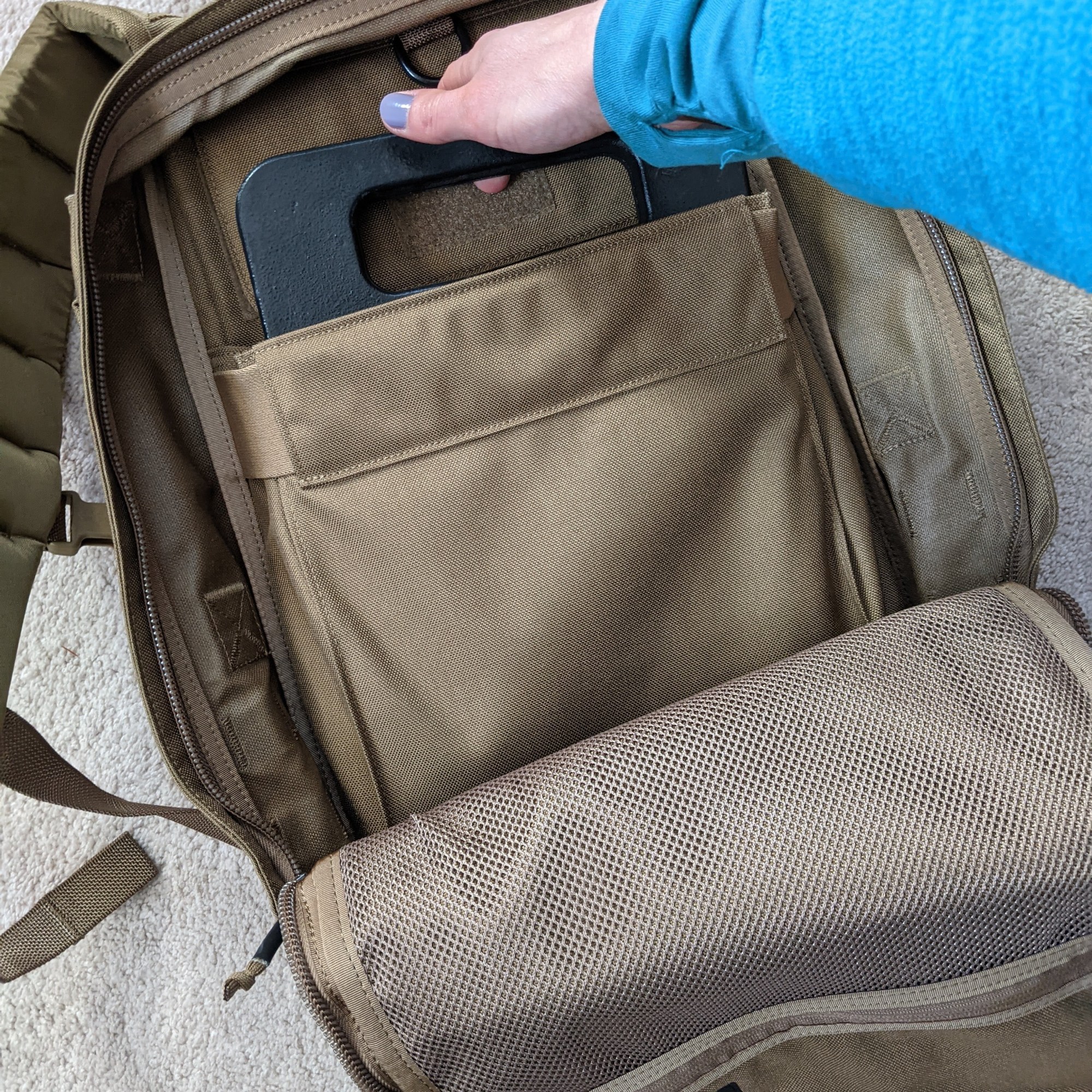
The right backpack is crucial too. The Jansport I use for school would not cut it. For a much lighter weight it might work, but 20 pounds would strain its limits. There are specially designed backpacks for rucking, with reinforced stitching and thick, padded straps that don’t shred your shoulders and that keep the weight up high and tight against your back. My husband and I swaddled two 10-lb weight plates in an old towel, cinched the straps to secure the backpack snugly onto my back, and off I went. 

I didn’t want to overdo it my first time out, so I walked on a flat, paved trail and only for about two miles.

The Verdict

Twenty pounds didn’t really sound like a lot of weight to me, but it was a good amount for my beginning ruck. From the first step, it did not feel like the typical stroll on the trail. Usually when I walk, it’s easy to lose track of time. I enjoy it so much, I often feel like I could keep walking forever. 

This was not like that. It felt long. Half a mile in, I was like, That was only half a mile?? But everything is hard when you first try it, so I embraced the discomfort and just observed what was happening throughout my body.

My shoulders and upper chest worked to counter the weight pulling down on them.
My upper back grew tight and fatigued.
My hips and core engaged, adjusting to the shift in my center of gravity.
I had to consciously pick my feet up to keep them from scuffing against the ground.
I felt myself getting slightly winded, though my pace—while brisk—would have been no big deal on a regular hike.

The next day, I wasn’t especially sore anywhere, though I noticed a little tightness across my shoulders and upper back. 

I did a few more rucks over the next couple of weeks, adding distance incrementally and focusing on maintaining good rucking form. You want to keep your head high and body upright—don’t lean forward. Keep shoulders relaxed away from your ears and glutes engaged. I suppose you could just stroll along at whatever pace you want, but setting a more intentional pace (my goal was 15 minutes per mile) will increase the cardio benefits.

One of the best things about rucking is that you can adjust the challenge level in so many ways. 

Add more (or less) weight.
Add more (or less) distance.
Add more (or less) speed.
Add some hills or stairs.
Mix in some strength intervals with pushups, squats, pullups, etc.

So the early votes are in, and I must say, rucking lived up to the hype. A little strength, a little cardio, and some unexpected mental engagement too. I’ll definitely be incorporating rucking into my workout circuit. I would not use the word “fun” to describe rucking, but I wouldn’t necessarily call my weight lifting or HIIT workouts fun either. Challenging, yes. Invigorating, yes. And satisfying for sure. It feels fantastic to work hard and accomplish a goal. I love it, even if it’s not always fun.

Actually, though, come to think of it, there is something fun about rucking. It happens when you unshoulder your rucksack at the end of a hike. It’s magical. In that moment of sudden weightlessness, it feels like you could fly!

Postscript:

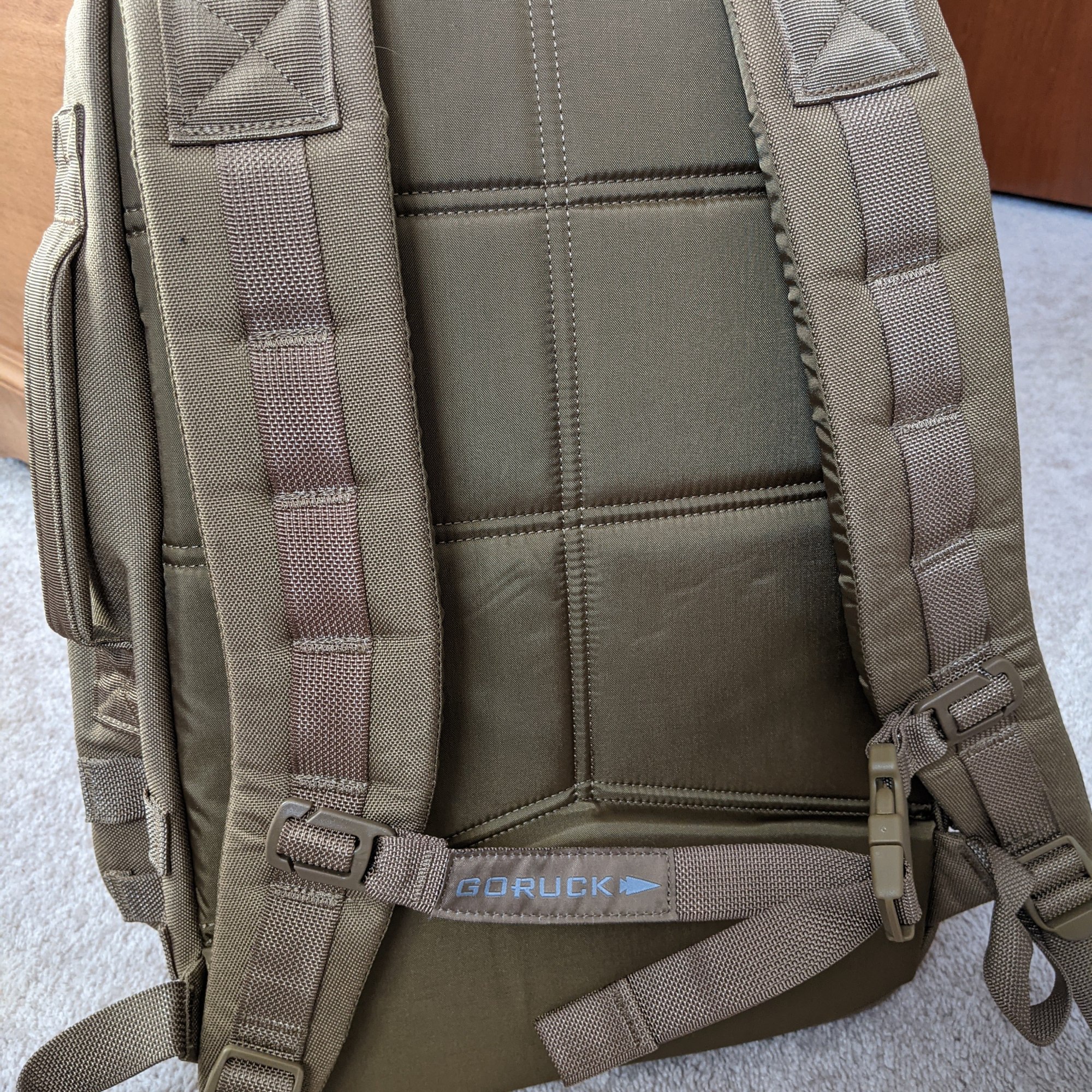
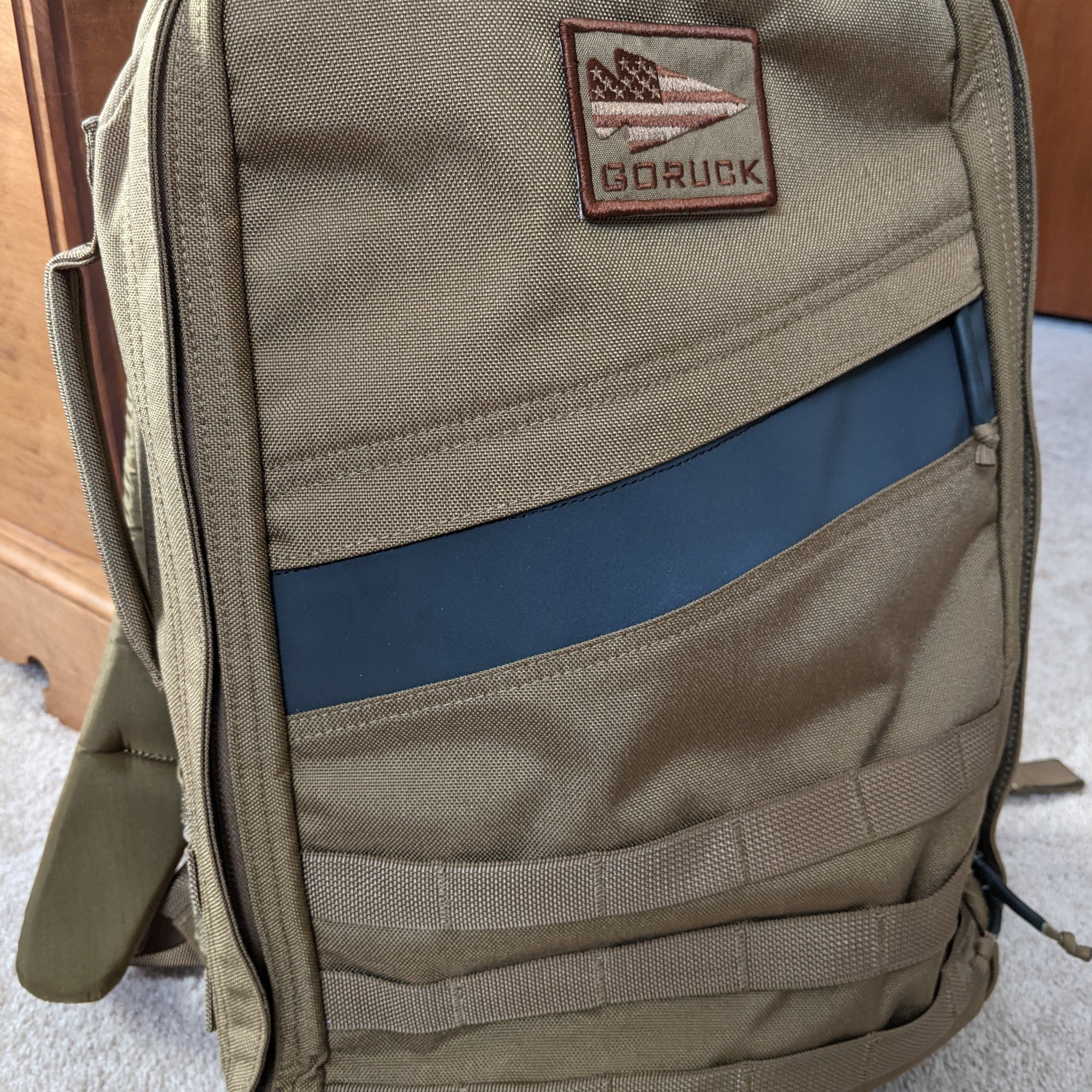
I took to rucking so enthusiastically that my husband surprised me with my very own rucksack and weight plate for my birthday! It’s one of the super nice bags from GORUCK (more info below), and wow is it comfortable. I love it. 


For further exploration:

If you are interested in learning more about rucking, there is no shortage of information out there once you start digging a little.

GORUCK is a company co-founded by former Green Beret Jason McCarthy and his wife, Emily (a former CIA operative). Michael Easter includes an interview with Jason in The Comfort Crisis. While the company does sell rucking gear, they are most passionate about serving others and building a strong community. There are GORUCK events you can sign up for, local GORUCK clubs to join, or if that’s not enough, you can become a member of the GORUCK Tribe for monthly challenges and a community of support.

I found an interesting episode on “The Art of Manliness” podcast. It is not a podcast I subscribe to, but this particular episode, an interview with Josh Bryant, certainly doesn’t apply just to manly men! Josh is the author of Rucking Gains, and in this 30-minute interview, he talks about the many benefits of rucking and shares advice on how to get started.

I also enjoy Michael Easter’s “2 Percent” newsletter. In a recent post he described a 100 pound, one mile ruck challenge (which, following his advice for a person my size, I scaled to a 70 pound, one mile ruck). Holy shit was that hard. But I loved it.

Read

Play by the “New Rules”

It’s that time of year when people start thinking about resolutions. New Year’s resolutions often include fitness and nutrition goals, which got me thinking about a conversation I had with a friend recently about exercise and fitness. We both really enjoy working out, so I told her about a book I’d read that changed the way I lift weights. 

“In fact,” I told her, “it changed my life.” 

We looked at each other in surprise. I hadn’t been expecting to say that, but I realized at that moment that it was true. 

I never received much coaching in lifting weights. And I’m a lifelong athlete! Things probably are a bit different today, but 20 years ago when I was in high school and in college, female athletes spent very little time in the weight room. Looking back, I can see the lack of focus and guidance. It’s like our coaches knew we probably “should” lift weights, but they weren’t that into it and weren’t real experts at it. 

As an adult, I continued to work out. I ran (outdoors and on the treadmill) and I carried on with my version of weightlifting. The version many women practice:

  • High reps (to “tone” muscles)
  • Low weights (I didn’t want to “bulk up”!)
  • Mostly machines (less intimidating than the free weight area)

BUT THEN.

I read The New Rules of Lifting for Women by Lou Schuler, Cassandra Forsythe, and Alwyn Cosgrove, and their book completely transformed the way I work out.

I learned new exercises. My workouts took on a different structure and concrete goals. But the number one thing I gained was the confidence to lift heavy weights.

A bit about the authors:

Lou Schuler is a certified strength and conditioning specialist, as well as an award-winning journalist and author. Alwyn Cosgrove is a strength and fitness coach and consultant, who owns the well-respected Results Fitness gym in California. Alwyn designed the New Rules workout programs. Cassandra Forsythe holds a PhD in kinesiology, an MS in nutrition, and is also a registered dietician and certified strength and conditioning specialist. She created the nutrition plan for the book. 

Throughout the book, they set out 21 “new rules” for women related to strength training and nutrition. One of the biggest myths—busted right off the bat—is that if women lift heavy weights, they are going to turn into

 It’s not going to happen. 

Lou wryly points out that for most men (himself included) there is no such thing as muscles that are “too big.” Even after decades in the weight room, with all the hormonal advantages of being biologically male, if a dude has big muscles he has worked REALLY hard for them. 

Truth be told, okay, yes, I was always a little afraid of becoming “bulky” and mannish. But Lou assures us that “unless you’re an extreme genetic outlier,” women do not need to worry about becoming bulky. 

The first four rules were among the most mind-shifting for me:

New Rule #1: The purpose of lifting weights is to build muscle
New Rule #2: Muscle is hard to build
New Rule #3: Results come from hard work
New Rule #4: Hard work includes lifting heavier weights

It dawned on me that for years I had been treading water. I’d been on autopilot, moving through the same series of exercises, using the same number of reps and weights each time. I stayed in decent shape, but I never got any stronger. 

Good spot for a disclaimer? I am not a personal trainer or exercise scientist. What I am is a woman who cares a lot about fitness, wellness, and functional strength that will serve me well for a lifetime. The New Rules philosophy has helped me to maximize my efforts and achieve goals I never imagined were possible. 

The workouts center on compound moves that involve multiple, coordinating muscle groups and mimic movements that one performs in real life. In real life, we don’t often bend and straighten our elbows in isolation (à la bicep curl or tricep kickback). But we do lift, push, pull, and carry things, sometimes heavy things. The biceps and triceps are designed to work in concert with the larger muscles of our upper torsos as we carry out those functions. 

So in the New Rules program, you will not see time devoted to small-muscle moves like tricep extensions. If you’re a bodybuilder training for Ms. Olympia, sure, you might need your triceps to ripple like a flag, but for the rest of us, our time is better spent on compound moves that work multiple muscle groups simultaneously. 

Moves like a chest press (which works your chest, shoulders, and triceps simultaneously).

Or a chin-up (which develops your upper back, shoulders, and biceps simultaneously). 

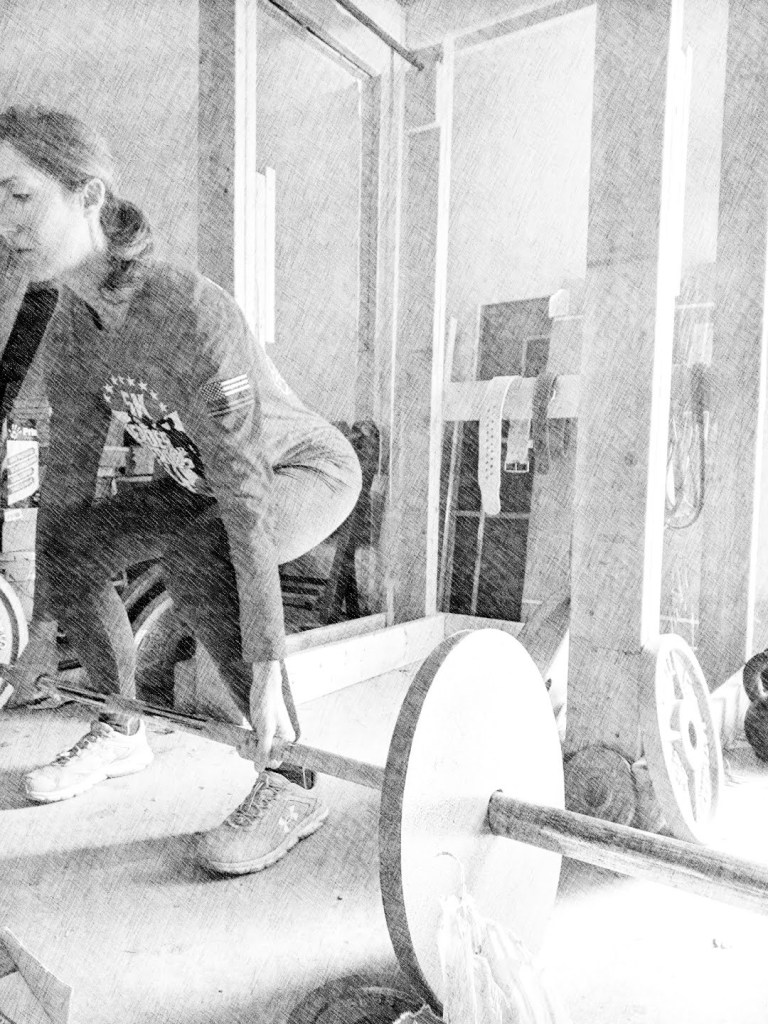
Or my favorite move of all: the deadlift, which works damn near every muscle in your body!

Increasing your muscle mass yields multiple benefits. Muscle is more metabolically active than fat, so even at rest, a muscular body will burn more calories than a doughy one of the same weight. Even more important though is the correlation between strength and longevity. All else equal, a person with more muscle mass has a decrease in all-cause mortality over same-age peers. The reasons for this are many, but the solution is (kind of) simple: Build your muscles! Do resistance training!

Nutrition is an essential component of the program, and four chapters, or six of the 21 “new rules,” outline how to properly nourish a strong body. 

Lou’s writing is friendly, factual, and funny. He and Alwyn have collaborated on four other New Rules books, as well as a fifth book titled Strong. I’ve gleaned useful information from all of them, though the second one is the one that really changed my life. The series includes:

The New Rules of Lifting
The New Rules of Lifting for Women
The New Rules of Lifting for Abs
The New Rules of Lifting for Life
The New Rules of Lifting Supercharged

……………………………………………………………………………………………………………….

Sometimes I think to myself, This is crazy, I’m stronger now than I’ve ever been in my life! But I know that probably is not really true. It seems unlikely that my mid-40s body is actually stronger than the 20-something body of a college athlete. But what IS true is that my 20-something self didn’t KNOW how strong she was, or could be. And my 40-something self knows better than to set limits on what is possible.