Blog

Read

How to Read Ann Patchett

I’ve been thinking about Ann Patchett a lot recently. Well, more than usual, I mean, because she IS one of my favorite authors after all. 

But recently, she has published a new book (Tom Lake), AND I had the opportunity to see her in person on the book tour for it. 

Since one of the main things I write about on this blog is books, it seems obvious that I should have an article about Ann Patchett. But the internet hardly needs another review of all of Ann Patchett’s work (and that would be way too long, anyway). 

Do I think you should read all of her books? Yes, I do. However, if you’re just getting started, or if you aren’t sure that you’ll explore her entire backlist, I have created my recommended roadmap to reading Ann Patchett. Read the following books, in the following order, to arrive at a healthy appreciation of the scope and beauty of her writing.

Starting Point: Read Her First Book

The Patron Saint of Liars is Ann’s first published novel. At the time, she was spending her days waitressing at a TGI Friday’s, while working out the details of the novel in her head. After about a year of that, she wrote it all down.


In the book, Rose Clinton is a woman feeling stifled and tethered by her marriage. (Through no fault of her husband, really. He’s a very kind and gentle man.) When Rose discovers that she is pregnant, that’s it; she decides to leave. Without a word. Driving east from California to Kentucky to arrive at St. Elizabeth’s Home for Unwed Mothers. (We know that she is not an unwed mother, but she lies about it.) The typical stay at the home is nine months or less, but Rose finds a way to remain there indefinitely. She makes herself indispensable in the kitchen, and she marries the handyman/caretaker, Son. (She doesn’t bother to tell him that she’s actually still married to her first husband.)

I didn’t really like Rose. Everyone’s got issues, but she just seemed so self-centered. It pissed me off that she insisted on naming her baby “Cecilia.” It pissed me off how aloof she always was with Cecilia. And she REALLY pissed me off at the end of the book. She wasn’t all bad—it’s not wrong to value one’s sense of independence, and she could be incredibly compassionate with the nuns and other women at the home. But come on, grow up, Rose. That’s what I wanted to tell her. 

I’m sure plenty of people would disagree with my assessment of Rose. But the bottom line is, this was a great book. And it was Ann’s first novel! I think you’ll be equally impressed and eager to continue on the reading journey.

Next Stop: Read Her Newest Book

Ann’s most recent novel is Tom Lake. The setting is northern Michigan. It’s a story told alternately in the present-day, at a cherry orchard during the Covid lockdowns, and in the 1980s at Tom Lake, a summer theater company. The main character, Lara, while harvesting cherries with her three adult daughters, unspools for them the tale of her brief acting career and love affair with the famous Peter Duke during the summer she spent performing Our Town. My favorite element of this book was the dynamic among the mom and her daughters. I was warmed by (and perhaps a little jealous of) their close-knit friendship. It also made me want to finally read Our Town.
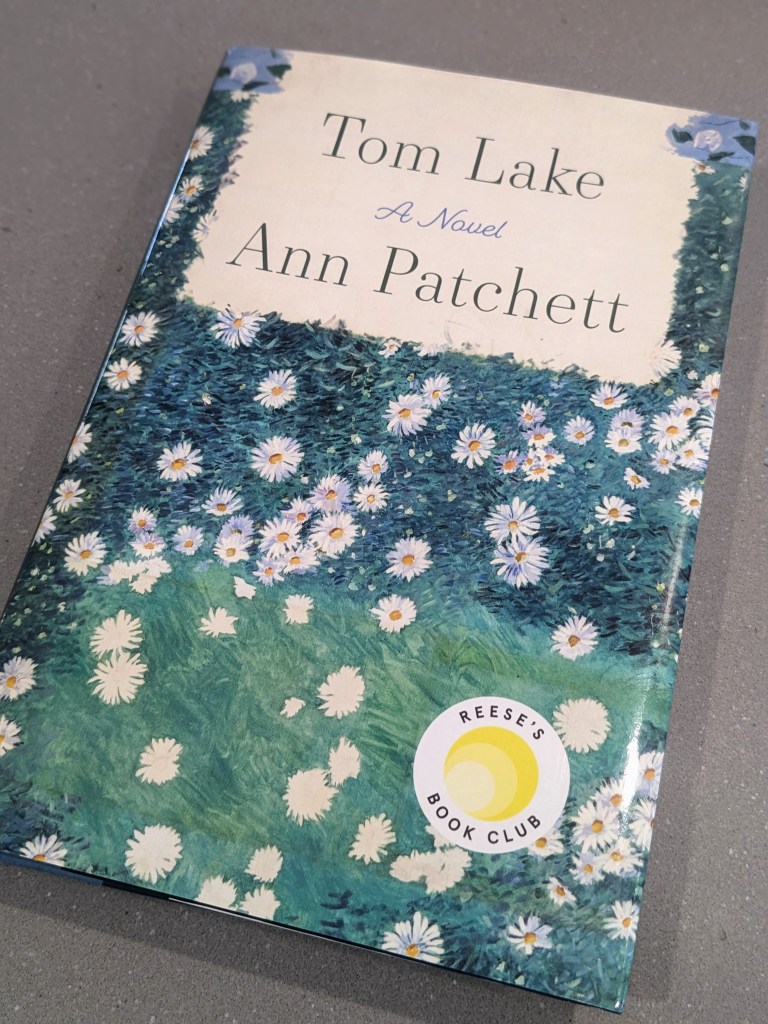

But the BEST part of Tom Lake is that I got to see Ann Patchett on her promotional book tour! Her tour included an evening at the Maltz Performing Arts Center in Cleveland, Ohio, just two hours from where I live, which made for the perfect overnight getaway.


The event featured Ann Patchett along with her good friend Kevin Wilson, talking all about books: Books they’ve read, books they want to read, books they’ve written. Their mutual respect and affection was obvious. It was an enjoyable, entertaining, and inspirational evening.


You’ve Arrived: Read Her Best Book

Since this is my blog, I get to decide which book is her best. And it’s State of Wonder. This was Ann’s sixth novel but the first one of hers that I read, and the way I learned of it was kind of unusual.

I was a little late to the party, but like every woman of a certain age, I eventually read Elizabeth Gilbert’s Eat Pray Love. I loved it, so I then proceeded to read everything else she’d written, including Big Magic, a nonfiction work about inspiration and how to live a creative life. In that book, she describes meeting Ann Patchett at a book event and the close friendship they developed from there. 

The crazy thing was this: As they corresponded and talked about writing, they discovered that they had each independently had the idea for a novel set in the Amazon. Novels with eerily similar plots. The idea had come to Elizabeth first, but she let it lie fallow for too long, at which point it seemed to have abandoned her and magically migrated to Ann’s head (and yes, Elizabeth really does theorize that ideas have the ability to do this). They were mutually delighted and astonished by this turn of events, which resulted in Ann’s book State of Wonder.

Intriguing, right? At the time I was unfamiliar with Ann Patchett, but I checked out State of Wonder . . . and then proceeded to read everything else she’d written. 
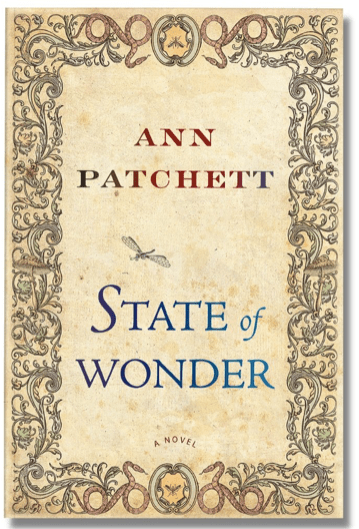

State of Wonder is such an inventive story: A pharmaceutical company is heavily invested in developing a fertility drug in the Amazon. But the doctor heading up the project is notoriously and unapologetically incommunicado. After the employee who’d been sent to the Amazon to check up on her work winds up dead of a fever, his colleague Marina Singh is dispatched to get some answers. The remote Amazonian setting is mesmerizing as well as terrifying in its foreignness. And Marina . . . I really liked her. She’s strong, smart, kind, and reliable. Some might fault her for being too hard on herself and not hard enough on others. But nobody could undergo such a foray into the Amazon and remain unchanged, and Marina is no exception. She discovers that she is stronger and more resilient than she ever knew and is finally able to let go of the things—from both the past and the present—that have been holding her back for far too long.  

Side Trip: Read Some Nonfiction

If you have the time and inclination, I also recommend that you check out some of Ann’s nonfiction. She has several collections of essays, my favorite of which is This Is the Story of a Happy Marriage. By reading her essays, I felt like I really got to know Ann as a person. Plus it makes it even more fun to read her novels because you spot autobiographical nuggets here and there that you wouldn’t otherwise recognize. 


I hope you enjoy your introduction to Ann Patchett. It should give you a good sense of Ann as a writer and as a person. And if you want to continue the journey you’re in luck, because she has six other novels, several more collections of essays, and even a couple of children’s books for you to explore. 

Eat

Easy Canned Peaches

Peter Piper picked a peck of pickled peppers,
A peck of pickled peppers Peter Piper picked;
If Peter Piper picked a peck of pickled peppers,
Where’s the peck of pickled peppers Peter Piper picked?

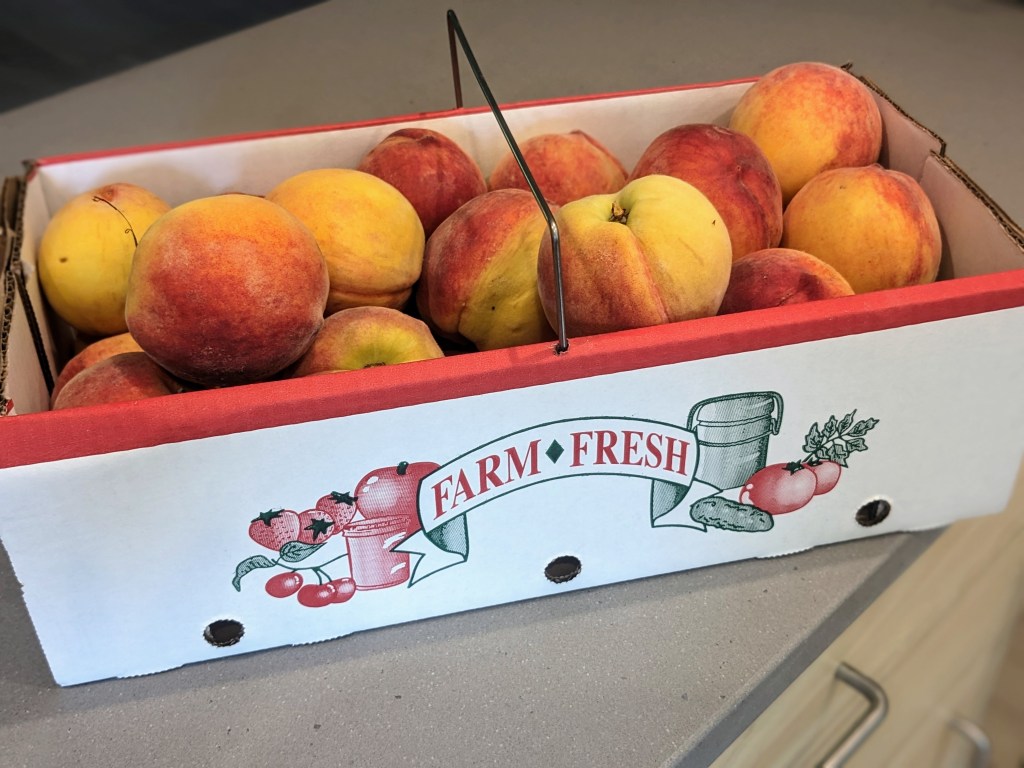
A peck of pickled peppers? Sounds pretty tasty, but I think I’d prefer a peck of perfect peaches instead.

Red Haven peaches, to be precise. 


For a brief window every summer, Lynd Fruit Farm in Pataskala, Ohio, offers Red Haven peaches for sale. In a good year, Lynd sells peaches from its own orchard. But peach-growing is a delicate business, and this year Lynd lost 90 percent of its peaches due to an extra harsh cold snap in December. They source from other farms when necessary, and this year (2023) most of the Red Havens came from Pennsylvania. 


Red Haven peaches are a freestone variety, meaning that the peach pit separates easily from the flesh when the peach is ripe. I’ve mistakenly purchased clingstone peaches for canning in the past, and there is nothing more frustrating than losing half of your peach to a clingy pit! 

So Red Havens are perfect for summertime canning. They are creamy and yellow with just the right amount of sweetness…. When you find yourself craving a little taste of summer during the dark of winter, just pull out a jar of delicious peaches.


There are many different methods for canning peaches. Most involve cooking a light, medium, or heavy sugar syrup to pour over the peaches. I’ve seen one recipe that topped off each jar of peaches with a glug of bourbon. But this year I used a unique method I learned about from one of my favorite people at school, our librarian.

I’ve mentioned Deanna before. She has very discerning taste, and not just in books. She’s kind of a foodie. We both enjoy local and home-made goods, and we’ve exchanged jams, pickles, relishes, and preserves for years. When we returned to school last August, Deanna gave me a jar of her peaches.

The method she used to can them was one I hadn’t heard of. She learned it from her mother, who learned it from a roommate in the 1940s. Deanna assured me that her method was “easy peasy” (maybe even “lazy”). Well, the truth is that canning ANYTHING is a bit of work, including these peaches. But I wanted to try her method for myself, so that’s what I did with this year’s peck of peaches.

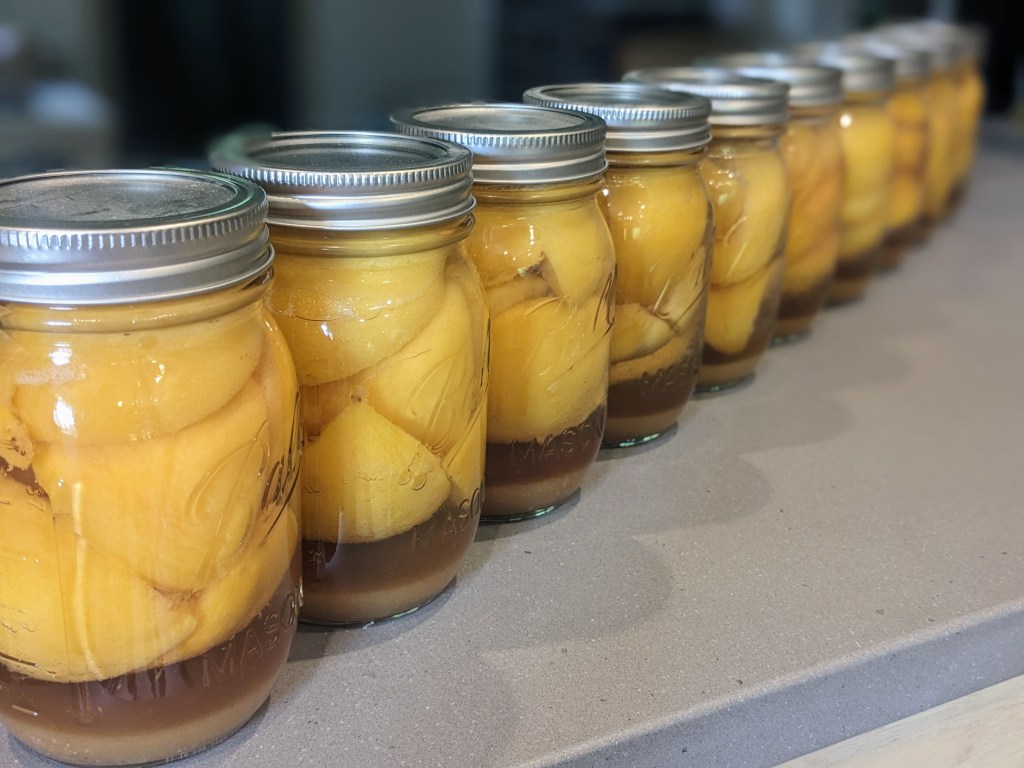
In short, the thing that makes these peaches “easy” is that you don’t create any kind of syrup to pour over the peaches before processing them. You just put sugar directly into each canning jar, add the prepared peaches, top them off with water, and process them. The sugar will dissolve on its own over the next few months, gradually enhancing the natural sweetness of the peaches.


While it might be easy to preserve the peaches, the hard part is the patience required until they’re ready to eat! The sugar will not fully dissolve until about November. That means the peaches should be ready just in time for a Thanksgiving brunch!


Deanna’s Canned Peaches

Ingredients:

A peck of peaches (or as many as you want to can; a peck will produce about 12-16 pint-size jars)
Granulated sugar
Water

Supplies:

Canning jars
Lids and rings
Canning pot for hot-water bath

Directions:

  1. Wash the peaches, cut them in half, remove the pits (freely!), and drop the peach halves in a pot of boiling water for about 30 seconds.
  2. Use a slotted spoon to remove the peach halves to a bowl of icy cold water. Let them sit for a few minutes, and the change in temperature will loosen the skins so that you can slide them right off the peaches.
  3. Ready for the easy part? Scoop 1/4 cup of sugar into each of your canning jars (or 1/2 cup sugar if you are using quart-size jars). Pack the jar with the prepared peach halves (or quarters, or whatever size you’d like your peaches), and then fill the jar with water. Leave about 1/2 inch of space at the top of the jar.
  4. Wipe the rims of each jar with a damp paper towel, apply the lids and rings, and process the jars in a boiling hot-water bath for the prescribed amount of time based on your altitude. The higher your altitude, the longer the processing time will be; it can range from 20 to 45 minutes.*
  5. When time is up, carefully lift the jars from the water bath. I put a towel on the countertop to protect it from the very hot jars as they cool. Allow the jars to sit for about 24 hours before you label them and tuck them away until November. 🙂

As the jars cool, you should hear some satisfying “pops” as the lids seal to the jars. After the jars have cooled, you can verify a proper seal by making sure the “button” in the center of each lid is sucked down tightly. If any jars did not seal correctly, just refrigerate them and eat those peaches sooner rather than later. 


*If you haven’t canned goods using a hot-water bath before, you might want to read or watch a more detailed tutorial first. There are so many good ones out there.

Once I got started with these peaches, I couldn’t stop! I went back to Lynd for more peaches, and made peach salsa and peach jam too. Not as “easy” as Deanna’s Canned Peaches, but definitely worth the effort.


While the peaches are a summertime favorite, Lynd is a worthwhile destination all year long. They offer a variety of u-pick fruits and vegetables, specialty treats and crafts from local vendors, community events with food trucks and music, and even tours for school groups. If you live anywhere nearby, I recommend getting on their email list to receive info and updates!

By the way—are you curious what a peck of peaches is, exactly? Maybe you already know. But I didn’t. So when I bought my peaches at Lynd’s, I asked the worker: What is a peck, anyway? She hemmed and hawed a little—it seems to be one of those things you just accept without really questioning. But then she said, “Well, I think it’s like 10 or 11 pounds, something like that.” 


Not bad! But in fact, I learned that in the U.S. a peck is a measure of dry volume, not weight. That means a peck of peaches would weigh a lot more than a peck of marshmallows! The term has been around since the 1300s, a vintage similar to its friend the bushel. (Four pecks equal one bushel.)

Maybe next time I go to Lynd I’ll bag a bushel of beautiful beets. But only if they’re out of pickled peppers or perfect peaches.


Source:
Britannica, The Editors of Encyclopaedia. “peck”. Encyclopedia Britannica, 29 Apr. 2004, https://www.britannica.com/science/peck. Accessed 14 August 2023.

Explore

Lost in Translation on the Rheinsteig

A few years ago, my husband and I hiked the West Highland Way in Scotland. In addition to completing the 95-mile trail, we also explored Glasgow and Edinburgh. The hike was rugged, remote, and rainy, but we loved the beauty and physical challenge of the adventure, bookended with a few days of city sightseeing. We knew we wanted to do another trip like it in the future.

So in June 2023, we traveled to Germany. We booked with the same company we’d used in Scotland, one that arranges inn-to-inn hikes for people, negotiating the daily accommodations and ferrying luggage from one stop to the next. Each day while we hiked, we had to carry only water, food, and our first aid kits.

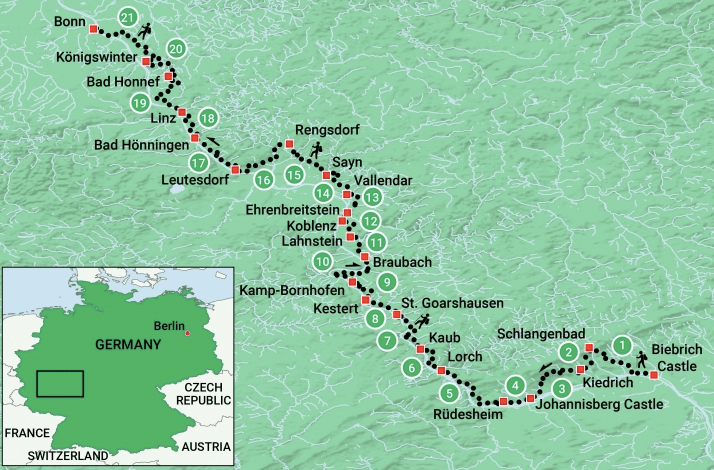
We chose to hike part of Germany’s Rheinsteig, a 320-km (200-mile) trail along the eastern banks of the Rhine River from Bonn to Wiesbaden. Germans love to hike, and the Rheinsteig is billed as one of Germany’s top trails. The trail is divided into 21 stages, which people explore in all different combinations of through-hikes and day-hikes.

Source


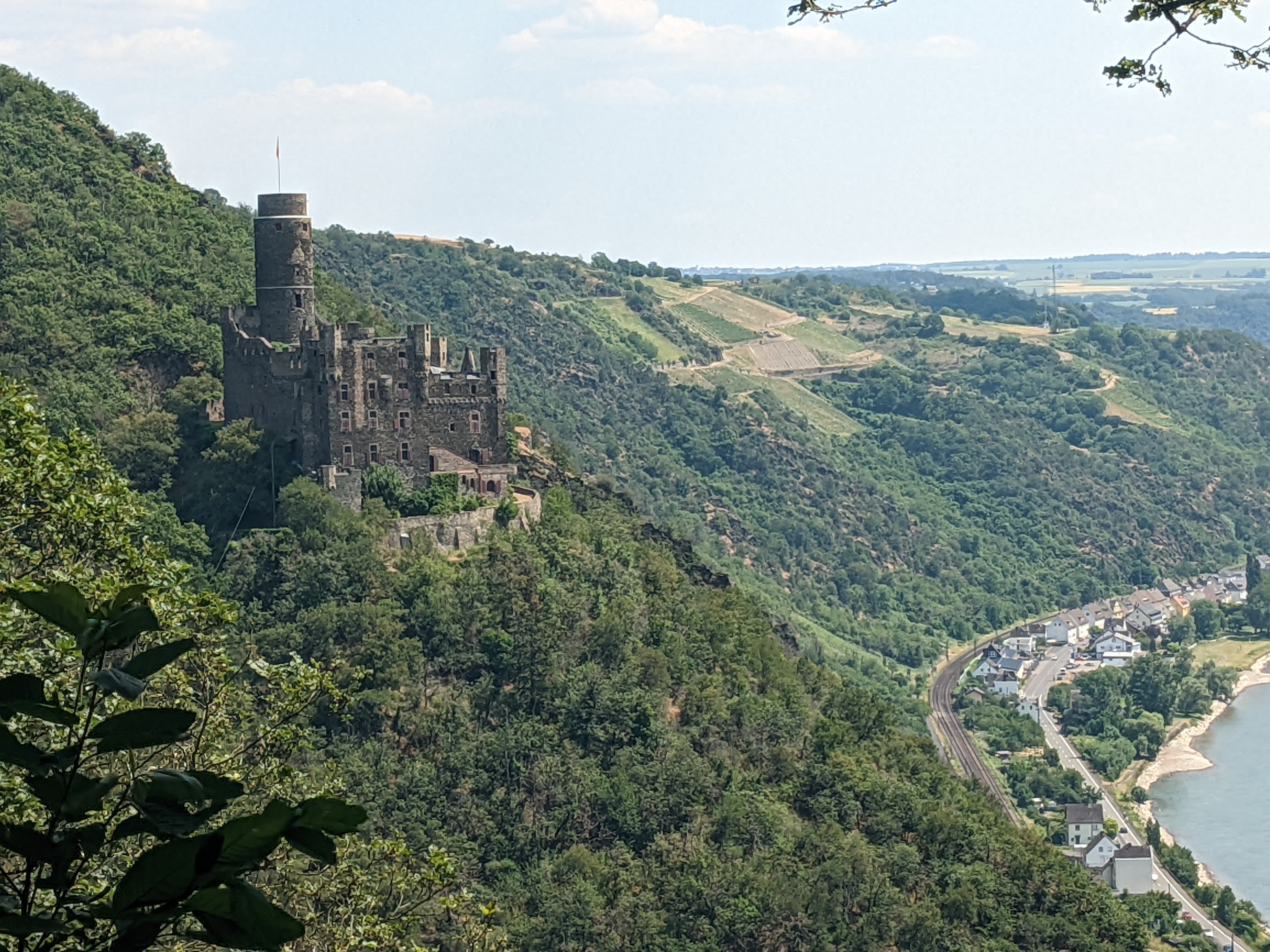
The portion we hiked was a 75-mile stretch of the Upper Middle Rhine Valley between Koblenz and Rüdesheim, a section that has been designated a UNESCO World Heritage Site because of the density of historic castles nestled along the way. We completed the hike over six days, so we averaged about 12 miles per day–pretty similar to the hiking we did in Scotland. 

The Rheinsteig trail blaze


Physically, I felt ready for the hike. My cardio was good, my strength was good, and I enjoy rucking, so carrying my daypack would be very doable. I also felt well-prepared mentally. The first hiking day in Scotland had just about finished me off, so I knew that I should expect the first day on the Rheinsteig to be hard, and maybe not even all that fun at times. But I knew I could do it—because I’d done something like it before. 

And it was indeed a tough day. Very tough. Thirteen miles of hiking up and down, up and down, up and down the hillsides flanking the Rhine. (Wouldn’t you expect a trail along a river to be nice and level?)

In the evenings, we nursed our sore feet, ankles, knees, and backs. Why did this hike feel so much harder than the West Highland Way? I mean, that one had some hills too. Was it just that we were older and creakier? Or were we not as prepared as we had thought we were? Or maybe our overall fondness for Scotland was gilding our memories of how difficult the hike actually had been.

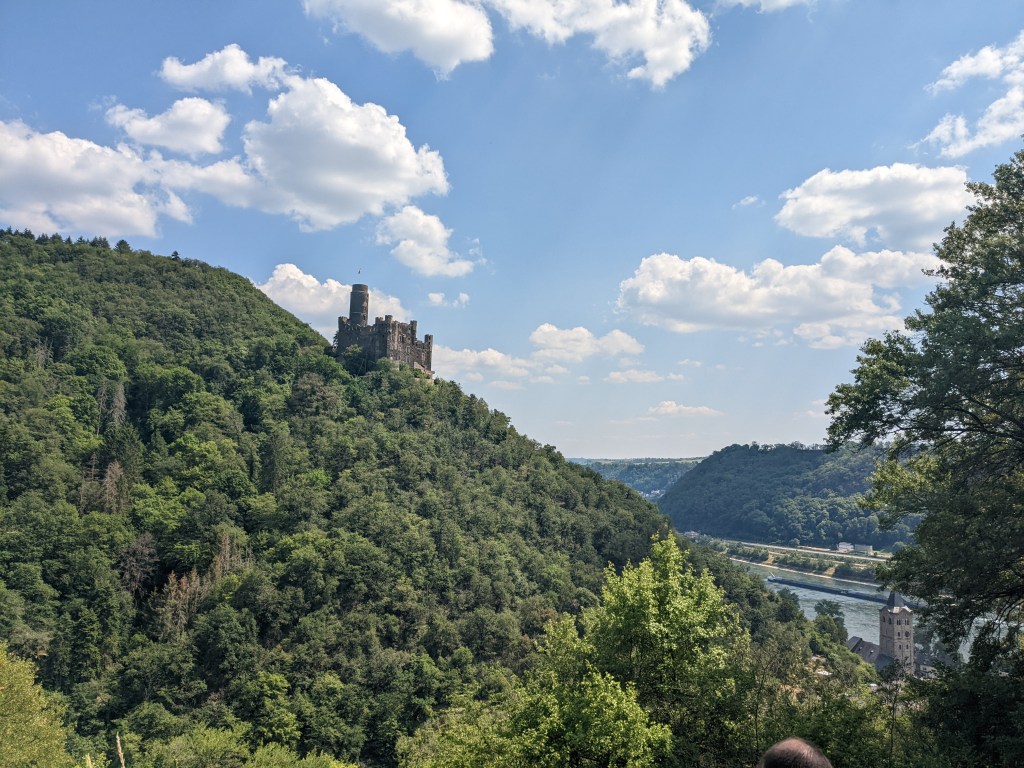
A view of Burg Maus near St. Goarshausen


Every day, the trail followed a similar trajectory. Lots of uphill, lots of downhill, with incredible views of the meandering river, majestic castles, and storybook half-timbered villages as a reward. Not to mention the beautifully manicured rows of grapevines striping the hillsides. For being one of Germany’s top trails, there were a surprising number of days where we encountered very few other people. It was peaceful, beautiful, and challenging!

Common sights: Castles, vineyards, and villages


As I lay on the bed the final evening with my feet propped up, enjoying a well-earned sense of accomplishment at having reached our finish line in Rüdesheim, it occurred to me: Why is the trail called the Rheinsteig, anyway? What does “steig” mean?


Oh. That explained a lot.

And had I studied the elevation profiles more closely ahead of time rather than assuming that a hike along the river would be nice and level:


Yeah. It was a Rhine Climb all right. But you know, living in central Ohio where the topography is extremely flat, I really don’t have a very good frame of reference for translating elevation profiles. I don’t think seeing those maps ahead of time would have put us off from the Rheinsteig, though we probably wouldn’t have been quite as surprised to be so sore and tired each night!


Thank goodness we always had a hearty breakfast awaiting us at our inns to fuel our daily hikes. One of my favorite things about traveling is experiencing different foods and dining customs. We tried a little bit of everything in Germany. Schnitzel and spaetzle. Sauerkraut and sauerbraten. Pretzels and pilsners. Now for breakfast, it would be hard to top the Scottish fry-up, but Germany’s Frühstück made a respectable showing. The typical spread leaned more toward the savory than sweet, with a range of deli meats and cheeses, smoked salmon, boiled eggs, sliced fruits and vegetables. Muesli and yogurt, of course. And bread—lots of bread.

We had an interesting breakfast experience following our first day of hiking. We hiked 13 miles from Koblenz to Braubach, then took a short train ride to the adjacent town for that evening’s lodgings. When we finally arrived at our inn, sweaty and exhausted, the kindly innkeeper sat down with us to get us checked in, then pulled out a menu sheet to mark our preferences for the next morning’s breakfast. 

“Would you like coffee or tea?” Coffee, please.
“Eggs?” Ja, bitte. 
“You like cheese and meat?” Of course!

And then there was an item he struggled to translate for us. “And how many…” He thought for a moment. “Ach, there is no word for it in English! I could say it in French, but…. You’ll be hungry in the morning? I’ll give you six. You can pack up any extras to take with you on your hike.” 

We thanked him and headed off to our room for a much-needed night of sleep. 

But I couldn’t stop imagining what sort of delicacy awaited us in the morning. I love trying new foods! And I really love breakfast. What could this untranslatable specialty be? I drifted off to sleep with my thoughts spinning. What could it be? Some kind of croquette or quiche? Untranslatable! This is going to be awesome!

Morning came, and we got dressed and headed to the breakfast room to eat. We settled ourselves at a table, pouring our coffee and cracking into our soft-boiled eggs. I was most excited, though, over the mysterious treat that was coming our way. The innkeeper greeted us, chatted with the other guests, refilled supplies as needed. But it didn’t look like he was gearing up to cook anything special. There was no new activity coming from the kitchen. Had he forgotten our six whatchamacallits? 

I looked at my husband in concern and whispered, “But where’s the thing? Is he going to make something? Should we ask?”

My husband nodded toward the far end of our table. “I think those are the things.”

It was a basket of bread rolls. Six of them.

Bread rolls. Bread rolls!?!? 

Bread rolls—like individual baguettes—are a staple of every German breakfast. They had featured prominently at the breakfast buffet at our first hotel, too. And the bread rolls are good, hearty and crusty, often studded with nuts and seeds. Spread with a little butter and jam, they’re delicious. But an untranslatable delicacy? My imagination had gotten the best of me on that one. 

The bread spread at a typical breakfast buffet


Learning new words is another of the great things about travel, but German was hard for me. I felt much more confident testing out my language skills when I traveled to Spain and Italy, having studied Spanish in high school and college. I could get by in those countries, but the little German I tried to learn just wouldn’t seem to stick. 

Luckily, Google Translate was there to save the day. We picked up fun words like “Geschmack!” (tasty!) and essential words like “Insektenschutz” (insect repellent). We learned many travel-related words (platform, arrival, departure, direction). But we never did learn the name of our breakfast “treat.” I would love to plug the innkeeper’s special word into Google Translate and see what pops up, but I never saw the word in print, and I can’t remember what it sounded like when he said it.

Looks like it will have to remain lost in translation.