Explore

Lost in Translation on the Rheinsteig

A few years ago, my husband and I hiked the West Highland Way in Scotland. In addition to completing the 95-mile trail, we also explored Glasgow and Edinburgh. The hike was rugged, remote, and rainy, but we loved the beauty and physical challenge of the adventure, bookended with a few days of city sightseeing. We knew we wanted to do another trip like it in the future.

So in June 2023, we traveled to Germany. We booked with the same company we’d used in Scotland, one that arranges inn-to-inn hikes for people, negotiating the daily accommodations and ferrying luggage from one stop to the next. Each day while we hiked, we had to carry only water, food, and our first aid kits.

We chose to hike part of Germany’s Rheinsteig, a 320-km (200-mile) trail along the eastern banks of the Rhine River from Bonn to Wiesbaden. Germans love to hike, and the Rheinsteig is billed as one of Germany’s top trails. The trail is divided into 21 stages, which people explore in all different combinations of through-hikes and day-hikes.
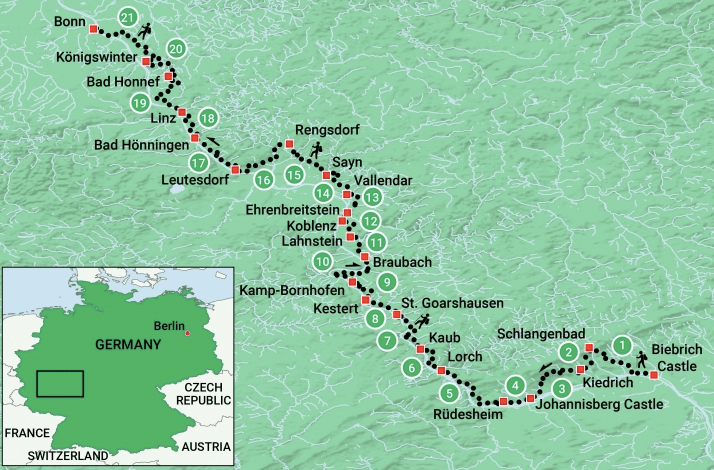
Source


The portion we hiked was a 75-mile stretch of the Upper Middle Rhine Valley between Koblenz and Rüdesheim, a section that has been designated a UNESCO World Heritage Site because of the density of historic castles nestled along the way. We completed the hike over six days, so we averaged about 12 miles per day–pretty similar to the hiking we did in Scotland. 

The Rheinsteig trail blaze


Physically, I felt ready for the hike. My cardio was good, my strength was good, and I enjoy rucking, so carrying my daypack would be very doable. I also felt well-prepared mentally. The first hiking day in Scotland had just about finished me off, so I knew that I should expect the first day on the Rheinsteig to be hard, and maybe not even all that fun at times. But I knew I could do it—because I’d done something like it before. 

And it was indeed a tough day. Very tough. Thirteen miles of hiking up and down, up and down, up and down the hillsides flanking the Rhine. (Wouldn’t you expect a trail along a river to be nice and level?)

In the evenings, we nursed our sore feet, ankles, knees, and backs. Why did this hike feel so much harder than the West Highland Way? I mean, that one had some hills too. Was it just that we were older and creakier? Or were we not as prepared as we had thought we were? Or maybe our overall fondness for Scotland was gilding our memories of how difficult the hike actually had been.
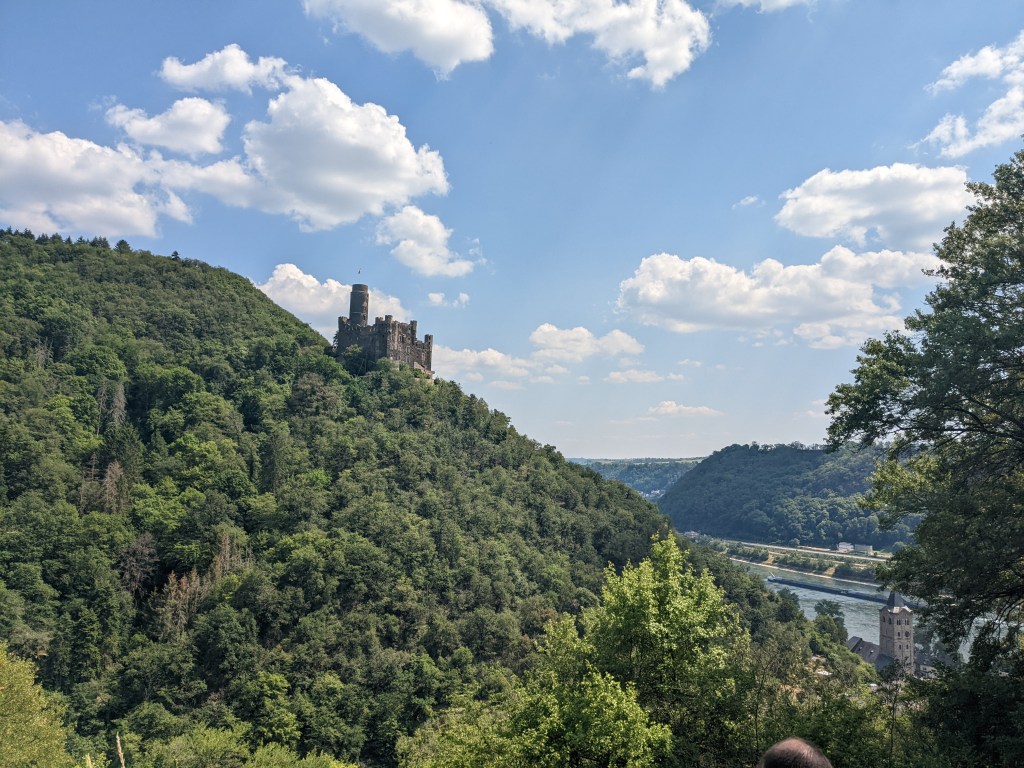
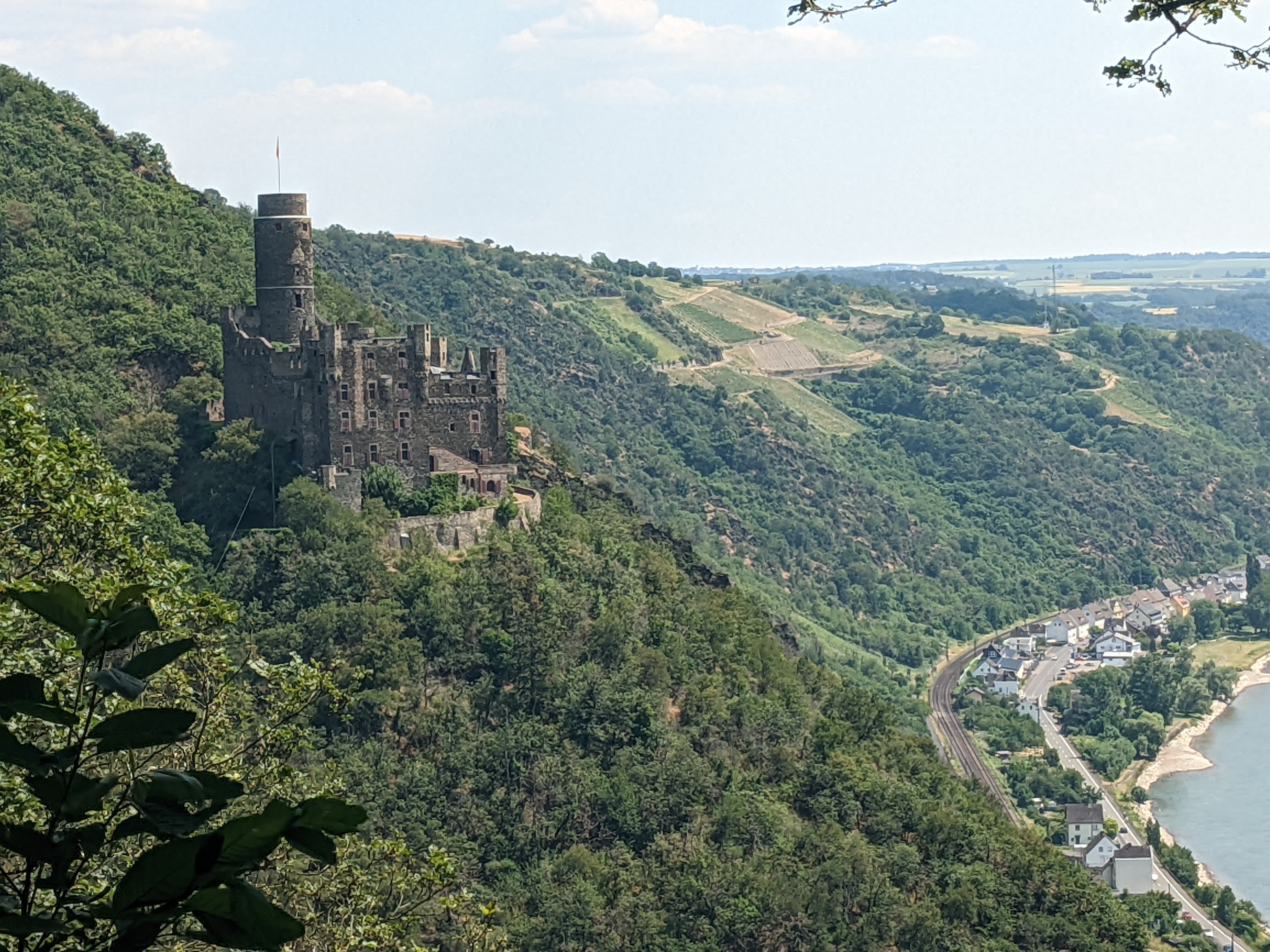
A view of Burg Maus near St. Goarshausen


Every day, the trail followed a similar trajectory. Lots of uphill, lots of downhill, with incredible views of the meandering river, majestic castles, and storybook half-timbered villages as a reward. Not to mention the beautifully manicured rows of grapevines striping the hillsides. For being one of Germany’s top trails, there were a surprising number of days where we encountered very few other people. It was peaceful, beautiful, and challenging!

Common sights: Castles, vineyards, and villages


As I lay on the bed the final evening with my feet propped up, enjoying a well-earned sense of accomplishment at having reached our finish line in Rüdesheim, it occurred to me: Why is the trail called the Rheinsteig, anyway? What does “steig” mean?


Oh. That explained a lot.

And had I studied the elevation profiles more closely ahead of time rather than assuming that a hike along the river would be nice and level:


Yeah. It was a Rhine Climb all right. But you know, living in central Ohio where the topography is extremely flat, I really don’t have a very good frame of reference for translating elevation profiles. I don’t think seeing those maps ahead of time would have put us off from the Rheinsteig, though we probably wouldn’t have been quite as surprised to be so sore and tired each night!


Thank goodness we always had a hearty breakfast awaiting us at our inns to fuel our daily hikes. One of my favorite things about traveling is experiencing different foods and dining customs. We tried a little bit of everything in Germany. Schnitzel and spaetzle. Sauerkraut and sauerbraten. Pretzels and pilsners. Now for breakfast, it would be hard to top the Scottish fry-up, but Germany’s Frühstück made a respectable showing. The typical spread leaned more toward the savory than sweet, with a range of deli meats and cheeses, smoked salmon, boiled eggs, sliced fruits and vegetables. Muesli and yogurt, of course. And bread—lots of bread.

We had an interesting breakfast experience following our first day of hiking. We hiked 13 miles from Koblenz to Braubach, then took a short train ride to the adjacent town for that evening’s lodgings. When we finally arrived at our inn, sweaty and exhausted, the kindly innkeeper sat down with us to get us checked in, then pulled out a menu sheet to mark our preferences for the next morning’s breakfast. 

“Would you like coffee or tea?” Coffee, please.
“Eggs?” Ja, bitte. 
“You like cheese and meat?” Of course!

And then there was an item he struggled to translate for us. “And how many…” He thought for a moment. “Ach, there is no word for it in English! I could say it in French, but…. You’ll be hungry in the morning? I’ll give you six. You can pack up any extras to take with you on your hike.” 

We thanked him and headed off to our room for a much-needed night of sleep. 

But I couldn’t stop imagining what sort of delicacy awaited us in the morning. I love trying new foods! And I really love breakfast. What could this untranslatable specialty be? I drifted off to sleep with my thoughts spinning. What could it be? Some kind of croquette or quiche? Untranslatable! This is going to be awesome!

Morning came, and we got dressed and headed to the breakfast room to eat. We settled ourselves at a table, pouring our coffee and cracking into our soft-boiled eggs. I was most excited, though, over the mysterious treat that was coming our way. The innkeeper greeted us, chatted with the other guests, refilled supplies as needed. But it didn’t look like he was gearing up to cook anything special. There was no new activity coming from the kitchen. Had he forgotten our six whatchamacallits? 

I looked at my husband in concern and whispered, “But where’s the thing? Is he going to make something? Should we ask?”

My husband nodded toward the far end of our table. “I think those are the things.”

It was a basket of bread rolls. Six of them.

Bread rolls. Bread rolls!?!? 

Bread rolls—like individual baguettes—are a staple of every German breakfast. They had featured prominently at the breakfast buffet at our first hotel, too. And the bread rolls are good, hearty and crusty, often studded with nuts and seeds. Spread with a little butter and jam, they’re delicious. But an untranslatable delicacy? My imagination had gotten the best of me on that one. 

The bread spread at a typical breakfast buffet


Learning new words is another of the great things about travel, but German was hard for me. I felt much more confident testing out my language skills when I traveled to Spain and Italy, having studied Spanish in high school and college. I could get by in those countries, but the little German I tried to learn just wouldn’t seem to stick. 

Luckily, Google Translate was there to save the day. We picked up fun words like “Geschmack!” (tasty!) and essential words like “Insektenschutz” (insect repellent). We learned many travel-related words (platform, arrival, departure, direction). But we never did learn the name of our breakfast “treat.” I would love to plug the innkeeper’s special word into Google Translate and see what pops up, but I never saw the word in print, and I can’t remember what it sounded like when he said it.

Looks like it will have to remain lost in translation.
Explore

Let There Be Light Therapy

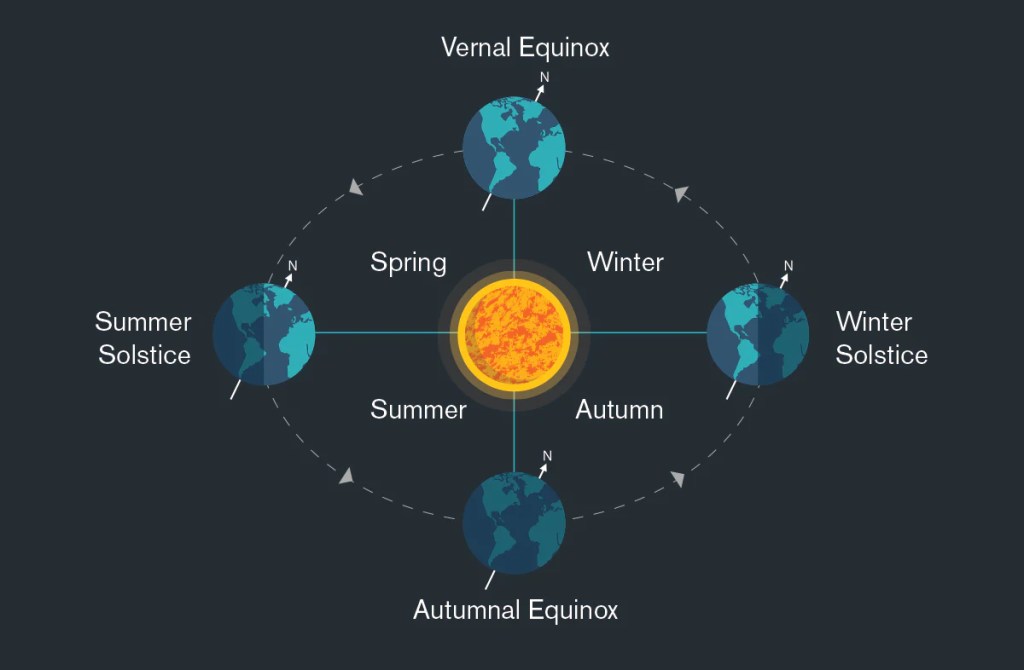
I love sunshine, yet the summer solstice in June is always kind of a bittersweet day for me. The solstice marks the longest day of sunlight hours in the northern hemisphere, and people all over the world celebrate this beautiful event. But after that day, even if I don’t notice it right away, I know that the daylight hours are shrinking. The long, dark days of winter are creeping closer.

During the summer solstice, the northern hemisphere is tilted toward the sun. More sunlight! (Image source)

When I was younger, the daylight/darkness ratio didn’t seem to bother me very much. I don’t remember thinking anything of it as a kid, or even as a young adult. It could be kind of inconvenient when it got dark outside at 5:00 PM, but it didn’t seem to affect my mood.

But for the past several years, as a 40-something adult, I have begun to struggle. I was familiar with the concept of seasonal affective disorder (SAD), what I’d always thought of as the “winter blues,” but for some reason it feels like there’s been a shift from concept to reality for me. This year more than any other, I felt the late afternoon darkness pressing down on me like a weight. I felt tired, grouchy, and rather disproportionately blue. 

It’s not known for certain what causes the symptoms of SAD, but the most likely culprit seems to be the interplay between sunlight and your circadian rhythm, serotonin levels, and melatonin levels. Reduced sunlight during the winter months can throw off your circadian rhythm (internal 24-hour clock), lower serotonin levels (a hormone which impacts mood, emotions, and appetite), and disrupt melatonin levels (a key hormone in regulating sleep patterns and mood). 

What should I do? I tried to channel my hygge. I thought, Goddammit. The Scandinavians put up with way more cold and dark than this. Suck it up. Light a candle and get cozy already. 

I lit four candles. 

But I still felt glum. 

When I told my sister-in-law about how I was struggling, she said, “You know, you can borrow a light therapy lamp from the library. I wonder if that might help?”

We have the most illuminating conversations.

What Is Light Therapy?

Light therapy, or phototherapy, has been shown to be a very effective treatment for seasonal depression. Many people notice the benefits in as little as two to four days. Light therapy boxes work by mimicking the powerful light we absorb from the sun during other times of year, delivering messages to our brains to help regulate certain hormones.

People use light therapy for more than just SAD. Different wavelengths of light can be used to treat things like acne, jaundice, and joint pain; UV light therapy can benefit conditions like eczema and psoriasis. The light lamps that are used for SAD filter out UV light and are not the same as other phototherapy treatments, so keep that in mind if you decide to try one. 

Why Does Light Therapy Work?

Hormones are a fascinating topic all on their own, and wow are they powerful. Hormones are chemical messengers that regulate pretty much every bodily system and function, from sleep to mood to digestion to reproduction. Light therapy sends signals to help regulate in particular the hormones melatonin and serotonin.

  • We produce melatonin during our hours of darkness each night (which is why your bedroom should be dark dark dark), and stop upon exposure to bright light in the morning. Cutting off melatonin production in the morning is important for getting it to resume at a reasonable time in the evening, heading off insomnia and promoting better sleep. 
  • Conversely, sunlight stimulates the brain’s production of serotonin, which plays a huge role in regulating mood, as well as digestion and appetite. 

It makes sense that disruption of these hormones would have a dramatic ripple effect.

Time to Get Lit

Since I do not have any of the conditions that would exclude me (bipolar disorder, macular degeneration, lupus, diabetes, etc.) from using a light therapy box, I stopped by the library and checked one out for two weeks. 

The instructions that came with the TaoTronics Light Therapy Lamp were pretty skimpy, so I did some reading about how to use the light most effectively. The recommendations:

  • Get a lamp that produces 10,000 lux of UV-free light
  • Use the lamp within the first hour of waking up
  • Place the lamp about 16-24 inches from your face
  • Bask in the light for about 20-30 minutes per day

(Lux is a unit of illumination. With lighting, you often see the terms “lumens” and “lux” to quantify the intensity of the light. Lumens is a fixed measurement of how much total light a source emits, in all directions. Lux measures how much light from that source falls on a given surface, so lux is higher if you are closer to the source or the center of its beam, and lower if you move farther away from the light source.)

Lux chart; Lumens vs. lux

You don’t want to look directly at the light, but you do want to make sure your eyes are open so that the light gets in there. There are special receptors in your retinas that communicate with the brain about melatonin and serotonin production. The light should be positioned at or a little above eye level, to mimic the angle of the sun toward your face. It seems that some people who report little benefit from the light simply might not have it at the most effective height and/or distance.

The Big Question: Did It Work?

I used the therapy light every morning for two weeks. Thirty minutes while I had my breakfast and coffee worked out to be perfect timing. 

  • I felt like it helped me “wake up” in the morning and feel more alert. On days when my alarm jolts me from sleep rather than waking up on my own, I usually find it very hard to shake off the slumber. On those mornings, the light really helped.
  • I slept soundly at night. Since I get up so early for school, I am usually tired pretty early at night as well, and that didn’t change. But I noticed that I woke up less frequently throughout the night and seemed to sleep more deeply.
  • I noticed a subtle boost in my mood. I felt more cheerful and patient. I still got tired and cranky sometimes (who doesn’t?), but overall I felt pretty good.

Since I didn’t check out the light box from the library until early January, my only regret is that I hadn’t “seen the light” and started using one earlier in the season. Next year I will.

So the big takeaway: If you can’t spend your winter in the sunny tropics, a good option might be to bring the sun to you, with a light therapy box. 


References and Further Reading

“Benefits of Sunlight: A Bright Spot for Human Health”

“Seasonal Affective Disorder (SAD)”

“Seasonal Affective Disorder Treatment: Choosing a Light Box”

“Sunlight, Serotonin, and Your Sleep Cycle”

“Will a SAD Sun Lamp Actually Make You Happy?”

Explore

Passport, Please

Here’s a riddle for you: I have two passports, but I do not have dual citizenship, and I’m not a secret agent. 

Can you figure it out? Give up?

Well, one of my passports gets me in and out of the country, while my other passport is for the national parks!

Our national parks are an absolute treasure. They preserve an incredible diversity of landscapes, ecosystems, and history; I’m continually amazed by the uniqueness of the parks I visit. Currently there are 63 national parks, but they continue to add new ones to the list over time. Like in December 2020, when West Virginia’s New River Gorge was upgraded from “national river” to “national park.” So far I’ve been to 21 of the parks, which means I still have a pleasantly long way to go to reach my goal of someday visiting all of them.

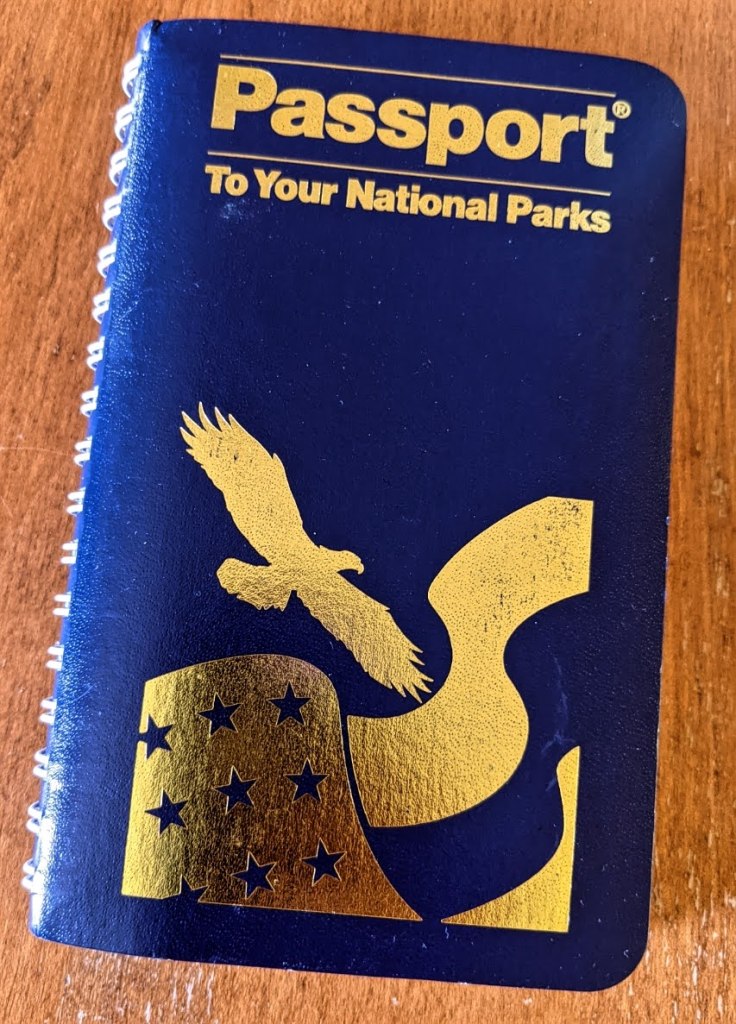
In addition to the photos, t-shirts, and coffee mugs I’ve accumulated as souvenirs of my parks adventures, I also have a collection of “passport” stamps. The National Park Service created a passport book that visitors can use to document their travels.

It divides the country into nine geographical regions; each section of the book features a map and list of the national sites within that region, a bit of background information on the region, and a set of blank pages to use for stickers and cancellation stamps.

Getting your passport stamped is such a fun way to anchor and commemorate a visit to a new park.

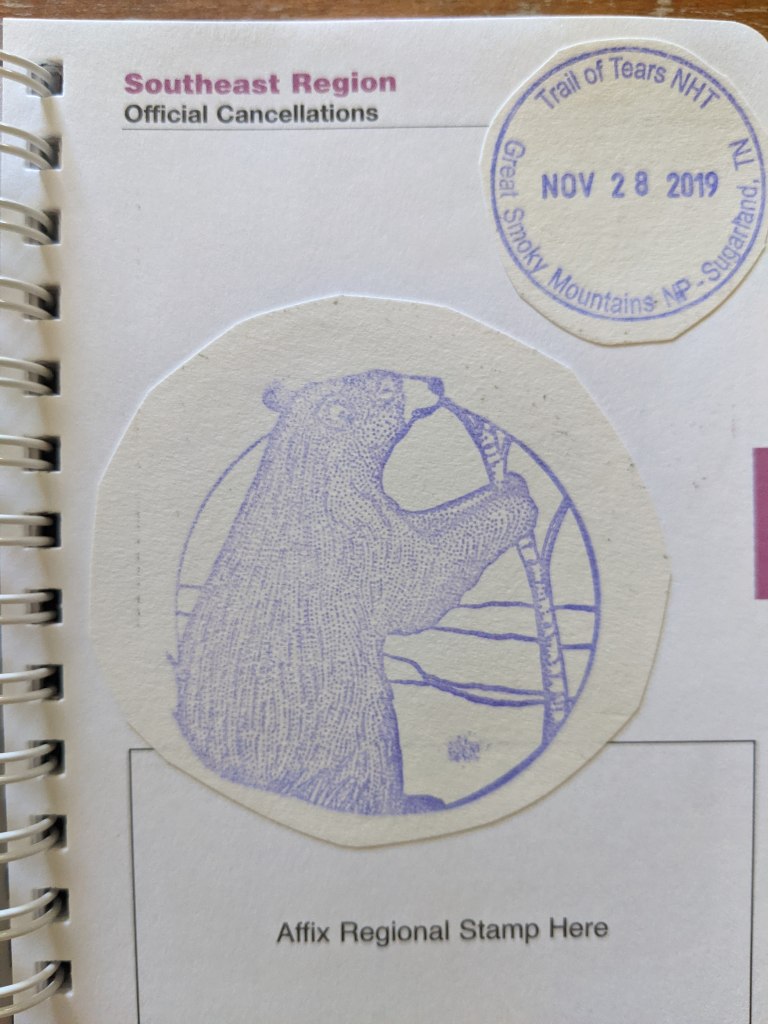
So how’s it work? Every park has a station, typically in the visitor’s center, housing an inkpad and a cancellation stamp featuring the location and current date. Sometimes there is a bonus stamp, maybe a black bear if you are in the Great Smoky Mountains . . .

. . . or a bathhouse if you are visiting Hot Springs.

Turn to the correct section of your book, stamp the page, and voilà. (And if you ever forget to bring your book with you, just stamp on a loose scrap of paper and add it to your book later.)

It is not only at national parks, though, where you can stamp your passport. There are more than 400 areas managed by the National Park Service, from national historical sites and battlefields, to national monuments and memorials, to national forests and lakeshores. . . . If it has the word “National” in front of it, there is a passport stamp to be had. 

And sometimes, you have to be tenacious and creative if you want your cancellation stamp.

In June 2021, I visited Yosemite National Park with my husband, sister, and niece. Yosemite is huge and has several distinct regions within it, featuring giant sequoias, tumbling waterfalls, pristine alpine lakes. Not to mention the iconic edifices of El Capitán and Half Dome, of course.

There are three visitor’s centers—at Wawona, Yosemite Valley, and Tuolumne Meadows—and each has its own cancellation stamp. Obviously, we wanted to stamp our passports at all of them. The trouble came when we drove out to Tuolumne Meadows. (By the way, it is pronounced “too-ALL-uh-me.” I had to google that.) It is a long drive to the meadows from Yosemite Valley, but it is breathtaking. Meandering creeks, granite domes, asters and sedge and pines. During summer 2021 the pandemic was still going strong, and that meant that throughout Yosemite, some park amenities remained closed. We hiked around and explored Tuolumne, but when it came time to stop by the visitor’s center before our drive back, it was closed, and there was no sign of an outdoor stamping station. 

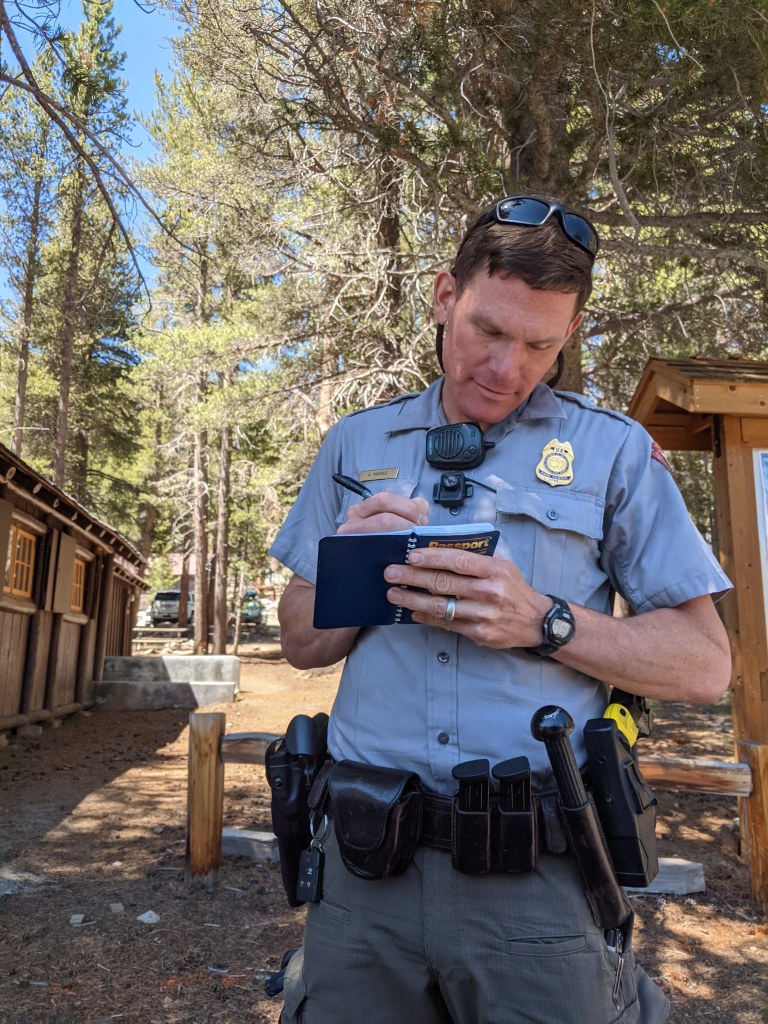
Not cool. We had driven through the park for TWO HOURS, yes to explore the beautiful sub-alpine lakes and meadows, but also . . . to get a stamp. As we trolled around looking for a makeshift stamping station, we spotted a park ranger. We flagged him down and asked, with the merest hint of desperation, if he knew where to find the passport stamp. He did not. But when my sister asked him if HE would draw a stamp in our passport books for us, he didn’t hesitate. He whipped out a pen and cheerfully obliged. It is easily my favorite stamp so far.

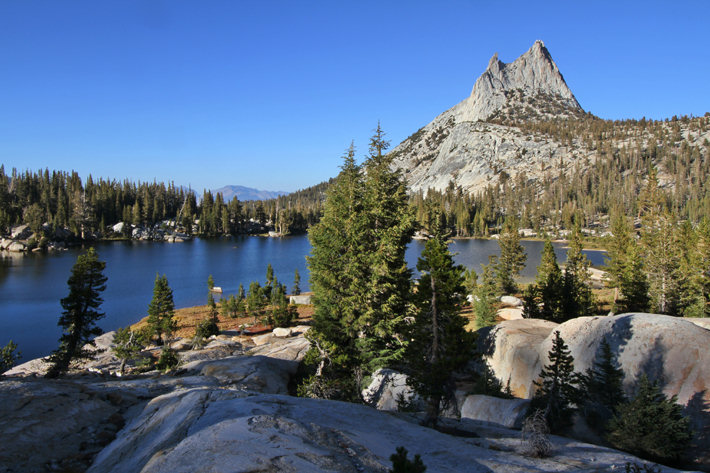
It’s Cathedral Peak!
Cathedral Peak (Source: yosemitehikes.com)

The passport books are a bit of a rabbit hole. There are sheets of stickers you can purchase, a different collection each year, which highlight various sites in each of the geographical regions. These are neat, but I wish I could purchase the regional stickers a-la-carte, because I wind up with a lot of stickers I don’t need. These days I mostly just stick with the cancellation stamps.

I already had my work cut out for me with the national parks passport book. But then for Christmas, my sister got me a passport book for Ohio’s 75 state parks. I didn’t know such a thing existed!

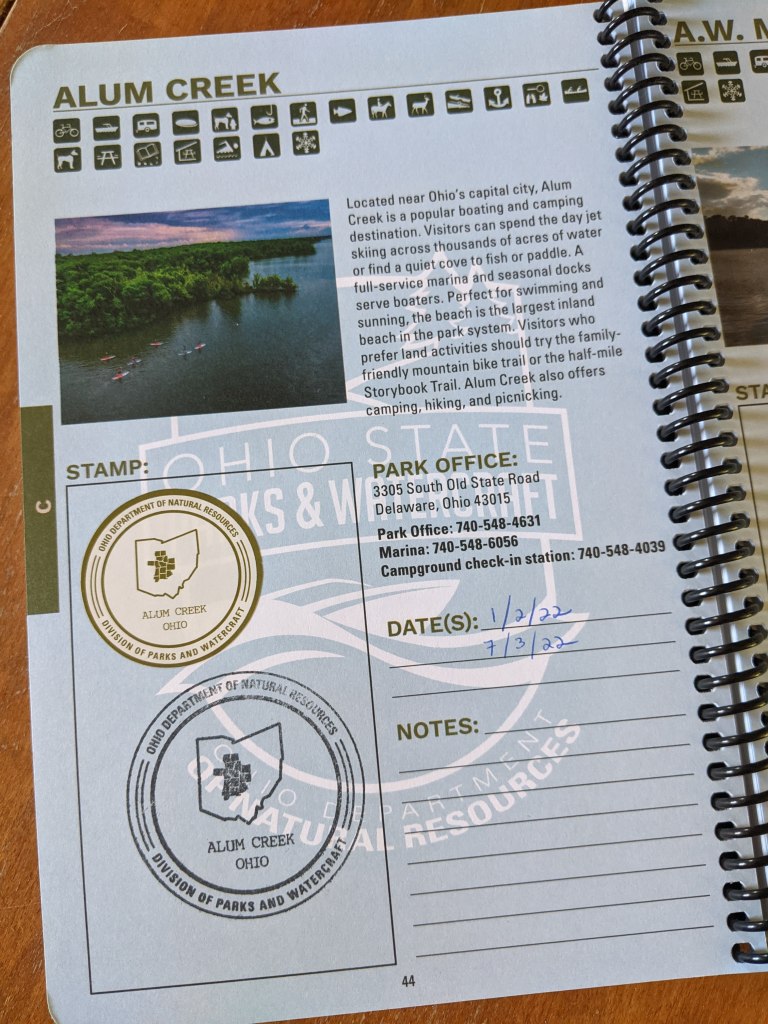
This passport book includes a set of stickers that you can use to document each park as you visit it, in case you are not able to find the official stamp while you are there. Alum Creek is the park closest to where I live and where I earned my first official stamp.

So I guess that means I have not just two, but three, passports. I’d better pack my bags—I’ve got some traveling to do!