Explore

Marvels and Misnomers at Arches National Park

There are five national parks in Utah (the so-called “Mighty 5”): Arches, Bryce Canyon, Canyonlands, Capitol Reef, and Zion.

Utah’s Mighty 5 (Source: utah.com)

A few years ago my husband and I visited Zion and Bryce; this summer we traveled to Arches and Canyonlands.

Of the four Utah parks we’ve explored, there are some notable similarities. 

They are hot.
They are colorful.
They are rocky.
They are majestic.

Yet each has something unique that distinguishes it from the others.

Arches reveals its claim to fame right there in its name. It is a high-desert marvel of red rock cliffs, fins, buttes, monoliths, spires, and, well, more than 2,000 arches. One of the fun things about the park is discovering doppelgangers in the rock formations. Many of the rocks resemble others things; it’s kind of like seeing shapes in the clouds.

Some of the formations already have names, like:

Elephant Butte…

Elephant Butte

and Three Gossips.

Three Gossips

Can you tell what the next one is? It’s a little tougher. Scroll down to the bottom for the answer. 

?

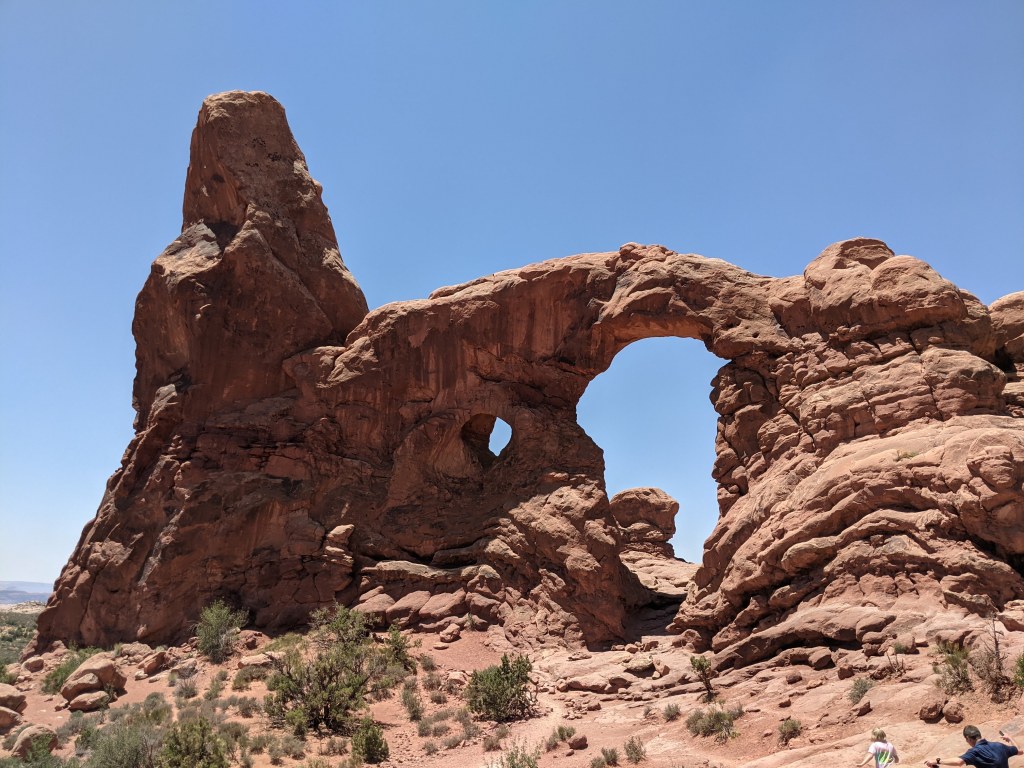
Many of the arches have names as well, like Double Arch and Turret Arch.

In general the names are appropriately descriptive, sometimes amusing or whimsical. There are a few arches, however, that didn’t seem to correspond to their names at all! Read on to find out more about three distinct Arches experiences, featuring plenty of marvels and a few misnomers.

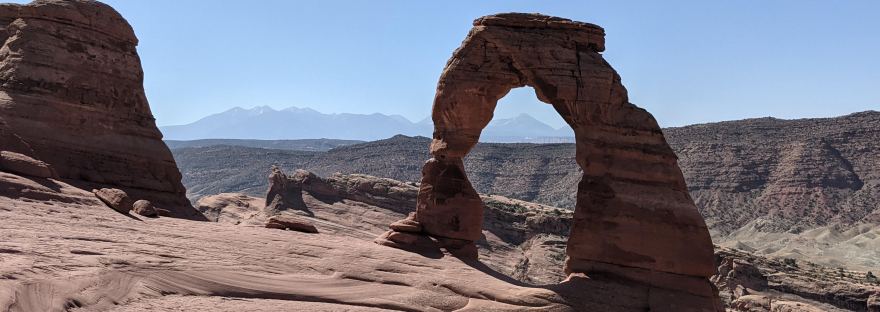
Delicate Arch

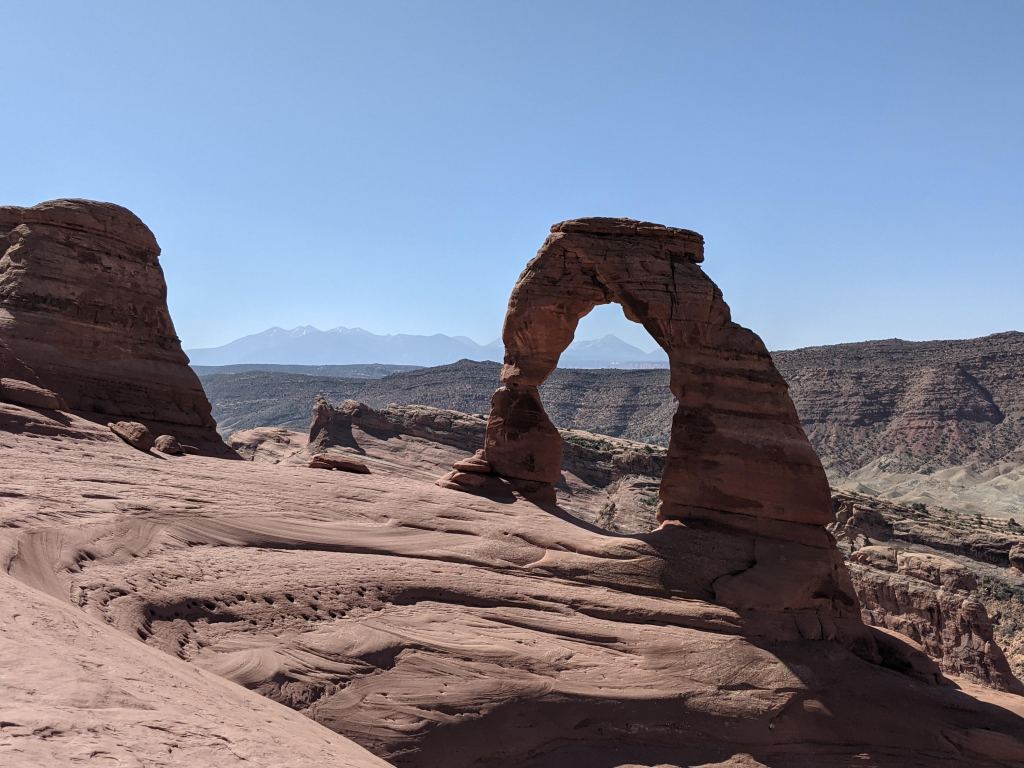
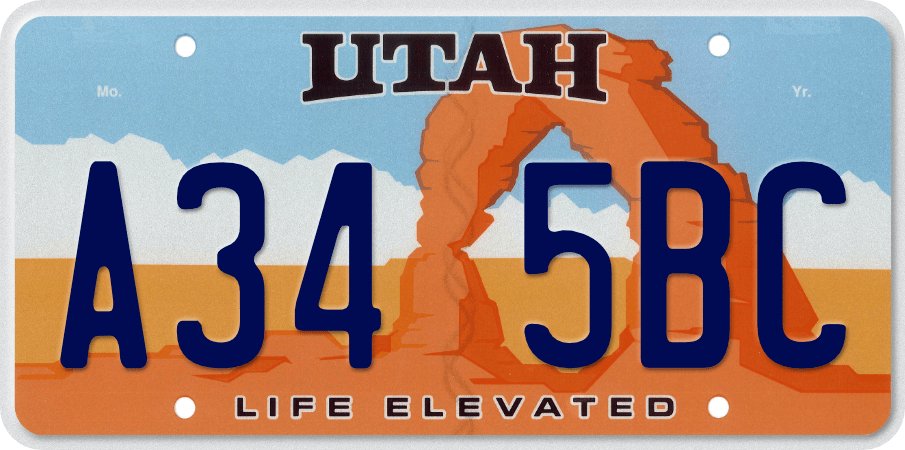
Delicate Arch is probably the most iconic sight at Arches. It is showcased on the Utah license plate, after all!
Delicate Arch
(Source: dmv.utah.gov)

There are two ways to experience the arch. One is by accessing the Upper or Lower Viewpoint trails, which are short and easy, with the tradeoff that you get only a very distant view of the arch. The other option is to hike the three-mile Delicate Arch trail, a moderately difficult trek up exposed slickrock hills and narrow windswept ledges.

The reward at the end of this trail is fantastic views of the arch, with the tradeoff that you will get buffeted by 30 mph gusts of wind. It is intense. At the top, children burrowed into their parents’ chests, trying to avoid the sand blasting their faces. The rest of us staggered around trying not to get blown off the cliff as we posed for pictures.

So windy!

I’m not sure how this arch got named “delicate,” because to me it seemed anything but. I guess it is a bit more slender than some of the arches, and it is perched rather delicately at the top of the bluff, but to withstand the relentless wind up there? Whew. Pretty stout. 

Landscape Arch

Perhaps they’d had a little too much sun on the day they were naming arches, because Landscape Arch is actually much more delicate and graceful than Delicate Arch. Spanning almost 300 feet, this ribbon of rock is the longest natural stone arch in the United States and one of the longest in the world.
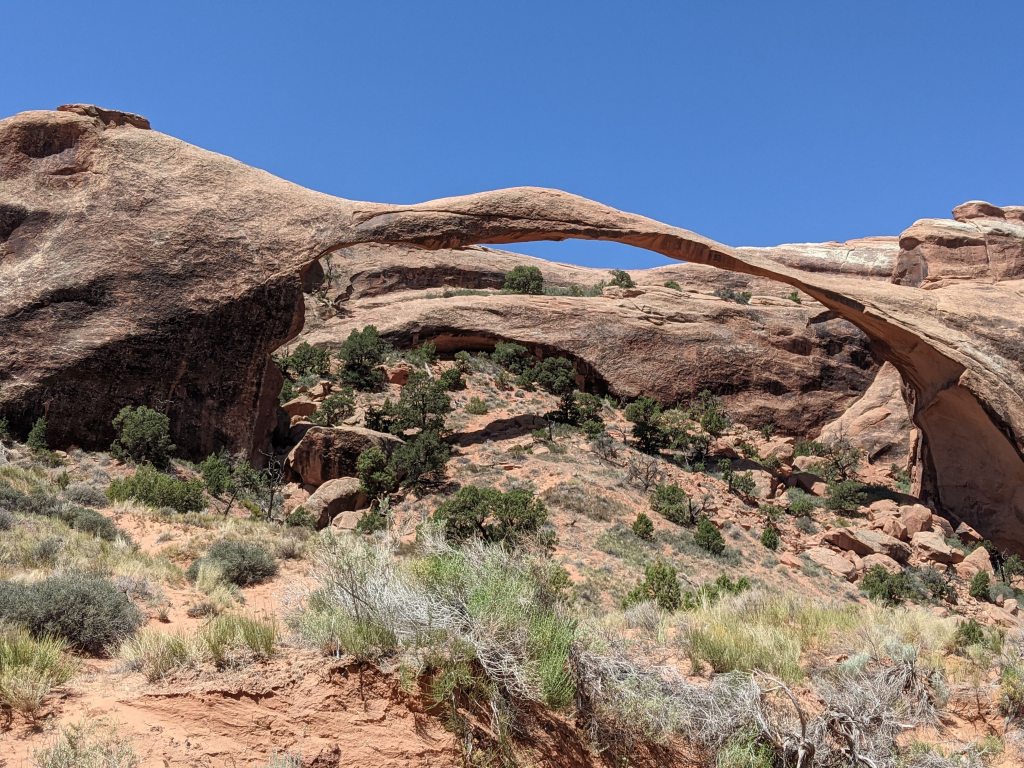
Landscape Arch

It wasn’t always quite so slender though. In the 1990s several slabs and chunks of rock broke off and fell from the arch, reducing its girth and necessitating closure of the trail passing underneath it. Landscape Arch is one of many in the Devils Garden section of the park, and you can enjoy its beauty by hiking a relatively easy one-mile (each way) trail. Short spurs nearby lead to a few other arches, like Pine Tree Arch. Which, aptly enough, features a tiny pine tree beneath it. 

If we someday return to Arches, I would like to explore the Devils Garden area more thoroughly. There are about eight miles of trails, with rocks and fins to scramble on and hidden arches to discover. With temperatures hovering around 100 degrees on the days we were there, it was simply too hot to hike around all of it.

Tapestry Arch

I have a theory about the trails at national parks. I think that every park has one trail that the rangers agree to downplay and keep quiet, allowing for adventurous hikers to discover and delight in its unexpected solitude and beauty. That trail at Arches is—should I reveal it?? I must. It’s the Sand Dune Arch-Broken Arch-Tapestry Arch trail. And I’m not going to complain about these arch names. Sand Dune and Broken are pretty spot-on. “Tapestry” is kind of bland and uninspiring, but that’s how we’ll keep too many people from finding it, see? We’ll deploy the ol’ Iceland / Greenland naming strategy

Here’s how our hike unfolded. By the end of our second day at Arches, we were pretty depleted by the cumulative effects of the heat, wind, and elevation. Feeling like our work at Arches was complete, we began driving out of the park. But then we noticed the turnout for Sand Dune Arch, which is billed as a short easy hike. Why not stop and see one last arch before leaving? 

We walked the sandy 0.3 mile trail to Sand Dune Arch.

Sand Dune Arch

Then we noticed that across the meadow (just another mile) Broken Arch beckoned. Well, since it was right there, we walked over.
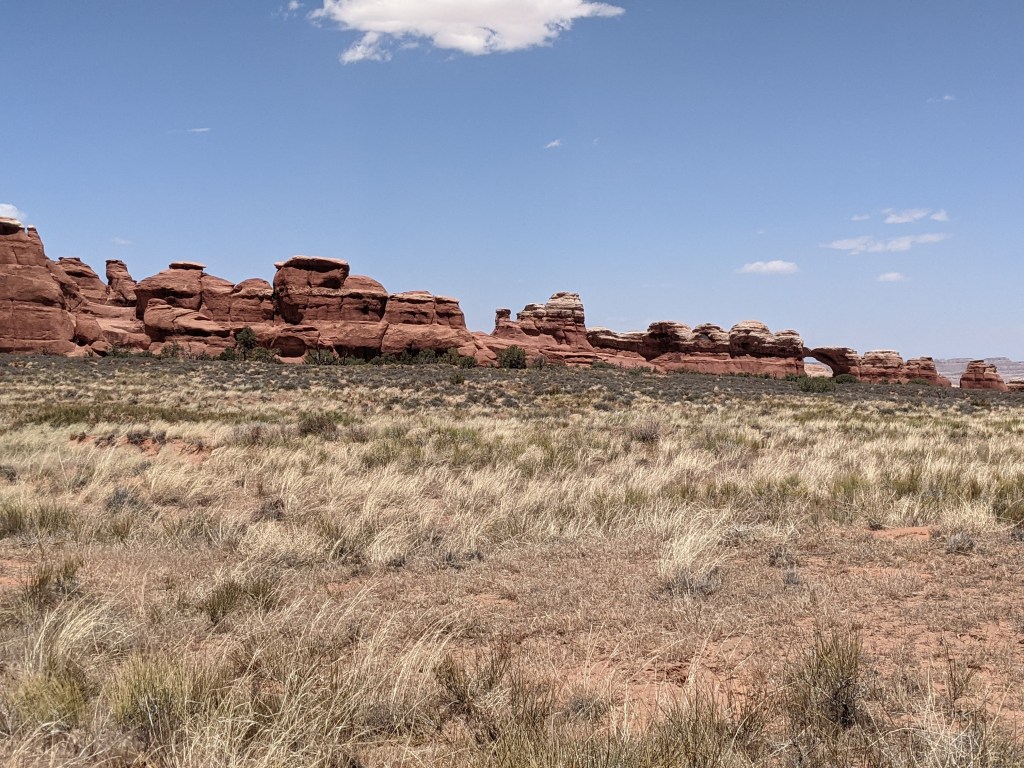
Broken Arch (See it? Over on the right?)

Once we arrived, there was signage that encouraged hikers to climb through the arch to continue on the trail. We figured we should climb up just to take a look . . . but then we kept walking. I mean, at this point it was just a little farther to the third arch, Tapestry Arch.

This was where the trail really turned magical. How was it possible that in a park with hundreds of visitors, we had this trail all to ourselves? We didn’t encounter another soul (except for some lizards) as we followed the carefully-situated cairns to Tapestry Arch. Without the cairns we would have gotten hopelessly lost as we scrambled up and down and over and through the rocks and hills. When we got to the arch we clambered up into its cool recess to sit and marvel at the landscape and the quiet.

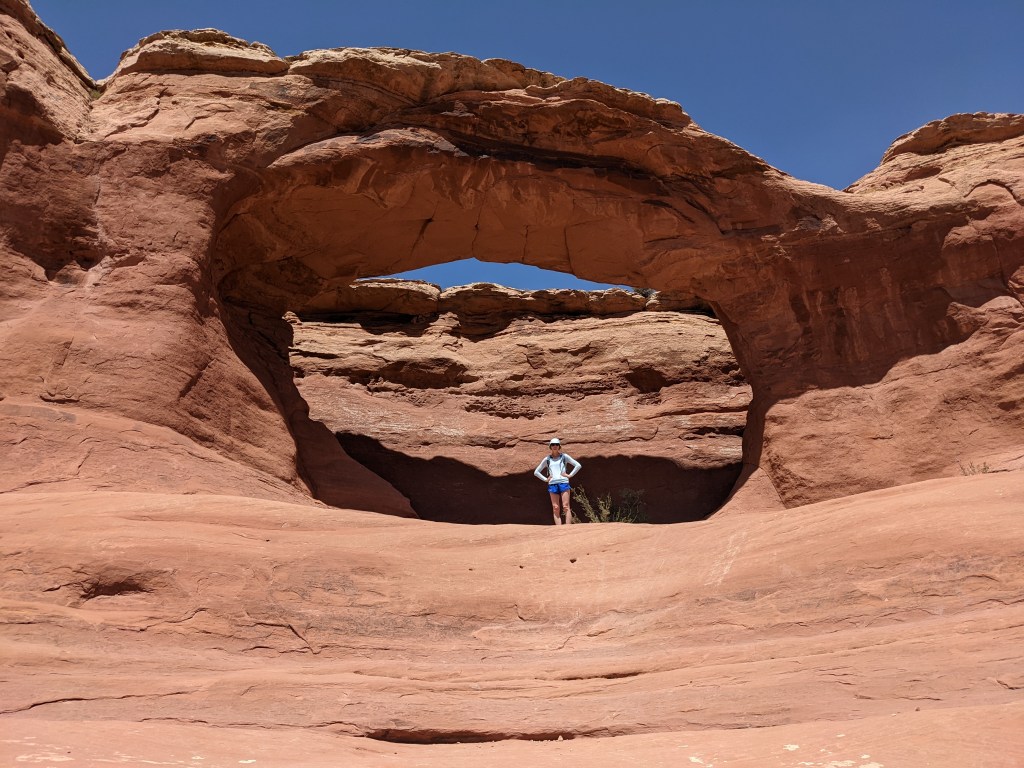
Tapestry Arch

It turned out to be the perfect hike to cap off our visit to Arches. It was an unexpected adventure, but often those are the best ones.

I know we’ve got another visit to Utah somewhere in our future, because Capitol Reef is still on the must-see list of parks. When we go, I’d love to stop at Arches again and discover even more of its hidden gems.


Two things to know before you go:

1. Like several other national parks, Arches is piloting a timed entry system during peak months of the year. You must have a reservation to enter the park. They say that the goal is not to reduce the number of visitors, but rather to spread them out more evenly throughout the day, to reduce congestion at the entrance station, in parking lots, and on the trails. Be sure to check the website several months in advance of your visit to make sure that you get your pass, if necessary!

2. Download the National Park Service app. It’s incredible. You’ll find alerts, maps, things to see/do, locations of passport stamps. And one of my favorite parts—a fun little feature that allows you to create virtual “postcards” to send to friends and family.

Answer: Sheep Rock

Explore

Being World-Class

world-class \ˈwərl(d)-ˈklas \ (adj)
being of the highest caliber in the world
Merriam Webster

We’ve all heard the accolade “world-class” attached to various people. Athletes, surgeons, musicians, chefs, anyone performing at the highest levels of their craft.

I never gave a moment’s thought to anything in MY life being world-class until recently.

I was listening to an episode on the Tim Ferriss podcast. His guest was Ann Miura-Ko, a technology-startup investor as well as lecturer on entrepreneurship at Stanford.

She grew up in a very traditional Japanese family (i.e. driven by education, effort, and excellence) in which her father’s common refrain throughout Ann’s childhood and adolescence, to check whether her work had met the family standard of quality, was to ask, “Is that world-class?” A tough metric by which to be measured, but that was the expectation. World-class effort. 

Ann shared a story about her work-study job at Yale. She was basically an office grunt for the Dean of Engineering. When she called her parents before her first day on the job, her dad reminded her to do world-class work. She was like, Um, pretty sure photocopying and filing is not world-class stuff. But then, standing in front of the copy machine, she couldn’t help thinking: What would world-class photocopying look like? Perfectly aligned pages, crisp and neat, color-matched exactly to the originals. What about world-class filing? Coffee runs? She decided to bring an effort and mindfulness to her work, tasks that many might have said didn’t really matter. Her “world-class” office work was noticed by her bosses, but even if it hadn’t been, it mattered to her to feel proud of the work she’d done.

I was very inspired by that philosophy. I do so many things on autopilot, or put minimum effort into tasks that seem insignificant. And maybe not everything I do has to be world-class, but it got me thinking, what if MORE of the things I do were? If I’m bothering to do something, why not try to do the thing as best I can? Show a bit more care? Go just a little above and beyond? Find a way to take something “small” and turn it into something special.

I think we kid ourselves when we take comfort in the knowledge that nobody else will witness our shoddy work or half-assed efforts. I think, whether we consciously acknowledge it or not, all that half-effort accumulates and erodes our sense of self-respect. Whether anyone else will ever know, WE know whether we’ve tried hard or not. It feels good to do your best at something. It feels kind of crappy to know that you slacked off. 

It’s probably not realistic for every aspect of your life to be world-class. Sometimes it’s fine if things are good enough. You can drive yourself into the ground if perfection is the only acceptable outcome for all of your endeavors, and I do not have the energy for that. But I enjoy turning that world-class lens on different aspects of my life:

  • What does a world-class teacher look like?
  • What would it mean to be a world-class wife?
  • Did I do a world-class job cleaning the bathroom??

Just asking the questions and reflecting on the answers is a worthwhile practice. I’m not a fan of the word “mindful” because it is so overused, but it is the perfect word in this case to describe taking that pause to consider the why and how of what we’re doing.

“World-class” has become sort of a thing for me and my husband. We use it in a kidding-not-kidding way, to acknowledge each other’s efforts and shine a light on people whose hard work we admire. 

Like this guy:

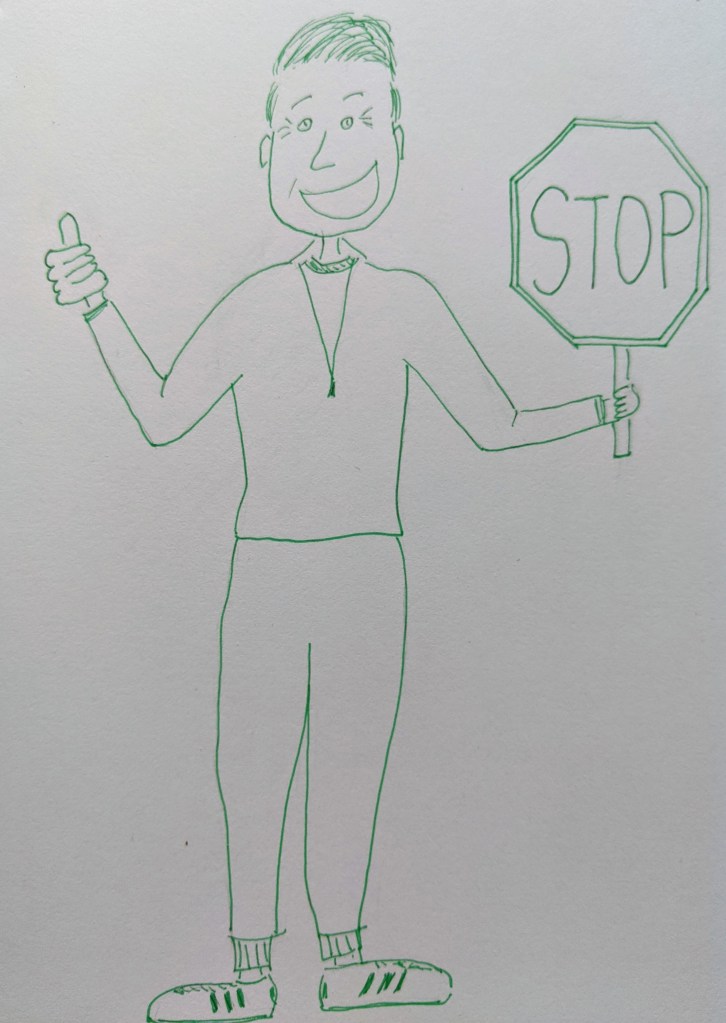
There is a crossing guard at the elementary school I drive past every day on my way home. He’s in his 50s or 60s, possibly an early retiree who enjoys having a little something to do in the afternoon each day. He’s been doing the job for several years, and every time I see him, I marvel at his energy and enthusiasm. He cheerfully greets the children by name. As he stops traffic to usher the children across the road, he lets the kids jump up and “high five” his stop sign as they pass. He then jogs back to the side of the road so that traffic can resume, but always gives the passing cars a smile and thank-you thumbs up. It makes ME happy to see him each day, and I don’t even know him! 

After listening to the podcast, it hit me: That’s a world-class crossing guard!

What stories can you share? Who is doing world-class things in your life? 

Explore

The Fun of Rucking

If you are not familiar with the term, “ruck” is a thing, and it’s also an action. You ruck with your ruck. Translation: You carry weight in your backpack. This simple activity, hiking while carrying a weighted pack, is not a new concept, though these days it is gaining traction with people from all walks of life.

I was familiar with rucking from my husband. He would sometimes load up his backpack with a weight plate (or two) before hitting the hiking trail. Years ago when he first started rucking, I was like, “Seriously? That sounds horrible. Why ruin a perfectly nice walk in the woods?”

And that was the sum of my thoughts about rucking.

Until recently, when I read The Comfort Crisis by Michael Easter. Rucking is hardly the central focus of his book, which interweaves the story of his month-long caribou-hunting expedition in the Arctic with research and commentary on how the comforts of our modern lifestyle can be detrimental to our health, happiness, and longevity. But he does spend some time discussing rucking (super relevant to the part of the story when he must carry 100 pounds of caribou meat five miles back to camp), and it was eye-opening.

Rucking’s genesis is in the military, where soldiers have always had to carry heavy loads pretty much everywhere they go. As far back as Roman times, soldiers engaged in weighted marches. Today, soldiers’ “rucksacks” generally weigh from 50 to 100 pounds. Not surprisingly, carrying all that extra weight exerts a substantial cardiovascular and strength load on your body and builds mental fortitude as well.

Like many things that started in the military and eventually trickled down into civilian use—like duct tape and the internet—rucking entered the mainstream in the 2000s. I was starting to understand its growing popularity. The benefits of rucking are huge:

  • It contributes to functional strength—we carry things all the time in regular life. And by improving core strength, balance, and body awareness, rucking makes us less injury-prone.
  • It provides time in nature. Always a good thing! 
  • It can be a social activity. Because it is easily scalable, people of varying abilities can still ruck together. 
  • It is so simple. You need very minimal gear to get started, and you can ruck literally anywhere. 
  • It exerts less impact on your joints than running, yet burns significantly more calories than walking. So it splits the difference between the benefits and risks of the two activities. Keep in mind that the heavier your rucksack, the more stress on your joints. It’s important to build up slowly, use good form, and wear appropriate footwear.

So it got me thinking. I like to walk. I like to strength train. I like to do cardio. Rucking checks all three of those boxes. A win-win-win! To his credit, when I shared my newfound excitement about rucking with my husband, he didn’t roll his eyes. Instead he offered to let me borrow his backpack and showed me how to load the weight properly. (I know—he’s the best.)

I did a little more reading about “Rucking for Beginners” to figure out how much weight I should carry. Starting out, they recommend about 10-15% of your body weight. I weigh about 140, so 20 pounds seemed like a good place for me to start. 

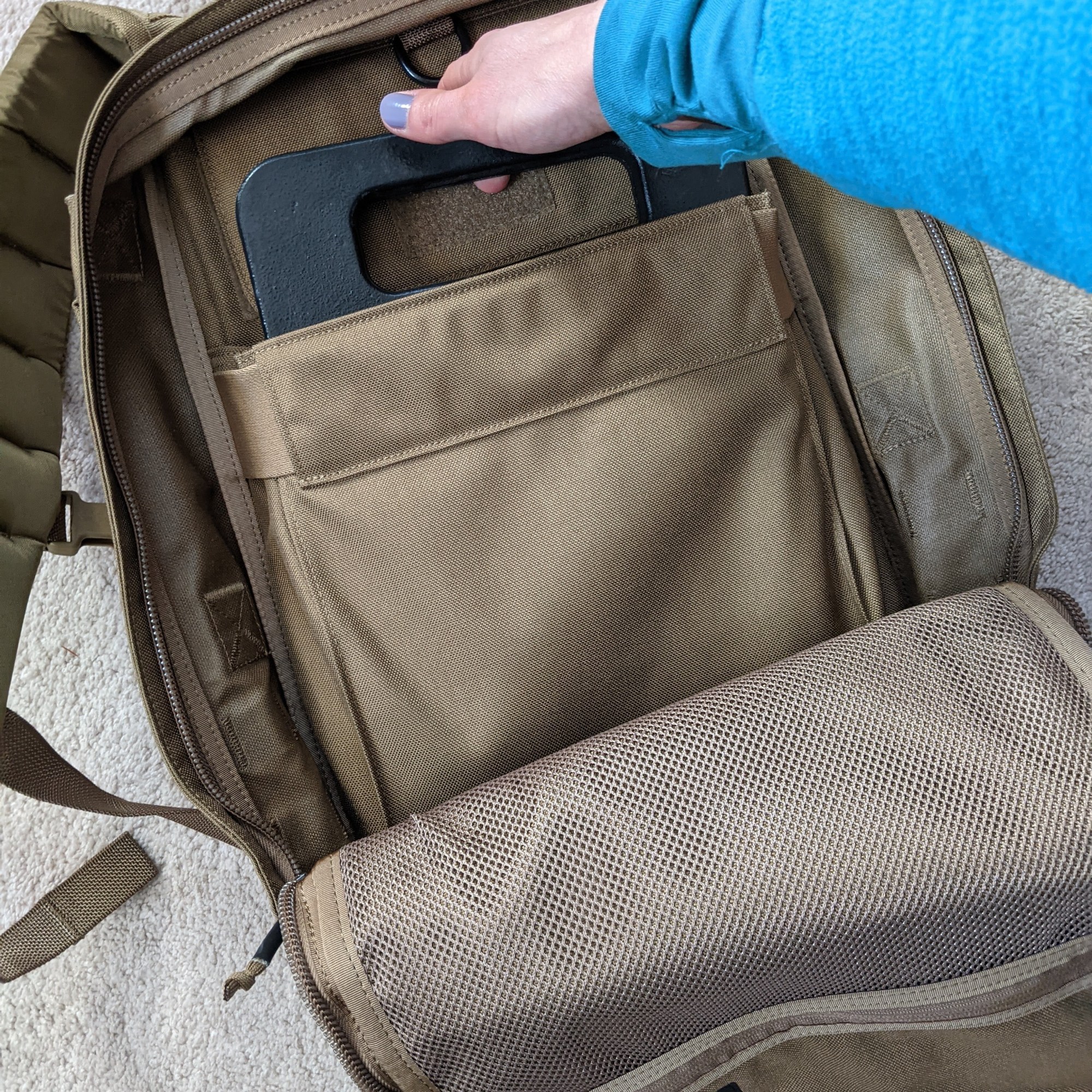
The right backpack is crucial too. The Jansport I use for school would not cut it. For a much lighter weight it might work, but 20 pounds would strain its limits. There are specially designed backpacks for rucking, with reinforced stitching and thick, padded straps that don’t shred your shoulders and that keep the weight up high and tight against your back. My husband and I swaddled two 10-lb weight plates in an old towel, cinched the straps to secure the backpack snugly onto my back, and off I went. 

I didn’t want to overdo it my first time out, so I walked on a flat, paved trail and only for about two miles.

The Verdict

Twenty pounds didn’t really sound like a lot of weight to me, but it was a good amount for my beginning ruck. From the first step, it did not feel like the typical stroll on the trail. Usually when I walk, it’s easy to lose track of time. I enjoy it so much, I often feel like I could keep walking forever. 

This was not like that. It felt long. Half a mile in, I was like, That was only half a mile?? But everything is hard when you first try it, so I embraced the discomfort and just observed what was happening throughout my body.

My shoulders and upper chest worked to counter the weight pulling down on them.
My upper back grew tight and fatigued.
My hips and core engaged, adjusting to the shift in my center of gravity.
I had to consciously pick my feet up to keep them from scuffing against the ground.
I felt myself getting slightly winded, though my pace—while brisk—would have been no big deal on a regular hike.

The next day, I wasn’t especially sore anywhere, though I noticed a little tightness across my shoulders and upper back. 

I did a few more rucks over the next couple of weeks, adding distance incrementally and focusing on maintaining good rucking form. You want to keep your head high and body upright—don’t lean forward. Keep shoulders relaxed away from your ears and glutes engaged. I suppose you could just stroll along at whatever pace you want, but setting a more intentional pace (my goal was 15 minutes per mile) will increase the cardio benefits.

One of the best things about rucking is that you can adjust the challenge level in so many ways. 

Add more (or less) weight.
Add more (or less) distance.
Add more (or less) speed.
Add some hills or stairs.
Mix in some strength intervals with pushups, squats, pullups, etc.

So the early votes are in, and I must say, rucking lived up to the hype. A little strength, a little cardio, and some unexpected mental engagement too. I’ll definitely be incorporating rucking into my workout circuit. I would not use the word “fun” to describe rucking, but I wouldn’t necessarily call my weight lifting or HIIT workouts fun either. Challenging, yes. Invigorating, yes. And satisfying for sure. It feels fantastic to work hard and accomplish a goal. I love it, even if it’s not always fun.

Actually, though, come to think of it, there is something fun about rucking. It happens when you unshoulder your rucksack at the end of a hike. It’s magical. In that moment of sudden weightlessness, it feels like you could fly!

Postscript:

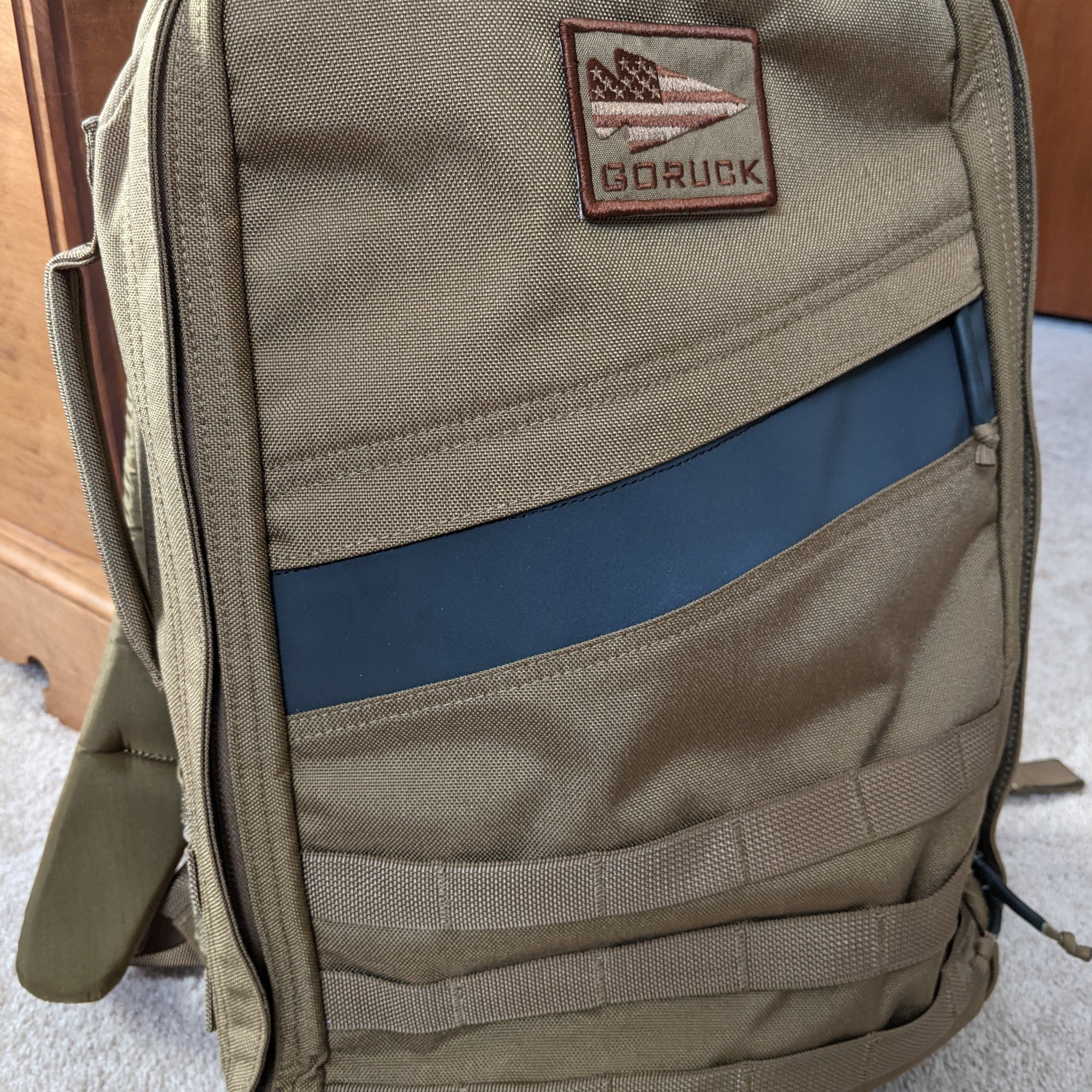
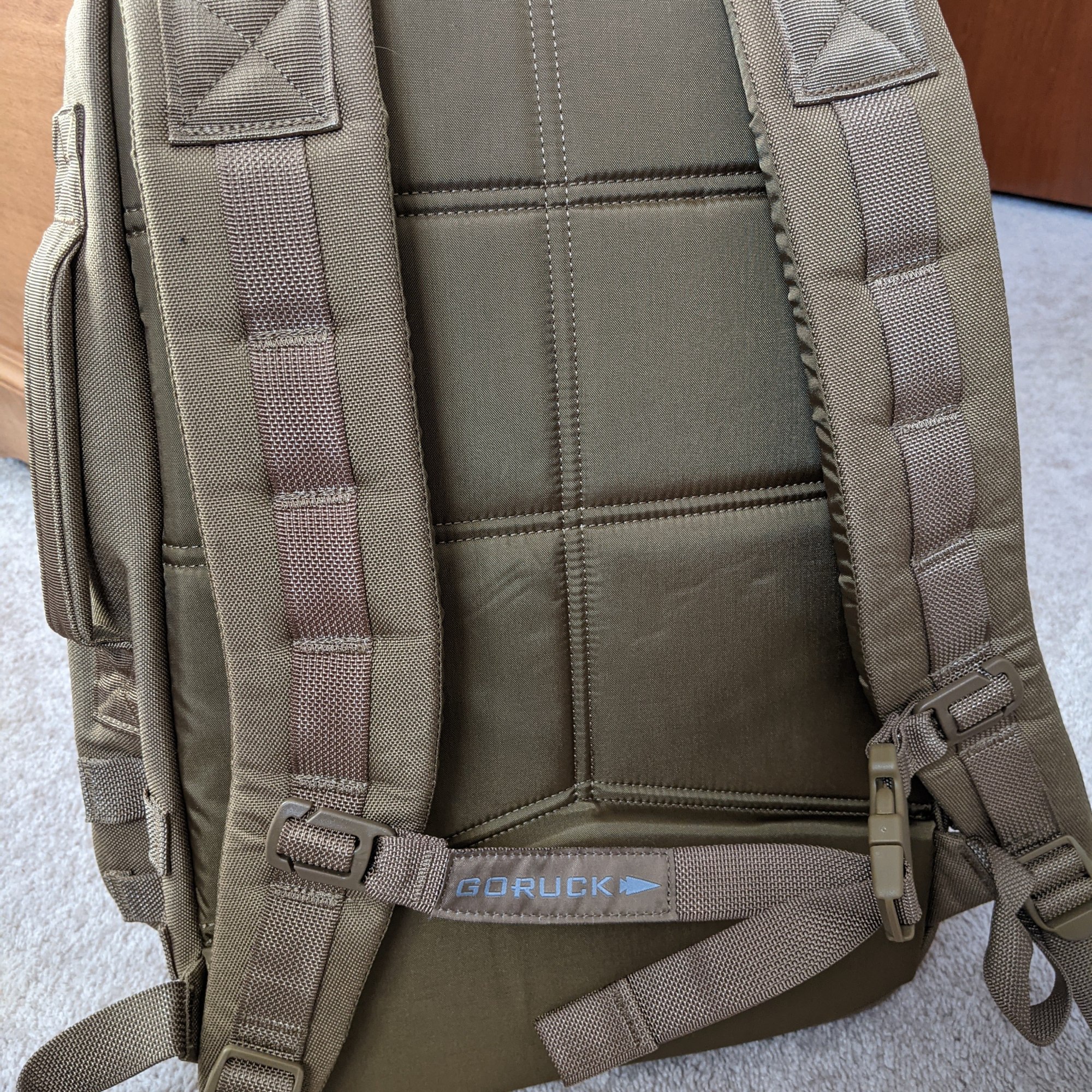
I took to rucking so enthusiastically that my husband surprised me with my very own rucksack and weight plate for my birthday! It’s one of the super nice bags from GORUCK (more info below), and wow is it comfortable. I love it. 


For further exploration:

If you are interested in learning more about rucking, there is no shortage of information out there once you start digging a little.

GORUCK is a company co-founded by former Green Beret Jason McCarthy and his wife, Emily (a former CIA operative). Michael Easter includes an interview with Jason in The Comfort Crisis. While the company does sell rucking gear, they are most passionate about serving others and building a strong community. There are GORUCK events you can sign up for, local GORUCK clubs to join, or if that’s not enough, you can become a member of the GORUCK Tribe for monthly challenges and a community of support.

I found an interesting episode on “The Art of Manliness” podcast. It is not a podcast I subscribe to, but this particular episode, an interview with Josh Bryant, certainly doesn’t apply just to manly men! Josh is the author of Rucking Gains, and in this 30-minute interview, he talks about the many benefits of rucking and shares advice on how to get started.

I also enjoy Michael Easter’s “2 Percent” newsletter. In a recent post he described a 100 pound, one mile ruck challenge (which, following his advice for a person my size, I scaled to a 70 pound, one mile ruck). Holy shit was that hard. But I loved it.