Read

How to Read Ann Patchett

I’ve been thinking about Ann Patchett a lot recently. Well, more than usual, I mean, because she IS one of my favorite authors after all. 

But recently, she has published a new book (Tom Lake), AND I had the opportunity to see her in person on the book tour for it. 

Since one of the main things I write about on this blog is books, it seems obvious that I should have an article about Ann Patchett. But the internet hardly needs another review of all of Ann Patchett’s work (and that would be way too long, anyway). 

Do I think you should read all of her books? Yes, I do. However, if you’re just getting started, or if you aren’t sure that you’ll explore her entire backlist, I have created my recommended roadmap to reading Ann Patchett. Read the following books, in the following order, to arrive at a healthy appreciation of the scope and beauty of her writing.

Starting Point: Read Her First Book

The Patron Saint of Liars is Ann’s first published novel. At the time, she was spending her days waitressing at a TGI Friday’s, while working out the details of the novel in her head. After about a year of that, she wrote it all down.


In the book, Rose Clinton is a woman feeling stifled and tethered by her marriage. (Through no fault of her husband, really. He’s a very kind and gentle man.) When Rose discovers that she is pregnant, that’s it; she decides to leave. Without a word. Driving east from California to Kentucky to arrive at St. Elizabeth’s Home for Unwed Mothers. (We know that she is not an unwed mother, but she lies about it.) The typical stay at the home is nine months or less, but Rose finds a way to remain there indefinitely. She makes herself indispensable in the kitchen, and she marries the handyman/caretaker, Son. (She doesn’t bother to tell him that she’s actually still married to her first husband.)

I didn’t really like Rose. Everyone’s got issues, but she just seemed so self-centered. It pissed me off that she insisted on naming her baby “Cecilia.” It pissed me off how aloof she always was with Cecilia. And she REALLY pissed me off at the end of the book. She wasn’t all bad—it’s not wrong to value one’s sense of independence, and she could be incredibly compassionate with the nuns and other women at the home. But come on, grow up, Rose. That’s what I wanted to tell her. 

I’m sure plenty of people would disagree with my assessment of Rose. But the bottom line is, this was a great book. And it was Ann’s first novel! I think you’ll be equally impressed and eager to continue on the reading journey.

Next Stop: Read Her Newest Book

Ann’s most recent novel is Tom Lake. The setting is northern Michigan. It’s a story told alternately in the present-day, at a cherry orchard during the Covid lockdowns, and in the 1980s at Tom Lake, a summer theater company. The main character, Lara, while harvesting cherries with her three adult daughters, unspools for them the tale of her brief acting career and love affair with the famous Peter Duke during the summer she spent performing Our Town. My favorite element of this book was the dynamic among the mom and her daughters. I was warmed by (and perhaps a little jealous of) their close-knit friendship. It also made me want to finally read Our Town.
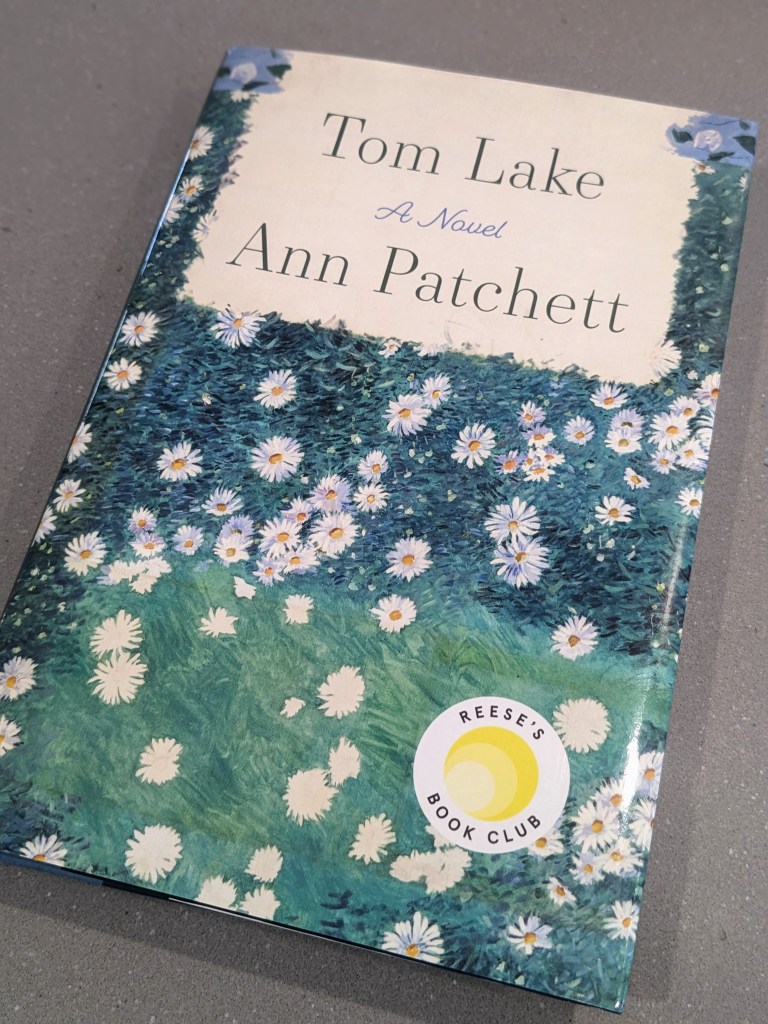

But the BEST part of Tom Lake is that I got to see Ann Patchett on her promotional book tour! Her tour included an evening at the Maltz Performing Arts Center in Cleveland, Ohio, just two hours from where I live, which made for the perfect overnight getaway.


The event featured Ann Patchett along with her good friend Kevin Wilson, talking all about books: Books they’ve read, books they want to read, books they’ve written. Their mutual respect and affection was obvious. It was an enjoyable, entertaining, and inspirational evening.


You’ve Arrived: Read Her Best Book

Since this is my blog, I get to decide which book is her best. And it’s State of Wonder. This was Ann’s sixth novel but the first one of hers that I read, and the way I learned of it was kind of unusual.

I was a little late to the party, but like every woman of a certain age, I eventually read Elizabeth Gilbert’s Eat Pray Love. I loved it, so I then proceeded to read everything else she’d written, including Big Magic, a nonfiction work about inspiration and how to live a creative life. In that book, she describes meeting Ann Patchett at a book event and the close friendship they developed from there. 

The crazy thing was this: As they corresponded and talked about writing, they discovered that they had each independently had the idea for a novel set in the Amazon. Novels with eerily similar plots. The idea had come to Elizabeth first, but she let it lie fallow for too long, at which point it seemed to have abandoned her and magically migrated to Ann’s head (and yes, Elizabeth really does theorize that ideas have the ability to do this). They were mutually delighted and astonished by this turn of events, which resulted in Ann’s book State of Wonder.

Intriguing, right? At the time I was unfamiliar with Ann Patchett, but I checked out State of Wonder . . . and then proceeded to read everything else she’d written. 
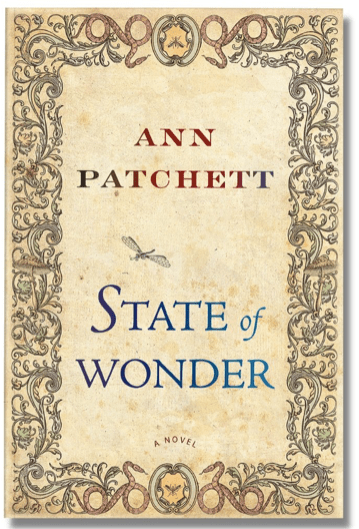

State of Wonder is such an inventive story: A pharmaceutical company is heavily invested in developing a fertility drug in the Amazon. But the doctor heading up the project is notoriously and unapologetically incommunicado. After the employee who’d been sent to the Amazon to check up on her work winds up dead of a fever, his colleague Marina Singh is dispatched to get some answers. The remote Amazonian setting is mesmerizing as well as terrifying in its foreignness. And Marina . . . I really liked her. She’s strong, smart, kind, and reliable. Some might fault her for being too hard on herself and not hard enough on others. But nobody could undergo such a foray into the Amazon and remain unchanged, and Marina is no exception. She discovers that she is stronger and more resilient than she ever knew and is finally able to let go of the things—from both the past and the present—that have been holding her back for far too long.  

Side Trip: Read Some Nonfiction

If you have the time and inclination, I also recommend that you check out some of Ann’s nonfiction. She has several collections of essays, my favorite of which is This Is the Story of a Happy Marriage. By reading her essays, I felt like I really got to know Ann as a person. Plus it makes it even more fun to read her novels because you spot autobiographical nuggets here and there that you wouldn’t otherwise recognize. 


I hope you enjoy your introduction to Ann Patchett. It should give you a good sense of Ann as a writer and as a person. And if you want to continue the journey you’re in luck, because she has six other novels, several more collections of essays, and even a couple of children’s books for you to explore. 
Read

Be 40 Percent Happier

At some point, we’ve all probably wrestled with questions about the meaning and purpose of our lives. Are we making the most of our time and talents? Do we feel fulfilled on a day to day basis? Could we be happier if (this) or (that)?

As I undertook a little journey to learn more about purpose and contentment, I came across the teachings of several people whose work can transform how we think about happiness and well being.  

First up is Tim Tamashiro. If you search for information about finding meaning or purpose in life, I wouldn’t be surprised if your search results include something about Ikigai.

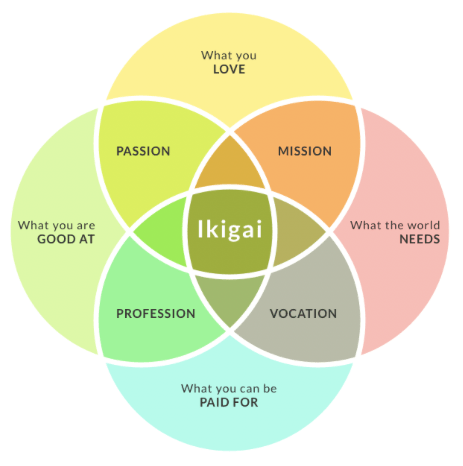
Ikigai (pronounced “EE-kee-guy”) is a Japanese concept that translates to “life’s worth.” It’s your reason for being. Who doesn’t want to know what their life’s purpose is? But that’s a really big question. To home in on your Ikigai, consider where these four smaller questions intersect:

  • What are you good at?
  • What do you love to do?
  • What does the world need?
  • What can you feel rewarded for?

Clarity and action on some or all of those questions will bring you ever closer to your Ikigai.

The first few books I read about Ikigai were a little abstract, but then I read Tim Tamashiro’s book, How to Ikigai. Tamashiro’s personable writing and actionable advice made Ikigai discovery feel within reach. 

At one point, he referenced an online course available through Coursera.org. It’s called “The Science of Well-Being” and is taught by Dr. Laurie Santos. You can audit the course free of charge. It is the online version of a class Santos teaches at Yale, one of the university’s all-time most popular courses. Santos leads us through the many reasons why the things we think will make us happy (such as good grades, the perfect job, and “awesome stuff”) actually do not. Then she lays out proven and practical ways that we can enhance our well-being.

Throughout the highly engaging series of lectures, I noticed that Santos cited a number of studies from Sonja Lyubomirsky, professor of psychology at the University of California, Riverside. 

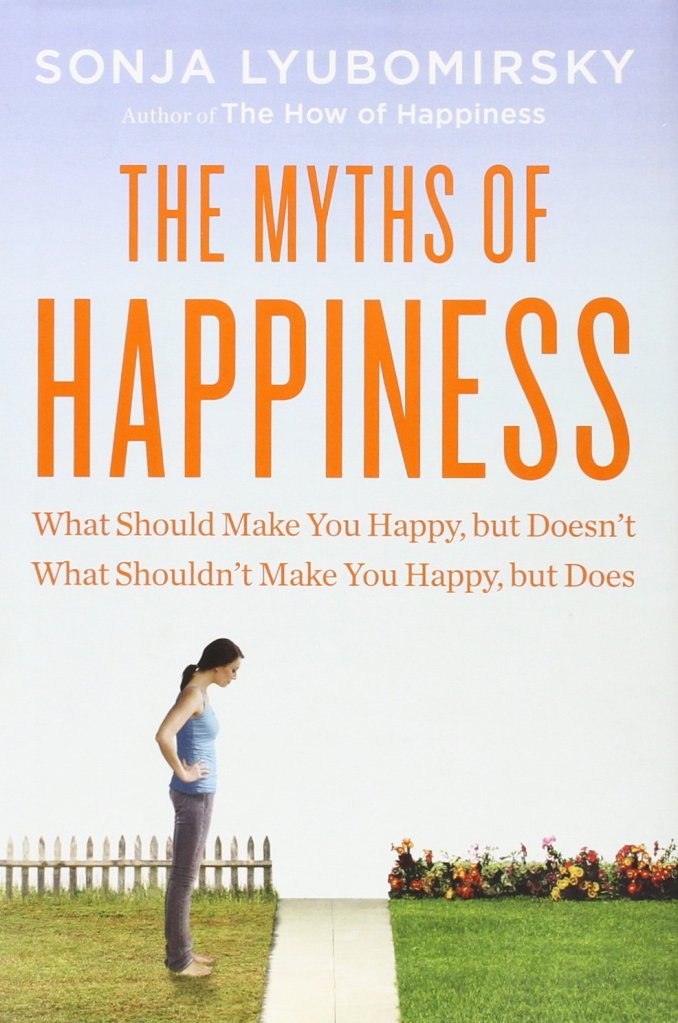
So my next step was to read Lyubomirsky’s book The Myths of Happiness. There is considerable overlap between the concepts in this book and the course by Laurie Santos, but basically Lyubomirsky goes further into the science of why all those things that we think will make us happy (perfect spouse, perfect job, more money) actually don’t. Thankfully, she also explains how to outsmart the myths to discover greater happiness. 

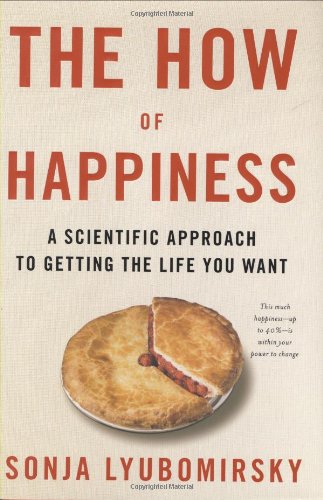
I really enjoyed learning more about The Myths, but it was another book by Lyubomirsky, The How of Happiness, that really has stuck with me. The major premise of the book is summarized by this simple pie chart that breaks down the components that contribute to one’s happiness in life:

Ten percent of our happiness in life is based on our life circumstances. Are we rich or poor? Single or coupled? Canadian or Cambodian? These things matter, but not as much as we imagine.

50 percent of our happiness comes from our genetic set point. Some people are naturally more optimistic and positive than others. Thanks! 🙂 or Thanks :/  mom and dad. 

However, we control a startling 40 PERCENT of our overall happiness with our intentional activities. With our actions, we hold the keys to becoming 40 percent happier. 

That’s pretty empowering!

In the book, Lyubomirsky outlines 12 different activities people can do (though she does not recommend that you try to implement ALL of them). Rather, there is a quiz to ascertain your person-activity matches—those things that are most suited to what you need but also what you are most likely to follow through with and enjoy. If you hate doing something, it is not likely to become an ongoing or enjoyable habit for you. 

The thing I appreciated most about each of these authors and scholars is that they offered practical advice. Tangible, actionable steps I could implement to increase my happiness quotient. I didn’t necessarily believe at first that happiness was something that could be rigorously studied and quantified, but people ARE studying and quantifying happiness. And their work has the potential to help a lot of people. 

It’s certainly helped me!

Read

Once Upon a Time with Stephen King

When you hear the name “Stephen King,” what comes to mind? 

If you are like most people, it’s probably

And that’s just the tip of the iceberg. King has published more than 100 pieces—novels, short stories, nonfiction, essays—and he’s still going strong. He’s one of the most prolific and imaginative writers of our time.

I have not read his complete anthology of works, but in my opinion, Stephen King’s greatest creations are not his horror novels, but his fantasy. 


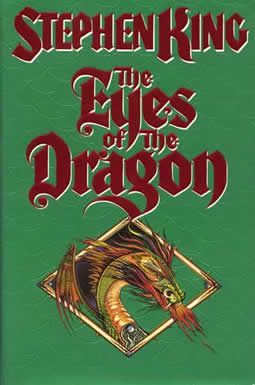
Once upon a time, when I was in middle school, I discovered Stephen King. I loved to scare myself silly reading books like IT and Carrie and Misery, books that nowadays hold virtually no appeal for me. I read to unwind, to learn, to be inspired . . . horror novels do not suit those purposes. But as much as l loved those dark and terrifying novels as a teenager, my favorite book of all was King’s somewhat-less-well-known The Eyes of the Dragon. It was very different from his other works in that it is a fairy tale. There is a king and queen, princes and magicians, dungeons and dragons. The story and characters were so compelling that even 30 years later, I could still recall specific lines from the novel and picture David Palladini’s exquisite illustrations (like the one in the header).


About a year ago, I thought it might be fun to reread The Eyes of the Dragon. I wondered if I would like it as much as I had in my youth. 

In fact, I loved it even more. The story was as beautiful as I remembered, and the passage of time deepened my reading experience. 

In The Eyes of the Dragon, the widowed king has two sons. The elder son and heir to the throne, Peter, is golden in every way. Intelligent and athletic, brave and kind. He is a devoted son and a good brother. The younger son, Thomas, is the complete opposite. Dumpy, awkward, sometimes mean to animals. He lives ever in his brother’s shadow and longs for his father’s love and approval, yet always seems to fall short. The court magician, Flagg, preys on Thomas’s jealousy and insecurity to achieve his own evil goals, and—

I should stop. I don’t want to give any spoilers. If you haven’t read the book, you must.

But I can say this: When I read the book as an adolescent, I hated Thomas. He was ugly and weak! He betrayed his father and brother! He ruined everything. No sympathy from THIS reader. Team Peter all the way.

Rereading the book as an adult, however, I was surprised by how my heart ached for Thomas. I still admired Peter, but poor Thomas. He was so vulnerable. He just wanted his father’s attention and love. I could imagine his unhappiness, confusion, and self-loathing.

It’s one of the unexpected pleasures of rereading a book: I relate to the story and the characters in new ways, because I am not the same person I was during the first reading. I’m changed. The world we live in is changed. We’re constantly evolving, and if you ever doubt it … just reread an old favorite.

According to legend (and stephenking.com), King wrote The Eyes of the Dragon for his teenage daughter, who loved fairy tales but did not have an interest in reading her dad’s horror novels. One of the characters in the book even shares her name, Naomi.

As I said, my reading tastes these days do not lean toward the macabre (though not ALL of his books fall into the horror genre of course), so Stephen King has been well off my radar. Until now.


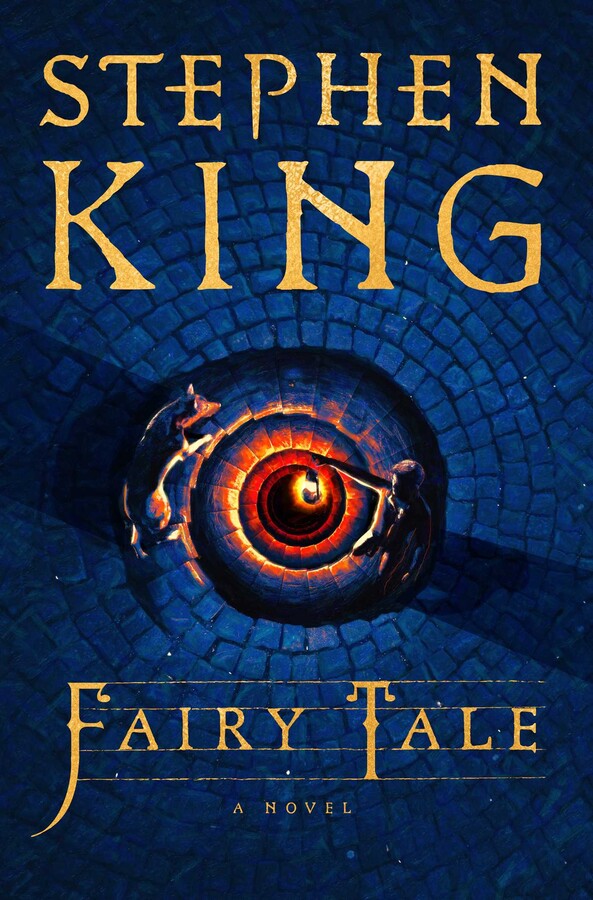
In 2022, King published another fairy tale novel, aptly titled Fairy Tale. I couldn’t get my hands on it fast enough, and it did not disappoint. Like The Eyes of the Dragon, the novel Fairy Tale is merely fairy-tale-scary: There are deaths and evildoers, but nothing that will haunt your nightmares. Nothing I couldn’t handle. Unlike Dragon, which is set in medieval-ish times, the new book bridges the modern world and an enchanted kingdom. There is:

  • A widowed father
  • His 17-year-old son
  • A reclusive old man and his dog
  • A golden treasure
  • A winding portal
  • A princess
  • Magical creatures
  • Monstrous creatures
  • A kingdom of spellbound people
  • Feats of strength and skill
  • Good versus evil


King alludes to many different fairy tale motifs throughout the novel, and while the 17-year-old protagonist, Charlie, is the first to own that he is no “Disney prince,” he is resourceful, brave, and loyal. We can’t help but root for him.

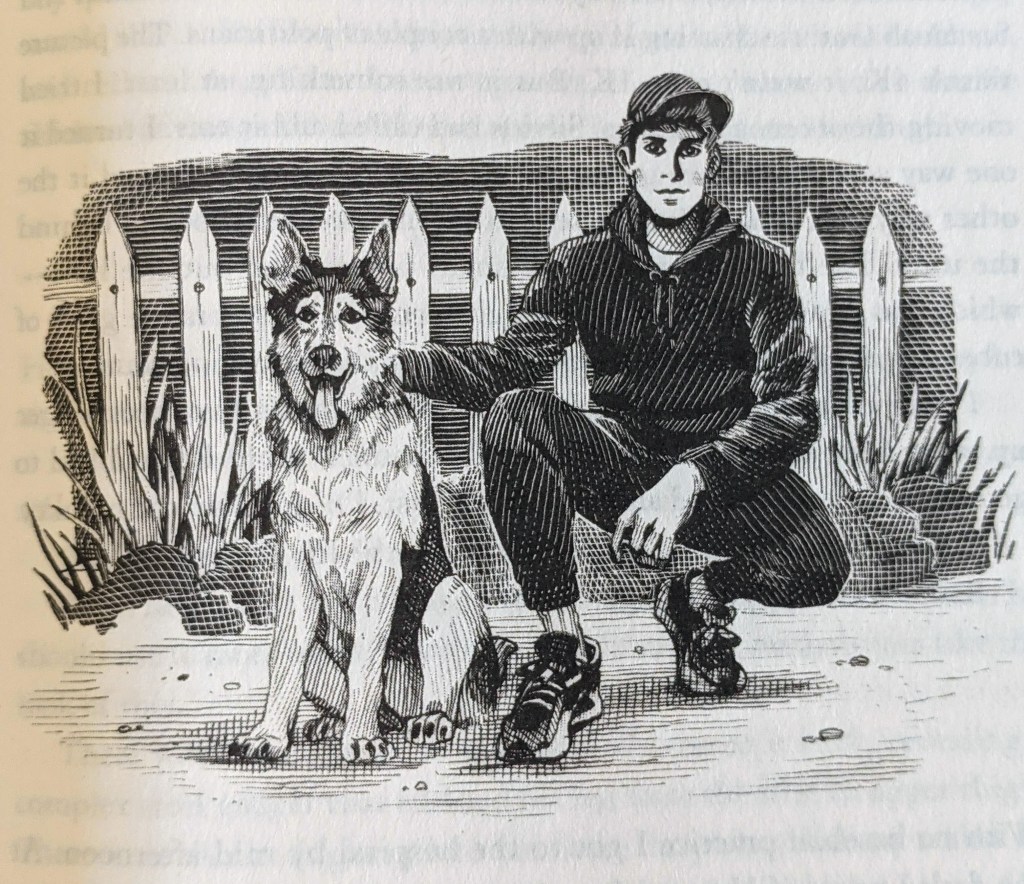
Charlie and Radar (Chapter 4 illustration by Nicolas Deloit)


But do fairy tales always have a happy ending? Well, that depends. Brothers Grimm? No. Disney and Pixar? Yes. 

What about Stephen King? I was cautiously optimistic throughout Fairy Tale, but I knew that with his books, anything was possible. 

So consider this—King wrote Fairy Tale during the COVID pandemic and lockdowns, when he posed a question to himself: What could I write that would make me happy? 

Hmm. I hope it worked, because the book certainly made ME happy!