
Many people are familiar with the concept of yin and yang, the ancient Chinese philosophy that all things exist in balance, that there are opposing but complementary forces at work in the universe, inseparable and harmonious. Male and female, light and dark, hard and soft. One does not exist without the other, and each is most striking when considered in relation to its counterpart.
My husband and I recently embarked on a long-anticipated hiking adventure in Utah. We had never been to Utah, but the allure of its national parks had been calling us for years. Given more time, we would have loved to take on the “Mighty 5” and explore all of Utah’s national parks in one sweep, but on this trip we had to prioritize. We visited Zion and Bryce Canyon. In retrospect, we couldn’t have planned a more interesting and complementary pair of parks to explore! We knew that we would see lots of rocks and canyons on this trip. What we did NOT know was how different each park’s rocks and canyons would be! Bryce Canyon is the yin to Zion’s yang.
First stop: Zion
Zion was a fantastic introduction to the splendor of Utah. It is a majestic, awe-inspiring place.
It is the most visited of Utah’s national parks, and from May through October, cars are in fact prohibited from driving into the main canyon of the park, from where hikers access the various trailheads. It would be too crowded, there isn’t enough parking, and frankly it would ruin the quiet and majesty of the area. Shuttle buses transport visitors from end to end and everywhere in between.
As you wind your way deeper into Zion, you’re surrounded by walls of massive sandstone. While in the company of such impassive and immovable giants, you can’t help but feel how tiny, brief, and fragile a single human life is. It was unfathomable that these canyons were created by the forces of wind and water. . . . So soft! So gentle! Well, in fact the flash floods that tear through the canyon walls, hurling boulders, flinging trees, gauging and fracturing and reshaping the landscape over the millenia are NOT so soft and gentle. We heard a lot about the flash floods during our time in Zion, and I couldn’t help but wish we’d had the opportunity to witness one of these events—from a safe height and distance, of course!

In Zion, all of the hikes begin at the bottom of the canyon. There are, of course, trails that STAY at the bottom of the canyon, flanking the Virgin River or tucked into a slot canyon, but our hikes involved some rigorous uphill climbing. There’s barely time to warm up your muscles before you begin ascending, and the trails we explored featured steep switchbacks—too many to count—and massive drop-offs. People die from falls on the trails and it was not hard to see why. Given my husband’s tendency to roll his ankles, we were particularly careful along these cliffs.
Angel’s Landing is one of the most famous and dramatic hikes at Zion. It’s a tough one from the get-go, but as you approach the final summit of Angel’s Landing, the trail becomes so narrow and treacherous that you must cling to chains embedded in the rocks to keep from falling. As an added challenge, while you are climbing UP this steep, narrow corridor, the returning hikers are coming back DOWN. At times it felt like a vertical game of Twister as we contorted our bodies to move past and around each other while maintaining our grips on the chains. But if you find spaces to pause here and there to safely look up and out, the views across the canyons from such a height are breathtaking.
Our favorite hike at Zion, however, was Observation Point. We decided to explore it after eavesdropping on a conversation on the shuttle bus. A fellow traveler asked the young intern/ranger on board about his favorite hike, and without pause he responded, “Observation Point.” We knew it would be a hard one—eight miles round trip, elevation gains even greater than the hike to Angel’s Landing—but the rigor tends to make trails less crowded, which is always a bonus in our estimation. In fact, there were many stretches of the trail when it felt like we were the only hikers on earth.

We hiked through artfully sculpted canyons, along narrow ridges, and across wildflowery meadows on our way to the top. Every drop of sweat was worth it when we reached the summit and took a few moments of well-deserved rest to soak in the vastness of the landscape.
Second stop: Bryce Canyon
From Zion it is a pleasant and scenic hour and a half drive to Bryce Canyon. As we soon discovered, Bryce Canyon is the opposite of Zion in almost every regard. If Zion is a muscley, solid, no-nonsense lineman, Bryce Canyon is a graceful, delicate, twirling ballet dancer.
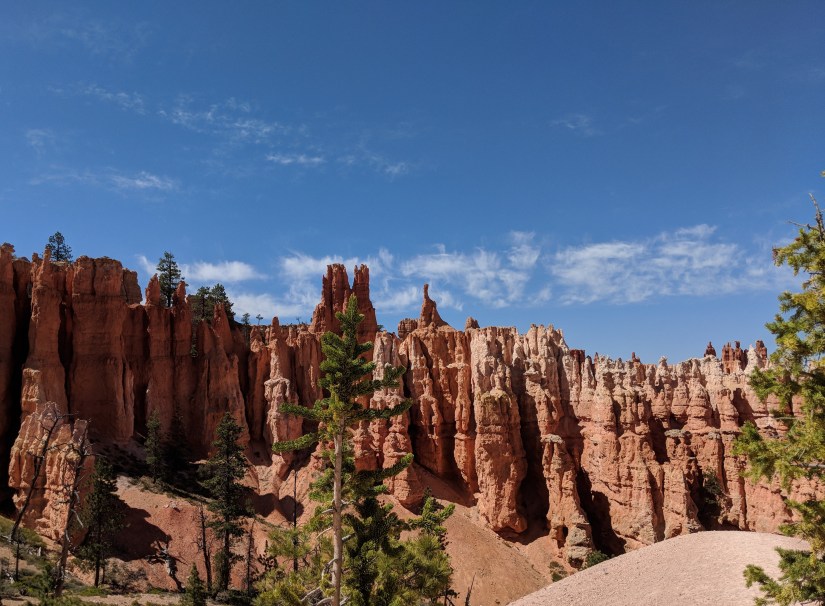
Bryce Canyon is much smaller. There are fewer visitors. It’s at a higher elevation, and therefore cooler. Its signature rock formations are delicately carved and improbably balanced statues of red rock. But the biggest difference is that in Bryce Canyon, home base lies at the TOP of the canyon rather than at the bottom. Entering Zion, there is no question that you are in a land of canyons. They rise up all around you! But as we drove into Bryce, we saw fields of cattle, and piney woods, but no canyon. Puzzling. We parked and gathered our hiking gear, and it wasn’t until we approached the edge of the rim that the canyon was revealed in all of its improbable and whimsical glory. It drops DOWN, below the horizon line, invisible from surface level, into an expansive amphitheater of hoodoos—intricately carved pillars of red rock rising up from the floor of the canyon, no two alike.

All of the hikes at Bryce, therefore, begin with a steep descent and end with a rigorous climb. A hiker is wise to save a little energy for the return trip. After experiencing both extremes of hiking, I prefer tackling the hardest part—the ascent—on the front end rather than as the finisher. My husband can attest that I get a little . . . cranky when I’m really out of gas.
We had a day and a half to explore Bryce. On our full day we took on the strenuous eight-mile Fairyland Loop that dips up and down and all around the amphitheater of the park. But on our first day, when we had just a few hours of daylight for hiking, we did the Peek-a-Boo Loop, and what an introduction it was!
We were a little concerned about crowds as we began the descent into the canyon for our hike, as the “main drag” leading down into the canyon from Sunset Point was thronged with tourists posing and snapping pictures of the breathtaking hoodoos. But the crowd dissipated almost entirely as we began the actual hike, which was steep and strenuous (see elevation profile below!) and featured the added challenge of being a horse-poop-minefield, as the trail is also used as a bridle trail. The temperatures at Bryce were not as hot as at Zion, but I could definitely feel the impact of the strong sun and thinner air at its higher elevation.

The trails we explored were quiet and secluded, and between gawking at the infinite vistas and marveling at the intricacies of the hoodoos, we were never at a loss for something to enjoy.
So when you go to Utah, if you have time to take on the Mighty 5 . . . lucky you! If not, Zion and Bryce Canyon make an excellent and complementary introduction to Utah’s canyon country.
 Don't Fleece the Bees