If there is one book that has changed my life—and I do not say this hyperbolically—it is Susan Cain’s Quiet.
I am a quiet person.
I am soft spoken and calm.
I listen more than I talk.
I think before I speak.
I need a lot of alone time.
In other words, I am a textbook introvert.
It’s funny, when I look at personality inventories or lists of questions to determine whether a person is an extrovert or an introvert, there is never any gray area with me. Not that it’s something I’ve ever doubted about myself—I’ve always known that I am an introvert. But it is striking to see it confirmed so unequivocally.
Yet for much of my life, I wished that I weren’t this way.
I couldn’t tell you how many times some extrovert has made the hearty joke, “Whoa, you shouldn’t talk so much!” Or how many times a teacher noted that I needed to participate more in class. Or that I noticed that my tally of close friends always equaled one or two, while other people had entire flocks.
What was wrong with me? Why wasn’t I more outgoing? Why would I rather stay home and read a book than go to a party? Why would I rather eat a quiet lunch at my desk than join a boisterous crowd in the cafeteria?
As an introvert, I grew up feeling less-than. Abnormal. For years, I felt like there was something wrong with me. Through high school, through college, even into adulthood, I always wished I could be different.
But don’t go feeling sorry for me! Because when I read Susan Cain’s book Quiet: The Power of Introverts in a World That Can’t Stop Talking, it changed everything.

The first, and most powerful, effect was that I realized: I’m not alone. She knew EXACTLY how I felt. She, and the people whose stories she shared, knew firsthand the bias against quiet people. The shame we felt as children being admonished to talk more and “come out of our shells.” The guilt we feel as adults declining party invitations in favor of solitude. I felt validated and understood for perhaps the first time ever.
Here’s what I learned.
One-third to one-half of the population are introverts. Half! We’re not some freakish anomaly—there’s a lot of us!
Introverts are often misunderstood and misrepresented. People hear the word “introvert” and picture an awkward, tongue-tied bookworm, pale and atrophied from spending too many hours alone in a laboratory.
But introverts can be social. Introverts can be public speakers. In fact, many introverts are probably people you wouldn’t expect.
People often assume that the main distinction is that introverts are shy and extroverts are outgoing. And many introverts are shy and experience significant social anxiety, but that isn’t the most important difference. In large part, it comes down to a difference in how their neurological systems respond to stimuli.
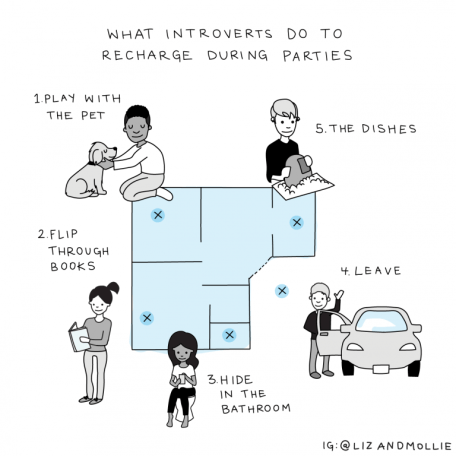
Introverts have sensitive neurological systems, a trait they often display from infancy. Their systems are, as Susan Cain explains, “high reactive,” easily overstimulated by too much noise, too many people, too much visual distraction. To recover, they must then “recharge their batteries” or restore their energy by spending time alone. Extroverts, on the other hand, have “low reactive” systems and need lots of stimulation in order to feel engaged and energized. So while introverts find themselves drained after a social event, even one at which they have enjoyed themselves, extroverts find the same experience invigorating. One of my secret coping mechanisms (in fact used by many fellow introverts) is to escape to a bathroom for a few minutes of quiet and solitude when I’m feeling overstimulated at a party or event.
It might seem counterintuitive that an introvert like myself would choose to be a middle school teacher. Talk about chaos and overstimulation! Spending all day either talking or being talked at definitely depletes me. I usually drive home from school with the radio off, just enjoying the silence in my car, and my understanding husband knows that I need about an hour of quiet time before I’m fit for additional socialization at home. Yet my work is also incredibly rewarding, and many of my coworkers (well, probably one-third to one-half) are introverts as well. Introvert does not equal awkward/antisocial/loner. But we’re probably going to pass on the Friday after-school Happy Hour in favor a quiet, restorative evening at home.
In fact, “restorative niches” are one component of a theory Cain learned about from Professor Brian Little, a former Harvard University psychology lecturer. This engaging, theatrical, and—surprise!—introverted professor developed the Free Trait Theory to explain personality characteristics. According to Professor Little, we are all born with certain fixed personality traits, like introversion, but can and do choose to access other “free traits,” like extroversion, when we want to. A free trait is not our biological default, but we can employ it when a situation demands, or when we are adequately motivated by our beliefs and passions. The Free Trait Theory explains how an introvert like Susan Cain can deliver speeches to crowds of people in boardrooms and auditoriums all over the world. She is passionate about her work, and the drive to share her passion with others trumps her instinct to stay hunkered down in her cozy office at home. (The Free Trait Theory also explains why you can’t always spot an introvert.) So introverts can enjoy success and fulfillment in traditionally extroverted settings (and vice versa), however . . . they’re going to need some restorative niches. Professor Little describes a restorative niche as the place we go to return to our true selves. An introvert can free-trait an extroverted persona for only so long. She needs a place, either an actual physical space or a quiet place in her mind, where she can escape to be alone and recharge her battery. Without restorative niches, a person is headed for burnout.
In our society, it can be difficult to be introverted. As we evolved from a rural, agrarian society into a more urban, industrial one during the twentieth century, our culture shifted toward a celebration of what Cain calls the Extrovert Ideal. The person who was bold, outspoken, and dramatic, quick to think and speak, was the one who stood out in a crowded city and could “sell” his or her talents in competitive marketplaces. Still today, in our schools, businesses, and popular culture, extroverts tend to command the most attention. Extroversion is still the “ideal” by which we are measured and to which we are encouraged, explicitly or not, to aspire.
But with Susan Cain’s quiet voice shining a light on the hidden power of introverts, things are starting to change. In Quiet, she offers research, personal stories, and advice for helping introverts find their path. She teaches us how to celebrate and cultivate our strengths and how to navigate a world that “can’t stop talking.” After all those years of wishing I were different, I now embrace my introversion.
We are gaining a deeper understanding of ourselves and the people around us. This is important for parents and children, teachers and students, spouses, and friends. We are learning to appreciate our differences and recognize that the world needs the yin and yang of extroverts and introverts.
References and Resources
Quiet: The Power of Introverts in a World That Can’t Stop Talking by Susan Cain
Susan Cain TED Talk: The Power of Introverts
Quiet Revolution: Susan Cain’s Newsletter
Quiet: The Power of Introverts with Susan Cain (Podcast)
 Don't Fleece the Bees