
Gut. Kind of an ugly word, isn’t it? That’s a shame, because it’s one of the most important and beautiful components to our overall health and well-being. The more I learn about the gut, the more I appreciate it. Trillions of microscopic bacteria in there, with so much potential to optimize our physical, mental, and emotional health. The tricky part is that their effectiveness depends on the quality of what we feed them. But really, that’s also the good news—it means we have a lot of power to improve the health of our microbiome by feeding it well.
But First: Fermentation
Fermented foods include things like yogurt, sauerkraut, kombucha, kefir, tempeh, even beer and wine. Fermentation is a technique that civilizations worldwide have used since ancient times to extend the life of perishable foods. Like by turning milk into yogurt. So how does this magical transformation occur? Basically, hungry bacteria. Fermentation happens when bacteria feast on the carbohydrates in a food item. The byproducts of this feast include various acids, which create an inhospitable environment for the growth of BAD bacteria in the food—and thus increase its shelf life.
There is a lot to know about fermentation, but let’s keep it simple and focus on yogurt. Milk becomes yogurt in the process called lacto-fermentation. This means that bacteria eat the lactose (a sugar) present in the milk and produce lactic acid (among other things) in the process. This acid gives yogurt that tanginess we all love. You’ll see below that one of the steps in yogurt-making involves adding a “starter” to the milk. At this stage, you are adding a bit of mature or finished yogurt—full of bacteria—to your warmed milk to kick off the microbial feast.
Feed Me Yogurt!
Fermented foods are chock-full of probiotic microbes that are helpful visitors in your gut. Every book or article I’ve read about gut health sings the praises of fermentation, which sparked all sorts of new kitchen adventures for me. Including…homemade yogurt. It’s easy, and exciting, to make your own yogurt. Start to finish it takes about 24 hours to make a batch, but only a fraction of that time requires activity on your part. Primarily you just have to give the bacteria time to work their magic!
But why invest the time or energy to make yogurt when you can so easily purchase it?
- It tastes so much better than store-bought. I’ve probably eaten just about every brand and variety of yogurt over the years—regular, Greek, whipped; plain, flavored, fruit on the top, fruit on the bottom—and they are definitely not created equal. But even the best yogurts from the store take a distant second to my homemade. It’s tangy but not too sharp and doesn’t have any sort of unpleasant chemical-y taste that I only started noticing in store-bought yogurt once I began making my own! It tastes utterly pure and fresh.
- It carries a significant cost savings. To buy organic Greek yogurt from the store, I pay at least $6.00 for a 32 oz. container. When I make my own yogurt, even when purchasing quality organic milk, I get twice as much yogurt for the same price.
If at First You Don’t Succeed…
Years ago I read that it was possible to make yogurt in a crockpot and thought, Gosh, that sounds easy! However, my first attempt at this was a fail. At the moment of the big reveal when I reverently slid the lid from the crockpot, ready to dip into my creamy creation, I was completely deflated to see nothing but milk soup. No thickening, no yogurt. I figured, Well. It was too good to be true that you could actually make your own yogurt in a humble crockpot.
But several years later, I felt inspired to give it another try. I did a bit more research, and realized that my mistake the first time around was using improper starter yogurt. There are several brands or varieties that will work, but you must ensure that it has the live and active cultures Lactobacillus bulgaricus and Streptococcus thermophilus. Lo and behold, when I attempted yogurt-making with the right starter, it worked beautifully! I haven’t had a failed batch since. (Before making my own yogurt, my favorite brand was Fage Total, and this is what I used to create my first successful batch at home. You can also purchase starter cultures online; a company with a good reputation is Cultures for Health.)
I’ve read many people’s methods for making yogurt, and each person’s system is slightly different. After you make it a few times, you’ll discover exactly what works for you.
Read on for my method!
What You’ll Need:
- 1 gallon of milk (I like to use organic 2% milk; whole milk is supposed to result in a thicker yogurt, but I have not noticed much difference in my experiments.)
- 1/2 cup of starter yogurt (check the ingredients list for those bacteria!)
- A crockpot
- An instant-read thermometer
- A wooden spoon
- A large towel
What You’ll Do:
1. Pour the milk into the crockpot (mine fits just shy of one entire gallon). Turn it on HIGH.

2. Bring the milk to 180°. The first few times you do this, you’ll want to start checking the milk after a couple of hours. In my crockpot, this step consistently takes four hours, but your crockpot is its own person and may heat faster or slower than this. (Probably faster. You can see from the photos that my crockpot is kind of a relic, but I’m quite fond of it.)
3. After the milk reaches 180°, turn off the crockpot and tent the lid. Allow the milk to cool to 110°-115°. For me, this takes about three hours.

4. The next step is to add the starter. But before you do anything else, remove the skin that has formed on the top of the milk. I forgot to do this once, and trust me, you don’t want to be the person fishing pieces of that out of your mouth later on.
In a small bowl, mix your 1/2 cup of starter yogurt with about one cup of warm milk you’ve scooped from the crockpot. I like to stir this very gently, with a wooden spurtle, pampering the live bacteria that are about to start working so hard for me.
5. Once the yogurt starter and milk are combined, pour the mixture into the crockpot and, gently still, stir to combine. I stir in a back-and-forth, side-to-side pattern, kind of like a plus sign. Don’t go whisking it in a vigorous circle. The bacteria are fragile.
6. Put the lid back on the crockpot and wrap the whole thing in a large towel. (It’s less bulky if you remove the crock from its metal housing before wrapping it up, but I’ve done it both ways and the resulting yogurt has been the same.)


7. And now we wait. Leave it to sit and ferment for a good 12 hours. This is not a hard-and-fast number. I’ve gone a bit above or below this time, and the yogurt has turned out fine every time. It will get tangier the longer it ferments though—but I like this taste!
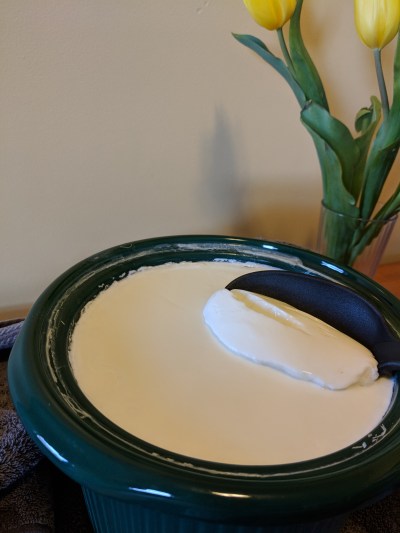
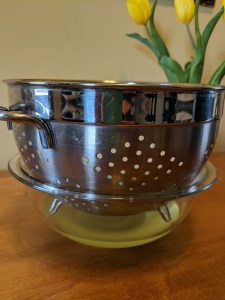
8. The final step is to strain the yogurt to your desired consistency. Some people just skim the whey from the top of the crockpot and then decant the finished yogurt into glass containers for refrigeration. I like it a little thicker, so I strain it for a couple of hours. I use gallon-size coffee filters for this step but other people just line a colander with cheesecloth. Either way, position the colander over a bowl and add the yogurt to it. After a couple of hours, it will be nicely thickened and ready to scoop out and store in the fridge.



In a Nutshell:
- Fill crockpot with milk. Turn on HIGH and heat milk to 180°.
- Once milk reaches 180°, turn crockpot off and allow milk to cool to 110°-115°.
- Once milk reaches 110°-115°, gently combine 1/2 cup starter yogurt with 1 cup warm milk from crockpot.
- Gently stir this mixture back into the crockpot, then wrap the whole thing in a large towel.
- Leave to ferment for 12 hours.
- Strain the finished yogurt until it reaches your desired consistency.
- Refrigerate and enjoy!
A Few Special Tips
Timeline: As I said at the beginning, this process takes about 24 hours start to finish, but very little of that is active time on your part. I make a batch of yogurt every weekend, and I have developed this as my perfect yogurt-making timeline:
- 12 noon on Saturday: Turn crockpot to high and begin heating milk
- 4 pm: Turn crockpot off and begin cooling milk
- 7 pm: Add starter; wrap crockpot in towel for overnight ferment
- 7 am on Sunday: Strain the yogurt
- 9 am: Store strained yogurt in glass containers in fridge
Quantity: My husband and I really like yogurt, and this recipe reflects the amount that we can go through in about a week. If you don’t think you’ll use that much, just pour less into the crockpot from the start. Maybe a half-gallon container of milk.
Coffee Filters
The first few times I made yogurt, I used a fine-mesh cheesecloth as recommended by most people, but to be honest, it was a freakin’ disaster every time. You can wash and reuse the cheesecloth, but it’s a messy process. I was not at all convinced that I was actually getting the fabric clean. I also found that too much of my yogurt was slipping through the colander with the whey, even when I doubled up the cheesecloth. It was frustrating and felt wasteful.
But then I read about using large 1.5-gallon-size coffee filters to strain the yogurt, and these saved the day. I might not have persisted in home yogurt-making without these. I had to order 500 at once, so thank goodness they worked out. Line a colander with a coffee filter and position it over a bowl. After a couple of hours, the yogurt will be nicely thickened, with nothing but whey in the bowl underneath it! Scoop your yogurt into the glass containers of your choice, and it is ready to store in the fridge.
Recommended Resources
For a fascinating read, check out The Good Gut: Taking Control of Your Weight, Your Mood, and Your Long-Term Health by Justin Sonnenburg and Erica Sonnenburg, PhDs. I learned so much from this book and thoroughly enjoyed the authors’ engaging and relatable voices.
Cultures for Health is a reputable company that sells all types of kits and starter cultures for home fermentation. This was the company I used when I needed a SCOBY and starter liquid for making kombucha.
Sandor Katz is a leader and authority in the field of fermentation. His books include Wild Fermentation and The Art of Fermentation, and HERE you can find an interview with Katz on NPR’s Fresh Air.
For a much more in-depth and scientific explanation of all things fermented, I found THIS article from Science-Based Medicine very informative and well researched.
 Don't Fleece the Bees