

It’s that time of year when people start thinking about resolutions. New Year’s resolutions often include fitness and nutrition goals, which got me thinking about a conversation I had with a friend recently about exercise and fitness. We both really enjoy working out, so I told her about a book I’d read that changed the way I lift weights.
“In fact,” I told her, “it changed my life.”
We looked at each other in surprise. I hadn’t been expecting to say that, but I realized at that moment that it was true.
I never received much coaching in lifting weights. And I’m a lifelong athlete! Things probably are a bit different today, but 20 years ago when I was in high school and in college, female athletes spent very little time in the weight room. Looking back, I can see the lack of focus and guidance. It’s like our coaches knew we probably “should” lift weights, but they weren’t that into it and weren’t real experts at it.
As an adult, I continued to work out. I ran (outdoors and on the treadmill) and I carried on with my version of weightlifting. The version many women practice:
- High reps (to “tone” muscles)
- Low weights (I didn’t want to “bulk up”!)
- Mostly machines (less intimidating than the free weight area)
BUT THEN.
I read The New Rules of Lifting for Women by Lou Schuler, Cassandra Forsythe, and Alwyn Cosgrove, and their book completely transformed the way I work out.

I learned new exercises. My workouts took on a different structure and concrete goals. But the number one thing I gained was the confidence to lift heavy weights.
A bit about the authors:
Lou Schuler is a certified strength and conditioning specialist, as well as an award-winning journalist and author. Alwyn Cosgrove is a strength and fitness coach and consultant, who owns the well-respected Results Fitness gym in California. Alwyn designed the New Rules workout programs. Cassandra Forsythe holds a PhD in kinesiology, an MS in nutrition, and is also a registered dietician and certified strength and conditioning specialist. She created the nutrition plan for the book.
Throughout the book, they set out 21 “new rules” for women related to strength training and nutrition. One of the biggest myths—busted right off the bat—is that if women lift heavy weights, they are going to turn into

It’s not going to happen.
Lou wryly points out that for most men (himself included) there is no such thing as muscles that are “too big.” Even after decades in the weight room, with all the hormonal advantages of being biologically male, if a dude has big muscles he has worked REALLY hard for them.
Truth be told, okay, yes, I was always a little afraid of becoming “bulky” and mannish. But Lou assures us that “unless you’re an extreme genetic outlier,” women do not need to worry about becoming bulky.
The first four rules were among the most mind-shifting for me:
New Rule #1: The purpose of lifting weights is to build muscle
New Rule #2: Muscle is hard to build
New Rule #3: Results come from hard work
New Rule #4: Hard work includes lifting heavier weights
It dawned on me that for years I had been treading water. I’d been on autopilot, moving through the same series of exercises, using the same number of reps and weights each time. I stayed in decent shape, but I never got any stronger.
Good spot for a disclaimer? I am not a personal trainer or exercise scientist. What I am is a woman who cares a lot about fitness, wellness, and functional strength that will serve me well for a lifetime. The New Rules philosophy has helped me to maximize my efforts and achieve goals I never imagined were possible.
The workouts center on compound moves that involve multiple, coordinating muscle groups and mimic movements that one performs in real life. In real life, we don’t often bend and straighten our elbows in isolation (à la bicep curl or tricep kickback). But we do lift, push, pull, and carry things, sometimes heavy things. The biceps and triceps are designed to work in concert with the larger muscles of our upper torsos as we carry out those functions.
So in the New Rules program, you will not see time devoted to small-muscle moves like tricep extensions. If you’re a bodybuilder training for Ms. Olympia, sure, you might need your triceps to ripple like a flag, but for the rest of us, our time is better spent on compound moves that work multiple muscle groups simultaneously.
Moves like a chest press (which works your chest, shoulders, and triceps simultaneously).
Or a chin-up (which develops your upper back, shoulders, and biceps simultaneously).
Or my favorite move of all: the deadlift, which works damn near every muscle in your body!
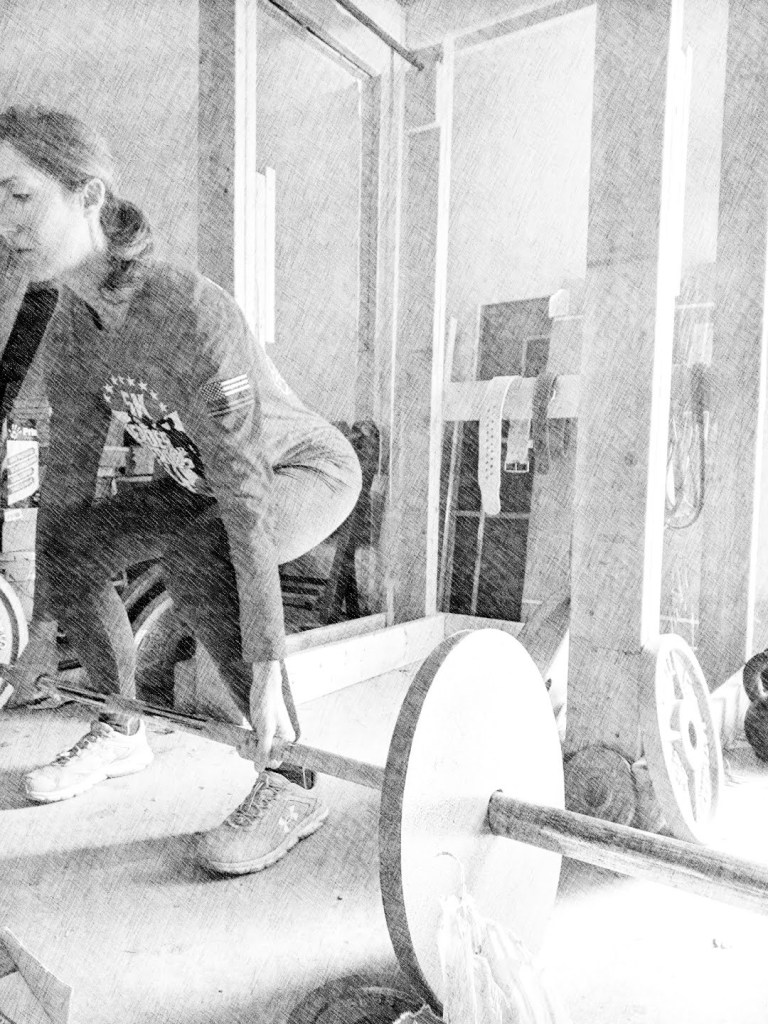

Increasing your muscle mass yields multiple benefits. Muscle is more metabolically active than fat, so even at rest, a muscular body will burn more calories than a doughy one of the same weight. Even more important though is the correlation between strength and longevity. All else equal, a person with more muscle mass has a decrease in all-cause mortality over same-age peers. The reasons for this are many, but the solution is (kind of) simple: Build your muscles! Do resistance training!
Nutrition is an essential component of the program, and four chapters, or six of the 21 “new rules,” outline how to properly nourish a strong body.
Lou’s writing is friendly, factual, and funny. He and Alwyn have collaborated on four other New Rules books, as well as a fifth book titled Strong. I’ve gleaned useful information from all of them, though the second one is the one that really changed my life. The series includes:
The New Rules of Lifting
The New Rules of Lifting for Women
The New Rules of Lifting for Abs
The New Rules of Lifting for Life
The New Rules of Lifting Supercharged
……………………………………………………………………………………………………………….
Sometimes I think to myself, This is crazy, I’m stronger now than I’ve ever been in my life! But I know that probably is not really true. It seems unlikely that my mid-40s body is actually stronger than the 20-something body of a college athlete. But what IS true is that my 20-something self didn’t KNOW how strong she was, or could be. And my 40-something self knows better than to set limits on what is possible.
 Don't Fleece the Bees