
Peter Piper picked a peck of pickled peppers,
A peck of pickled peppers Peter Piper picked;
If Peter Piper picked a peck of pickled peppers,
Where’s the peck of pickled peppers Peter Piper picked?
A peck of pickled peppers? Sounds pretty tasty, but I think I’d prefer a peck of perfect peaches instead.
Red Haven peaches, to be precise.
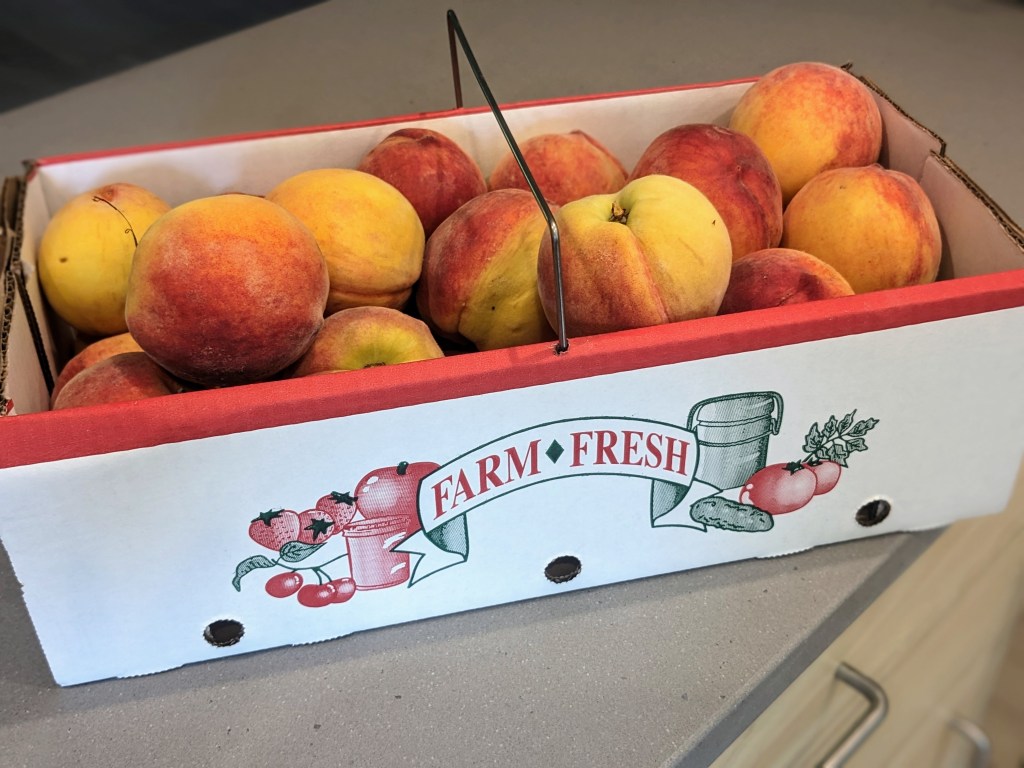
For a brief window every summer, Lynd Fruit Farm in Pataskala, Ohio, offers Red Haven peaches for sale. In a good year, Lynd sells peaches from its own orchard. But peach-growing is a delicate business, and this year Lynd lost 90 percent of its peaches due to an extra harsh cold snap in December. They source from other farms when necessary, and this year (2023) most of the Red Havens came from Pennsylvania.

Red Haven peaches are a freestone variety, meaning that the peach pit separates easily from the flesh when the peach is ripe. I’ve mistakenly purchased clingstone peaches for canning in the past, and there is nothing more frustrating than losing half of your peach to a clingy pit!
So Red Havens are perfect for summertime canning. They are creamy and yellow with just the right amount of sweetness…. When you find yourself craving a little taste of summer during the dark of winter, just pull out a jar of delicious peaches.

There are many different methods for canning peaches. Most involve cooking a light, medium, or heavy sugar syrup to pour over the peaches. I’ve seen one recipe that topped off each jar of peaches with a glug of bourbon. But this year I used a unique method I learned about from one of my favorite people at school, our librarian.
I’ve mentioned Deanna before. She has very discerning taste, and not just in books. She’s kind of a foodie. We both enjoy local and home-made goods, and we’ve exchanged jams, pickles, relishes, and preserves for years. When we returned to school last August, Deanna gave me a jar of her peaches.
The method she used to can them was one I hadn’t heard of. She learned it from her mother, who learned it from a roommate in the 1940s. Deanna assured me that her method was “easy peasy” (maybe even “lazy”). Well, the truth is that canning ANYTHING is a bit of work, including these peaches. But I wanted to try her method for myself, so that’s what I did with this year’s peck of peaches.
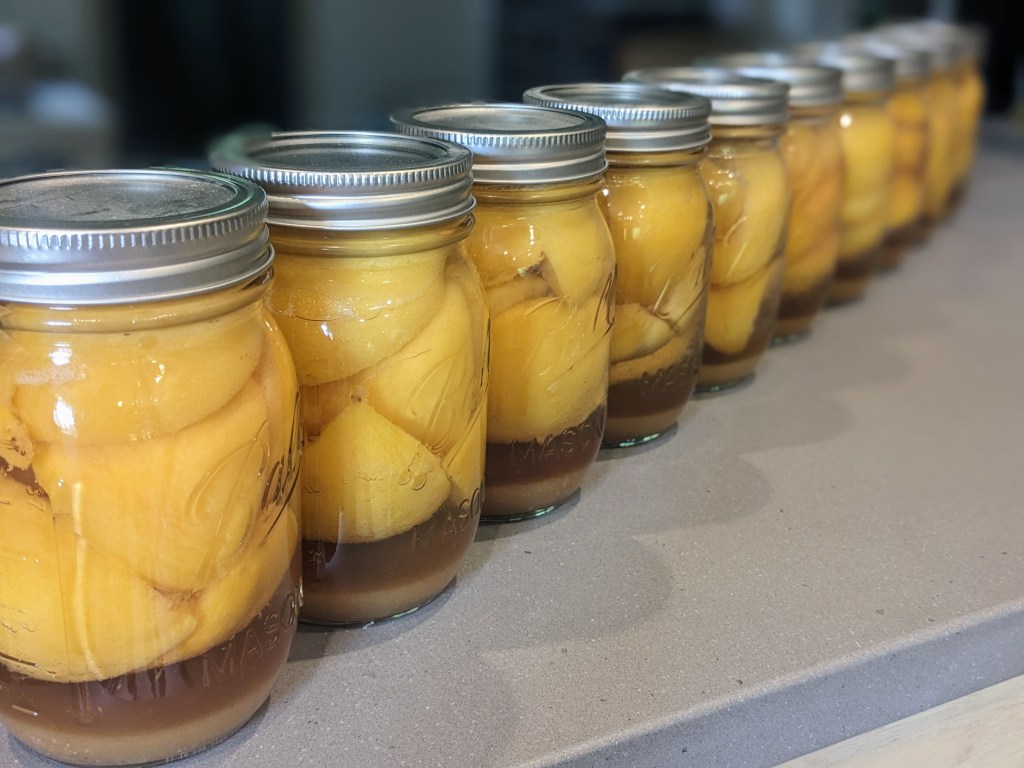
In short, the thing that makes these peaches “easy” is that you don’t create any kind of syrup to pour over the peaches before processing them. You just put sugar directly into each canning jar, add the prepared peaches, top them off with water, and process them. The sugar will dissolve on its own over the next few months, gradually enhancing the natural sweetness of the peaches.

While it might be easy to preserve the peaches, the hard part is the patience required until they’re ready to eat! The sugar will not fully dissolve until about November. That means the peaches should be ready just in time for a Thanksgiving brunch!

Deanna’s Canned Peaches
Ingredients:
A peck of peaches (or as many as you want to can; a peck will produce about 12-16 pint-size jars)
Granulated sugar
Water
Supplies:
Canning jars
Lids and rings
Canning pot for hot-water bath
Directions:
- Wash the peaches, cut them in half, remove the pits (freely!), and drop the peach halves in a pot of boiling water for about 30 seconds.
- Use a slotted spoon to remove the peach halves to a bowl of icy cold water. Let them sit for a few minutes, and the change in temperature will loosen the skins so that you can slide them right off the peaches.
- Ready for the easy part? Scoop 1/4 cup of sugar into each of your canning jars (or 1/2 cup sugar if you are using quart-size jars). Pack the jar with the prepared peach halves (or quarters, or whatever size you’d like your peaches), and then fill the jar with water. Leave about 1/2 inch of space at the top of the jar.
- Wipe the rims of each jar with a damp paper towel, apply the lids and rings, and process the jars in a boiling hot-water bath for the prescribed amount of time based on your altitude. The higher your altitude, the longer the processing time will be; it can range from 20 to 45 minutes.*
- When time is up, carefully lift the jars from the water bath. I put a towel on the countertop to protect it from the very hot jars as they cool. Allow the jars to sit for about 24 hours before you label them and tuck them away until November. 🙂
As the jars cool, you should hear some satisfying “pops” as the lids seal to the jars. After the jars have cooled, you can verify a proper seal by making sure the “button” in the center of each lid is sucked down tightly. If any jars did not seal correctly, just refrigerate them and eat those peaches sooner rather than later.
*If you haven’t canned goods using a hot-water bath before, you might want to read or watch a more detailed tutorial first. There are so many good ones out there.
Once I got started with these peaches, I couldn’t stop! I went back to Lynd for more peaches, and made peach salsa and peach jam too. Not as “easy” as Deanna’s Canned Peaches, but definitely worth the effort.

While the peaches are a summertime favorite, Lynd is a worthwhile destination all year long. They offer a variety of u-pick fruits and vegetables, specialty treats and crafts from local vendors, community events with food trucks and music, and even tours for school groups. If you live anywhere nearby, I recommend getting on their email list to receive info and updates!
By the way—are you curious what a peck of peaches is, exactly? Maybe you already know. But I didn’t. So when I bought my peaches at Lynd’s, I asked the worker: What is a peck, anyway? She hemmed and hawed a little—it seems to be one of those things you just accept without really questioning. But then she said, “Well, I think it’s like 10 or 11 pounds, something like that.”

Not bad! But in fact, I learned that in the U.S. a peck is a measure of dry volume, not weight. That means a peck of peaches would weigh a lot more than a peck of marshmallows! The term has been around since the 1300s, a vintage similar to its friend the bushel. (Four pecks equal one bushel.)
Maybe next time I go to Lynd I’ll bag a bushel of beautiful beets. But only if they’re out of pickled peppers or perfect peaches.
Source:
Britannica, The Editors of Encyclopaedia. “peck”. Encyclopedia Britannica, 29 Apr. 2004, https://www.britannica.com/science/peck. Accessed 14 August 2023.
 Don't Fleece the Bees