Explore

Busy as Bees at Monkey Hollow

I visited Monkey Hollow recently to help with the honey harvest. Monkey Hollow is a small farm not far from where I live, and it’s kind of a magical place. For one thing, it’s a beautiful property, with woods, meadows, fields, a pond; chickens, lambs, and bees. For another, the owners, Al and Jill, are naturalists who know about everything! Al might humbly correct that they know a little bit about a lot of things, but my experience with them points to the former. I learn so much every time I see them.

IMG_20190730_162026
A helpful chart on display in the equipment room

On this trip to Monkey Hollow, I was looking forward not only to extracting and bottling honey, but seeing the actual bee hives. At first, though, a visit to the hives looked a bit unlikely since it was a rather rainy day. The bees like to stay home when it’s rainy rather than go out foraging, and they can be cranky when people come and disturb them. I can relate, I suppose. I also like to curl up and enjoy a quiet day at home when the weather is gloomy. But as luck would have it, by the end of our honey extracting work (learn more about that in THIS post), the clouds disappeared and the sun came out, making it a perfect day to see where all that honey began.
img_20190730_160524


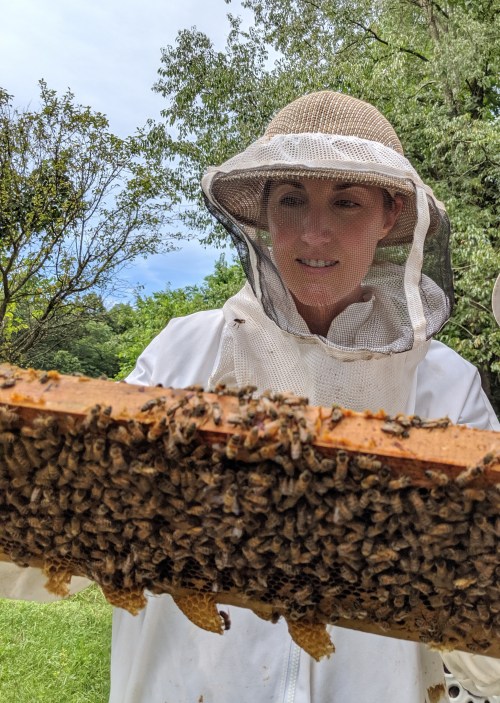
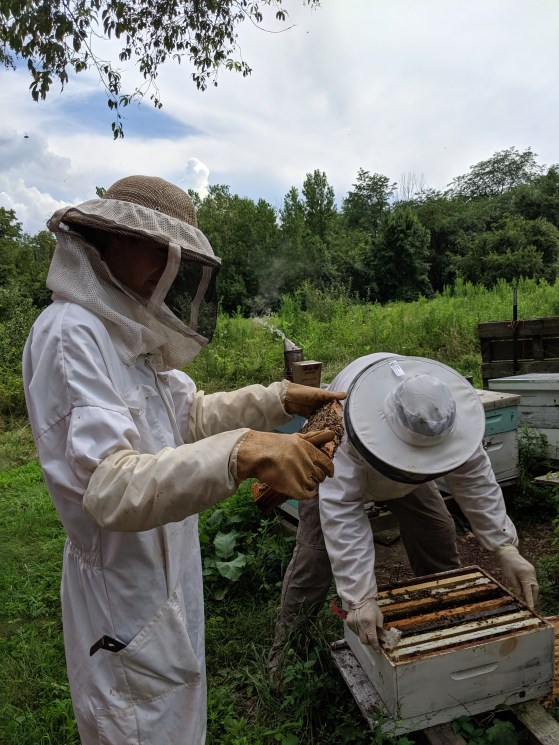
The first order of business for a trek out to the hives was to suit up. Al had plenty of extra bee-suits for visitors. He explained that the suits are white because to the bees, the white blends in with the sky and becomes part of the backdrop. (However, a dark color, like black, looks like a bear to them. Fair warning!) I felt very protected: thick, tightly woven suit all zipped up, gloves in place, head net secured. I was eager to see the bees, but I really did not want to get stung. It’s been decades since I’ve had a bee sting, but with the way I swell up from mosquito bites, I could only imagine how painful a sting would likely be. 

(Of course, I didn’t think to ask the question until we were out at the hives, surrounded by thousands of bees: Wait, can you get stung through these suits? “Oh yes!” Al cheerfully replied. “And after a bee stings, it releases an alarm pheromone to alert other bees to try to sting that same spot.”)

So I was a little scared. But I made sure to take nice slow breaths and exude nothing but calm, positive vibes. I mean, those bees are all about the pheromones. No fear to smell on me!

Al’s bee hives are comprised of stacks of boxes called supers. Each super has nine frames hanging within it on which the bees construct their hives, lay their eggs, and produce their honey.

Al began by filling a small canister with wood shavings. The smoke is a way of saying “Hi” to the bees and alerting them to your presence, but it also can help you gently maneuver them this way or that. Whenever Al needed to restack one of the supers on the hive, he’d hit the box underneath with some smoke to shoo the bees downward and reduce the number that might get squished. Unfortunately, a certain number of bees fall victim anytime the beekeeper tends the hives. Al estimated about 140 or so. And yet a good beekeeper must keep up on his or her hives, checking them every few weeks to ensure the health of the hive and stave off any infestations or problems.

As Al prepared his smoker and tools, I stood in the clearing and listened to the hum of activity. There was a constant stream of bee traffic in and out of the hives. Hundreds; thousands! I had to resist the instinct of flinching from or waving away bees that came too near, reminding myself that I was protected from them (well, you know) and didn’t need to worry. Remember the scene in Batman Begins when the bats are swarming around grown-up Bruce Wayne (played by Christian Bale) in the cave, and he slowly rises and calmly stands in their midst? It was kinda like that. 

batgif-2

Al opened up one of the hives and began prying out individual frames to check on the bees. He uses a small tool that looks like a mini crowbar to dislodge the frames, which become sort of glued in place by a substance called propolis. Also known as “bee glue,” propolis is a sap or resin that bees collect to repair, seal, and protect their hive, and in fact we spotted one bee with her tiny saddlebags full of the reddish material. Apparently, even in ancient times people recognized the healing and antifungal properties of propolis, and it remains a highly sought health supplement today. 
img_20190730_160813

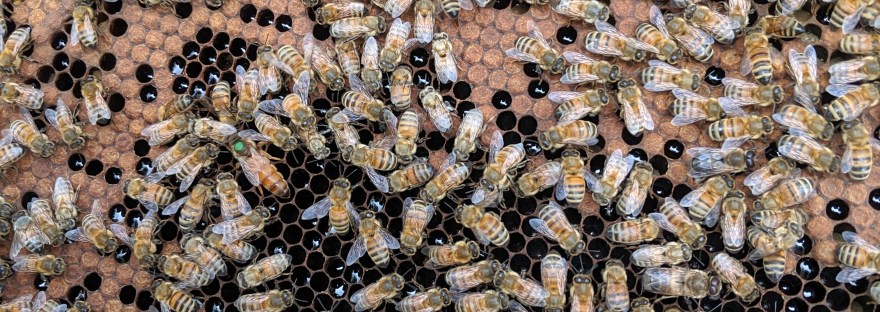
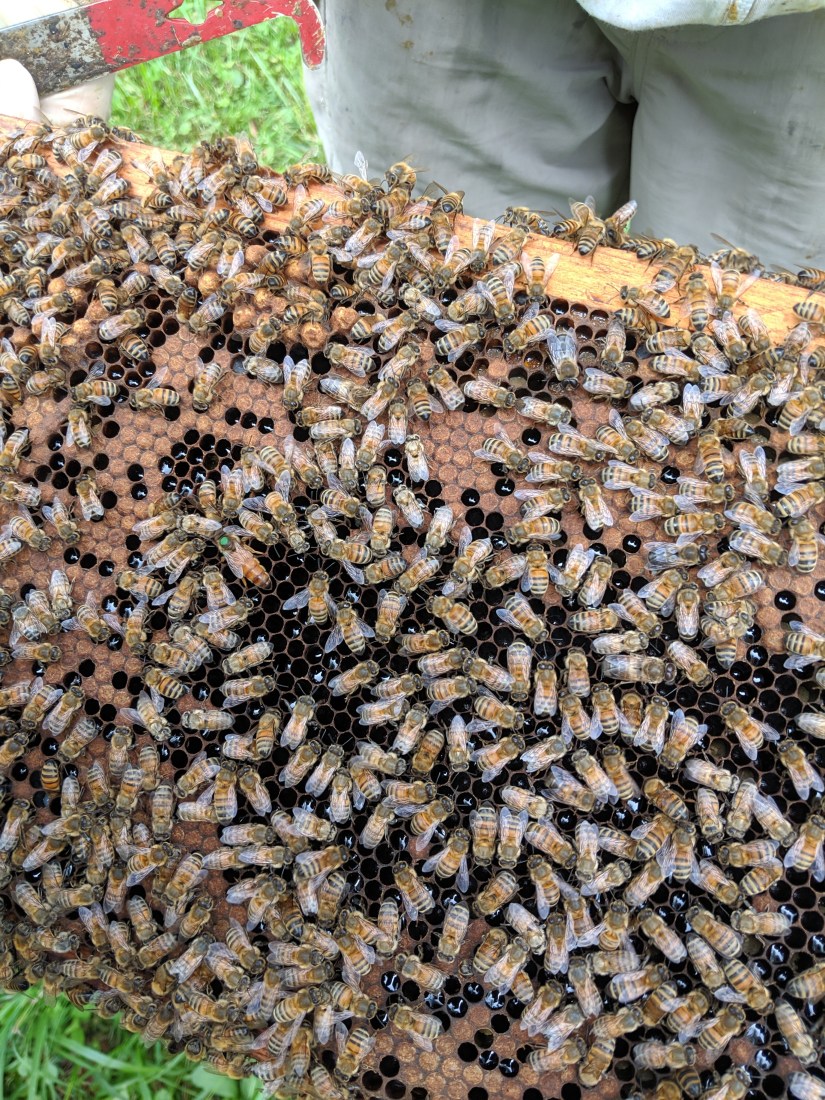
Al’s been a beekeeper for so long that in a glance, he recognizes a million details that I wouldn’t notice even if I stared at the frame for hours. To make it easier to find the queen bee in each hive, Al marks her with a tiny dot of paint, using a different color each year. (This year, it was green. Can you find her in the photo?)
IMG_20190730_155858_1

Speaking of queen bees, that reminds me of a potentially awkward scene we had in the workshop. Al showed us some eggs and larvae on one of the frames, which triggered a few questions from my curious three-year-old nephew: Where is the mom of all the baby bees? Where’s their dad?

The other adults in the shop cast their eyes around, unsure how to tackle such a fraught topic, loathe to describe the gory intricacies of apiary copulation to a three year old. I quickly slipped into Teacher Mode and stepped forward, kneeling down to answer him. 

“Well, you see, a queen bee takes one mating flight in her life, during which anywhere from 10 to 20 drone bees—lured in by her irresistible pheromones—deposit their seed in a marvel of midair choreography. However, the drone must eject his seed so forcefully into the queen that it rips off his endophallus and tears his abdomen, and he dies.”

He nodded thoughtfully and ran outside to chase the chickens.

I’m kidding! He’s three for goodness sake. We told him the moms and dads were back at the hive. 

But it is true that drones go out in just such a blaze of glory. And then the queen, full of semen, returns to the hive where she spends the rest of her days laying and fertilizing eggs, around 2,000 per day, in the cells of the hive. The eggs are tiny, hardly even as big as a pinhead. Even when I knew where to look, it was still hard to see them.

To the untrained eye like mine, a beehive is clearly a busy place, but the more I learn about bees, the more I can admire the organization and complexity of their communities. The hive has a rigid social organization in which each bee diligently executes his or her assigned role. They are unselfish in maintaining the wellbeing of the hive. 

I’m not sure we’d want our human community to be a macro version of a beehive, necessarily, but surely there are some lessons there for us. If we all thought a little more about others and a little less about ourselves, it might just make life a little sweeter all around.


Sources/References:

Batman Begins gif
Honey Bee Reproduction
Propolis


Create

A Sweet Day at Monkey Hollow

There is a farm not too far from where I live, on a quiet country lane called Monkey Hollow Road. I’ve visited several times, as the owners (Al and Jill) enjoy sharing their love of growing, creating, and learning with others. A family member is good friends with Al, so we often have the inside scoop about happenings at the farm. We’ll get messages like: “Al is bottle feeding the baby lamb! Want to go watch?” or, “Al is making apple cider this weekend. Want to go along?” And most recently: “Al is extracting honey this Sunday. Want to come help?” Um, yes, yes, and YES!!

Al and Jill are the coolest people. So easygoing and down to earth. They have a little bit of everything on their Monkey Hollow farm—sheep, chickens, vegetable garden, apple orchard, fishing pond, and of course—beehives!

Today was honey extracting day, and 10 of us showed up to help. Extracting honey is a multi-step process but is surprisingly simple. There are elements of the process that can be mechanized, but part of what is so neat about Al’s setup is that the tools and machinery are low-tech, timeworn, and simple. I like when things are simple.

Al has Langstroth hives, a popular and traditional system that uses a series of stacking boxes called “supers.” Inside the boxes are hanging frames with cells that the bees fill with honey. Once the cells are packed with honey and the bees have coated the surface with a protective layer of wax (beeswax!), the frames are ready to be removed from the hives for the honey to be harvested.

In the first step of the honey extraction process, you shave away the beeswax layer with a hot knife. Al makes this operation look exceedingly smooth and easy, the layer of beeswax falling away in a single unbroken sheet. For the uninitiated, however, there is a bit more beeswax butchery that occurs. It’s hard to hold the knife at just the right angle and tricky to skim it across the cells at just the right speed. 

IMG_20180708_102106
In the background, you can see one of the supers with the honey-filled frames all lined up.

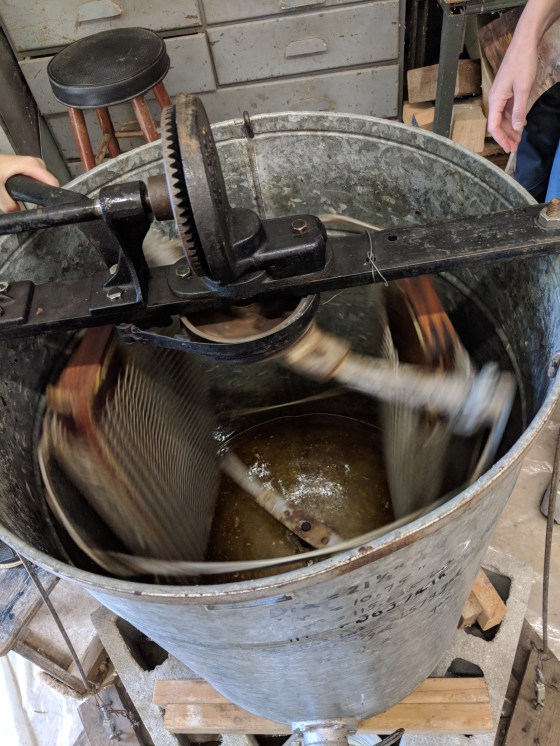
The next person takes two of these shorn frames and shuttles them—heavy and dripping with honey—to the centrifuge. These drop into baskets on opposite sides of the drum and as the next helper turns the crank to spin the centrifuge, the rotational force pulls the honey out of the comb. It collects in a shiny layer on the sides of the drum before slowly dripping down to the bottom. Turning the crank on the centrifuge was my four-year-old nephew Simon’s favorite part by far. Jill brought out a step for him to stand on so that he could reach the handle, and turning it was a two-handed, full-body exercise for him. I bet his little abs were sore the next day. 

IMG_20180708_105210_1

Before long, the honey at the bottom of the drum is deep enough that it starts to interfere with the spinning mechanism. The next step is to open the valve at the bottom and begin decanting the honey into buckets to be transferred to the filtration vat. The honey goes through two rounds of filtration before it’s bottled and ready to sell or trade. As a “thank you” for helping, Al gave each of us a jar of the day’s honey to take home. Those jars went through only the initial sieve—just enough to filter out any stray bee legs and chunks of wax.

IMG_20180708_120507

I enjoyed the day of honey harvesting for a number of reasons, but if I were to list my favorite things about it, these three would rise to the top:

1. Axle Grease

Well, not actual axle grease. Not surprisingly, Al is quite a connoisseur of honey. When he travels to different states and different countries, he likes to share his Monkey Hollow honey with other beekeepers and collect as many varieties as he can. Just for fun, he arranged a honey lineup from his collection for us to sample.

IMG_20180708_105506

It began with a super light linden honey, progressed to a medium-bodied manuka honey from New Zealand, and finished with the extra dark and molassesy honey he affectionately calls his “axle grease.” Starting from light to dark, we dipped toothpicks into the honeys and tasted each one, as Al excitedly solicited feedback about which were our favorites. The linden honey was popular, as was a blueberry variety. I was a little wary of the axle grease, but it was delicious!, bold and assertive, the honey equivalent of a French roast coffee. I expected to be blown away by the manuka honey, since it is ridiculously expensive in local stores due to its rarity as well as its medicinal properties, but taste-wise . . . it was just okay. The clear winner for me was the honey we were extracting and bottling THAT day, the apple honey from Al’s orchard. That honey simply exploded with a bright, pure, apple sweetness. Honey doesn’t come any better than that.

2. The Honey Breeze

IMG_20180714_163254_1

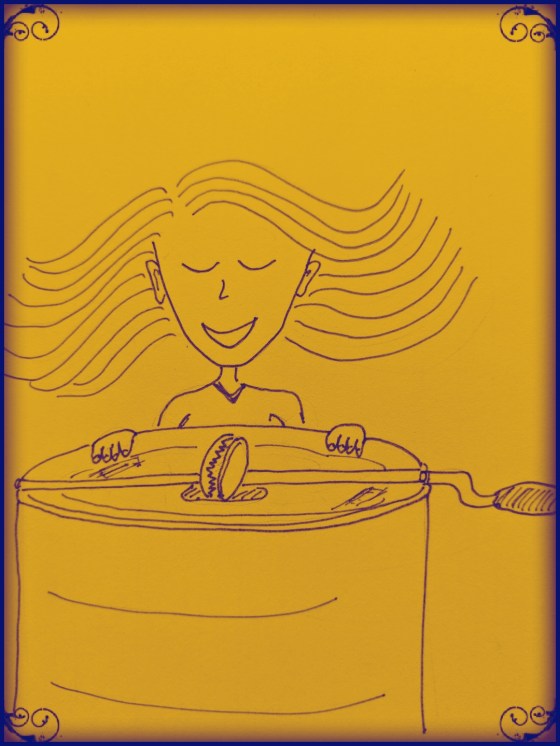
Ah, the Honey Breeze. One of the unexpected byproducts of the extraction process is what I call the Honey Breeze. When the honey frames are dropped into the hopper and you turn the crank on the centrifuge, a breeze rises up from the spinning baskets. A wave of sweet honeyed air caresses your face and blows back your hair. It is like being immersed in a cloud of honey, with all of the sweetness and none of the stickiness. I could bask in the honey breeze all day long.

3. Something Like Strega Nona

The very best thing about Honey Day, however, was the stories we heard from Al and Jill. Stories about Al’s initiation into beekeeping, stories about bee stings (and remedies!), stories about the social lives of bees, stories about people they know. . . . I have a feeling that Al and Jill are very popular around a campfire.

One of their stories that day reminded me of Tomie dePaola’s classic children’s book Strega Nona

Strega_Nona_(Tomie_dePaola_book)_cover_art

Here’s why: When you open the valve on the centrifuge to begin transferring honey to the filtration vat, the honey streaming out of the spigot is strangely hypnotic. It’s like a smooth golden rope, rhythmically unspooling and coiling into a glossy puddle. In fact, Jill told us about the time that their daughter became so mesmerized by the undulating honey that she simply didn’t notice when the container was full and it was time to close the spigot. Honey ran and ran, overflowing the container and creating a sticky flood on the floor of the workshop. In Strega Nona, it is not a flood of honey, but rather pasta from a magic pot that floods an Italian village when Strega Nona’s assistant muffs up the magic spell. He is made to right his wrong by eating the superfluous macaroni—a fitting punishment, right? (I’m pretty sure that Al and Jill didn’t force their daughter to eat her way out of the mess she created. Though if you ask me, I’m not sure that would really be much of a punishment!)

At the end of the day, after enjoying the fruits of the bees’ labor so thoroughly, many of us were curious about seeing where all this honey magic begins. Al promised that at the next Honey Day, we could don some protective gear and he’d take us out to visit the beehives. The fun and adventure never ends at Monkey Hollow!