
A few years ago, my husband and I hiked the West Highland Way in Scotland. In addition to completing the 95-mile trail, we also explored Glasgow and Edinburgh. The hike was rugged, remote, and rainy, but we loved the beauty and physical challenge of the adventure, bookended with a few days of city sightseeing. We knew we wanted to do another trip like it in the future.
So in June 2023, we traveled to Germany. We booked with the same company we’d used in Scotland, one that arranges inn-to-inn hikes for people, negotiating the daily accommodations and ferrying luggage from one stop to the next. Each day while we hiked, we had to carry only water, food, and our first aid kits.
We chose to hike part of Germany’s Rheinsteig, a 320-km (200-mile) trail along the eastern banks of the Rhine River from Bonn to Wiesbaden. Germans love to hike, and the Rheinsteig is billed as one of Germany’s top trails. The trail is divided into 21 stages, which people explore in all different combinations of through-hikes and day-hikes.
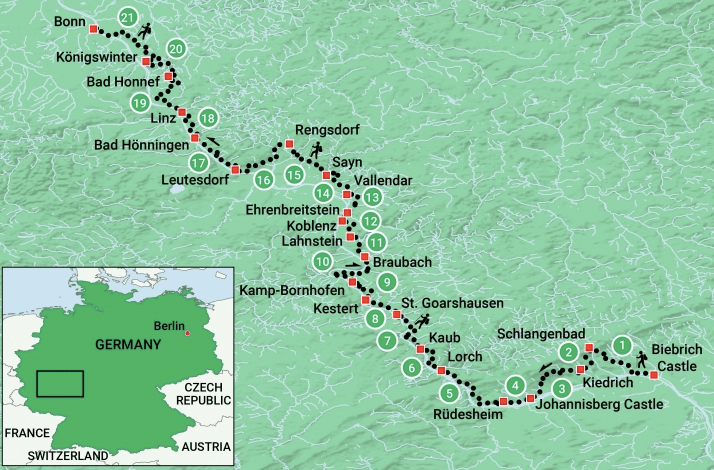
The portion we hiked was a 75-mile stretch of the Upper Middle Rhine Valley between Koblenz and Rüdesheim, a section that has been designated a UNESCO World Heritage Site because of the density of historic castles nestled along the way. We completed the hike over six days, so we averaged about 12 miles per day–pretty similar to the hiking we did in Scotland.

Physically, I felt ready for the hike. My cardio was good, my strength was good, and I enjoy rucking, so carrying my daypack would be very doable. I also felt well-prepared mentally. The first hiking day in Scotland had just about finished me off, so I knew that I should expect the first day on the Rheinsteig to be hard, and maybe not even all that fun at times. But I knew I could do it—because I’d done something like it before.
And it was indeed a tough day. Very tough. Thirteen miles of hiking up and down, up and down, up and down the hillsides flanking the Rhine. (Wouldn’t you expect a trail along a river to be nice and level?)
In the evenings, we nursed our sore feet, ankles, knees, and backs. Why did this hike feel so much harder than the West Highland Way? I mean, that one had some hills too. Was it just that we were older and creakier? Or were we not as prepared as we had thought we were? Or maybe our overall fondness for Scotland was gilding our memories of how difficult the hike actually had been.
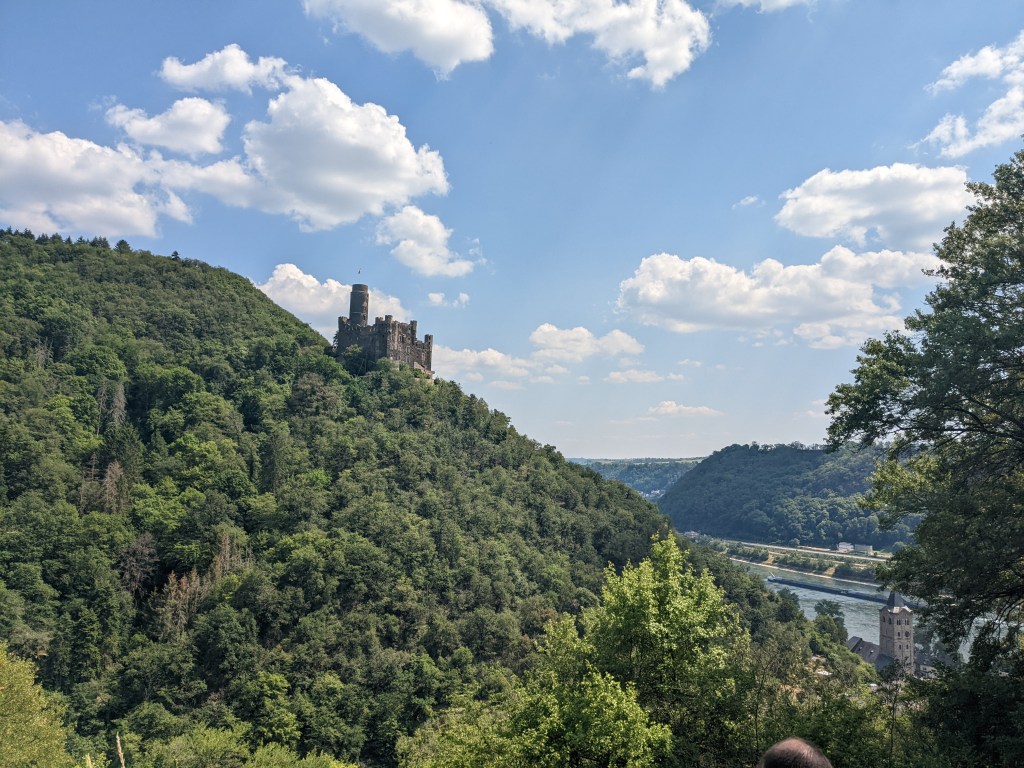
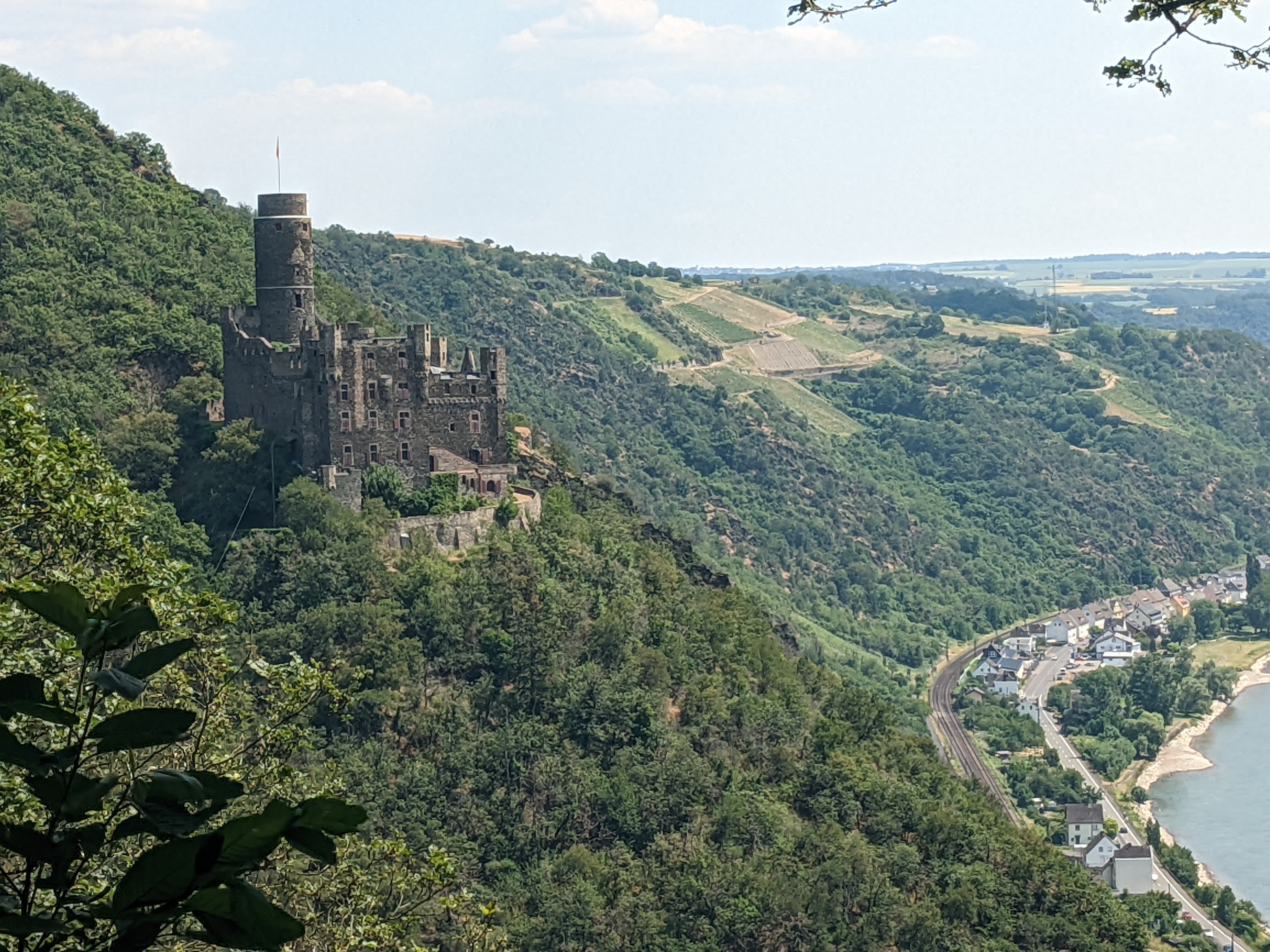
Every day, the trail followed a similar trajectory. Lots of uphill, lots of downhill, with incredible views of the meandering river, majestic castles, and storybook half-timbered villages as a reward. Not to mention the beautifully manicured rows of grapevines striping the hillsides. For being one of Germany’s top trails, there were a surprising number of days where we encountered very few other people. It was peaceful, beautiful, and challenging!

As I lay on the bed the final evening with my feet propped up, enjoying a well-earned sense of accomplishment at having reached our finish line in Rüdesheim, it occurred to me: Why is the trail called the Rheinsteig, anyway? What does “steig” mean?

Oh. That explained a lot.
And had I studied the elevation profiles more closely ahead of time rather than assuming that a hike along the river would be nice and level:

Yeah. It was a Rhine Climb all right. But you know, living in central Ohio where the topography is extremely flat, I really don’t have a very good frame of reference for translating elevation profiles. I don’t think seeing those maps ahead of time would have put us off from the Rheinsteig, though we probably wouldn’t have been quite as surprised to be so sore and tired each night!
Thank goodness we always had a hearty breakfast awaiting us at our inns to fuel our daily hikes. One of my favorite things about traveling is experiencing different foods and dining customs. We tried a little bit of everything in Germany. Schnitzel and spaetzle. Sauerkraut and sauerbraten. Pretzels and pilsners. Now for breakfast, it would be hard to top the Scottish fry-up, but Germany’s Frühstück made a respectable showing. The typical spread leaned more toward the savory than sweet, with a range of deli meats and cheeses, smoked salmon, boiled eggs, sliced fruits and vegetables. Muesli and yogurt, of course. And bread—lots of bread.
We had an interesting breakfast experience following our first day of hiking. We hiked 13 miles from Koblenz to Braubach, then took a short train ride to the adjacent town for that evening’s lodgings. When we finally arrived at our inn, sweaty and exhausted, the kindly innkeeper sat down with us to get us checked in, then pulled out a menu sheet to mark our preferences for the next morning’s breakfast.
“Would you like coffee or tea?” Coffee, please.
“Eggs?” Ja, bitte.
“You like cheese and meat?” Of course!
And then there was an item he struggled to translate for us. “And how many…” He thought for a moment. “Ach, there is no word for it in English! I could say it in French, but…. You’ll be hungry in the morning? I’ll give you six. You can pack up any extras to take with you on your hike.”
We thanked him and headed off to our room for a much-needed night of sleep.
But I couldn’t stop imagining what sort of delicacy awaited us in the morning. I love trying new foods! And I really love breakfast. What could this untranslatable specialty be? I drifted off to sleep with my thoughts spinning. What could it be? Some kind of croquette or quiche? Untranslatable! This is going to be awesome!
Morning came, and we got dressed and headed to the breakfast room to eat. We settled ourselves at a table, pouring our coffee and cracking into our soft-boiled eggs. I was most excited, though, over the mysterious treat that was coming our way. The innkeeper greeted us, chatted with the other guests, refilled supplies as needed. But it didn’t look like he was gearing up to cook anything special. There was no new activity coming from the kitchen. Had he forgotten our six whatchamacallits?
I looked at my husband in concern and whispered, “But where’s the thing? Is he going to make something? Should we ask?”
My husband nodded toward the far end of our table. “I think those are the things.”
It was a basket of bread rolls. Six of them.
Bread rolls. Bread rolls!?!?
Bread rolls—like individual baguettes—are a staple of every German breakfast. They had featured prominently at the breakfast buffet at our first hotel, too. And the bread rolls are good, hearty and crusty, often studded with nuts and seeds. Spread with a little butter and jam, they’re delicious. But an untranslatable delicacy? My imagination had gotten the best of me on that one.

Learning new words is another of the great things about travel, but German was hard for me. I felt much more confident testing out my language skills when I traveled to Spain and Italy, having studied Spanish in high school and college. I could get by in those countries, but the little German I tried to learn just wouldn’t seem to stick.
Luckily, Google Translate was there to save the day. We picked up fun words like “Geschmack!” (tasty!) and essential words like “Insektenschutz” (insect repellent). We learned many travel-related words (platform, arrival, departure, direction). But we never did learn the name of our breakfast “treat.” I would love to plug the innkeeper’s special word into Google Translate and see what pops up, but I never saw the word in print, and I can’t remember what it sounded like when he said it.
Looks like it will have to remain lost in translation.

 Don't Fleece the Bees
Die heissen Brötchen! – closest to something like “little breads” or “tiny breads” LOL
LikeLike
Mystery solved, perhaps! 🙂 Thank you!
LikeLike